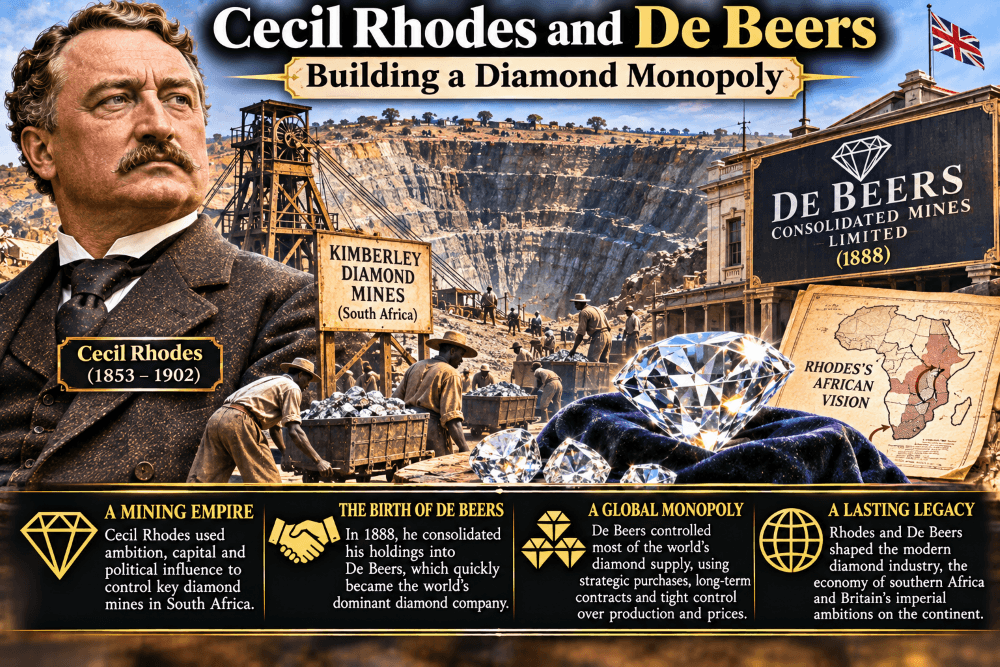
In the 1880s, a young Englishman in southern Africa did something few entrepreneurs have ever managed: he gained control of nearly an entire global commodity market. The story of Cecil Rhodes and De Beers is a lesson in consolidation, financing, and market control. It is also a story of colonial exploitation, coercive labor practices, and the ways in which monopoly power can be built on the backs of others.
Diamond Fever in Kimberley
Diamonds were discovered in South Africa in the late 1860s, and the discovery triggered a massive rush.
- Thousands of prospectors poured into the area around what became Kimberley.
- The famous “Big Hole” mine became one of the largest hand-dug excavations in history.
- Individual diggers worked small claims, and the industry was chaotic and competitive.
As the mines grew deeper, new problems emerged.
- Claims collapsed and flooded, making digging more expensive and dangerous.
- A flood of diamonds threatened to push prices down.
- Small operators lacked the capital to deal with these challenges.
This created an opening for anyone who could bring order, capital, and consolidation.
Who Was Cecil Rhodes?
Cecil Rhodes was born in England in 1853 and sent to southern Africa as a teenager for his health. He joined his brother in Natal and soon moved to the diamond fields.
- He began with a modest, practical business: renting out water pumps to claim holders whose workings were flooding.
- He used his profits to buy claims and gradually built a larger position.
- He also pursued studies at Oxford during these years, moving between England and Africa.
His early success reflected a classic entrepreneurial pattern: serve the miners’ needs first, then buy into the mines themselves.
Consolidating the Mines
The Birth of De Beers
In 1880, Rhodes and his partner Charles Rudd founded the De Beers Mining Company, named after a farm where the diamond deposit had been found.
- Rhodes’s strategy was to buy up small claims and merge them into larger, more efficient operations.
- Consolidation allowed better mining techniques and more control over output.
- Controlling supply meant controlling prices.
Rivals and Rothschild Financing
Rhodes’s main rival was Barney Barnato, whose Kimberley Central Mining Company controlled a major portion of the mines.
- The two fought for control, since competition risked flooding the market.
- Rhodes secured financing from the banking house of N M Rothschild & Sons, linking this story to the banking dynasty covered earlier in this series.
- In 1888, the rivals reached a deal, and Barnato’s company was bought out for a sum of roughly five million pounds, an enormous amount for the time.
That year, De Beers Consolidated Mines was formed. It controlled roughly 90 percent of the world’s diamond production.
An Unusual Charter
De Beers Consolidated’s founding documents were reportedly drafted very broadly, allowing the company to pursue activities well beyond mining, including acquiring territory. This flexibility later supported Rhodes’s wider ambitions.
The Monopoly Strategy
Rhodes understood that diamonds were valuable partly because they were scarce.
- Control supply: By limiting how many diamonds reached the market, De Beers could keep prices high.
- Consolidate production: Owning the mines meant controlling the flow.
- Manage information and sales: Over time, the company built systems to control how rough diamonds were sold.
This approach is a textbook example of using consolidation to manage supply and stabilize prices.
The Human Cost
It would be wrong to tell this story only as a success. The system was built on harsh treatment of African workers.
Compounds and Labor Control
De Beers introduced closed compounds for African mine workers in the 1880s.
- Workers were housed in fenced compounds for the length of their contracts.
- They were searched, restricted in their movement, and monitored to prevent diamond theft.
- Pay was low, and the system limited their freedom and bargaining power.
Laws against illicit diamond buying, introduced in the Cape Colony, reinforced this control. Historians widely see the compound system as a forerunner of later migrant labor control in South Africa, including under apartheid.
Racism and Colonial Power
Rhodes’s views were openly racist and imperial.
- He promoted policies that pushed Africans toward wage labor and limited their land and political rights, including the Glen Grey Act of 1894.
- He believed in British expansion and supported conquest and settler rule.
Rhodes Beyond Diamonds
Rhodes used his wealth to pursue political power.
- He became Prime Minister of the Cape Colony in 1890.
- His British South Africa Company helped colonize territory that became Rhodesia, now Zambia and Zimbabwe.
- His involvement in the failed Jameson Raid of 1895 to 1896 damaged his reputation and forced his resignation as prime minister.
He died in 1902.
Legacy
De Beers After Rhodes
De Beers remained dominant for a century.
- In the 20th century, the company, led by the Oppenheimer family, controlled supply through a sales system that managed global distribution.
- In 1947, the advertising agency N.W. Ayer, discussed earlier in this series, helped create the “A Diamond Is Forever” campaign, turning diamonds into a symbol of love.
- The company later faced antitrust scrutiny and criticism over conflict diamonds, leading to reforms like the Kimberley Process.
Rhodes’s Mixed Memory
Rhodes’s will funded the Rhodes Scholarships at Oxford, which remain prestigious. At the same time, his legacy has faced growing criticism, including protests in the 2010s such as the “Rhodes Must Fall” movement over statues and memorials.
Lessons from Cecil Rhodes and De Beers
- Consolidation can create market power. Controlling supply allowed De Beers to stabilize and raise prices.
- Start by serving the market. Rhodes began by renting pumps before buying mines.
- Financing matters. Rothschild backing helped him outmaneuver rivals.
- Monopoly can be built on harm. The compound system and colonial policies show the human cost of concentrated power.
Frequently Asked Questions
Who was Cecil Rhodes? Cecil Rhodes was a British businessman and politician who founded De Beers, became Prime Minister of the Cape Colony, and helped colonize Rhodesia.
How did De Beers gain control of the diamond market? Rhodes consolidated small mining claims, defeated rivals like Barney Barnato with Rothschild financing, and formed De Beers Consolidated Mines in 1888, which controlled roughly 90 percent of world production.
What were the De Beers compounds? They were closed housing facilities where African mine workers were confined and searched during their contracts to prevent diamond theft, a coercive system that limited workers’ freedom.
What is the legacy of Cecil Rhodes today? He is remembered for the Rhodes Scholarships and De Beers, but also criticized for colonialism and racism, with debates over statues and memorials continuing.
Related Articles
- Krupp and Siemens: Steel, Electricity and Empire
- German Chemical Industry: The Birth of Corporate R&D
- Zaibatsu: Iwasaki Yataro and Meiji Japan’s Mitsubishi
- Goldman Sachs and Lehman Brothers: Wall Street’s Rise
- Gustavus Swift: The Refrigerated Railcar That Fed America
- Alexander Graham Bell: The Telephone and a Patent Race
- Sears and Montgomery Ward: The Catalog Revolution
About The History of Entrepreneurship
This article is part of The History of Entrepreneurship, an ongoing series exploring how entrepreneurs, civilizations, technologies, financial institutions, and business innovations gradually created the modern economy.
Leave a Reply