Daily Market Review | Monday, November 2, 2026
Wall Street began November with mixed results as investors struggled to regain confidence following October’s brutal selloff in artificial intelligence and semiconductor stocks.
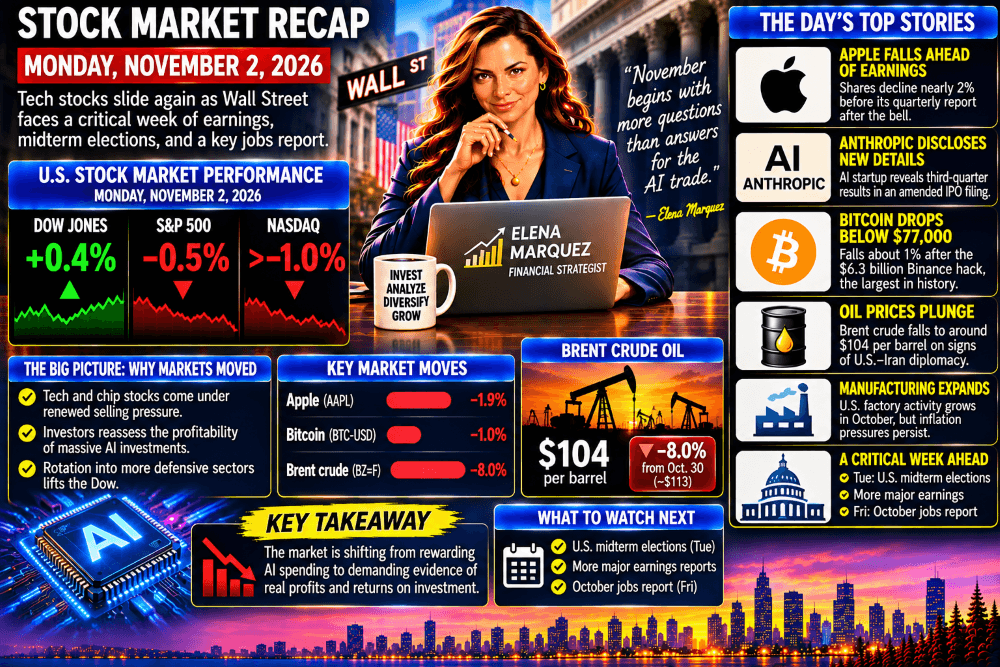
The Dow Jones Industrial Average gained approximately 0.4%, but the S&P 500 declined 0.5%, and the technology-heavy Nasdaq Composite dropped more than 1%.
Early optimism faded as technology shares came under renewed selling pressure.
Investors are confronting several major developments simultaneously: another round of corporate earnings, the U.S. midterm elections, an important employment report, and growing questions about whether artificial intelligence investments will generate sufficient profits.
Meanwhile, Bitcoin fell below $77,000, oil prices declined sharply amid hopes for diplomacy between the United States and Iran, and Anthropic disclosed new financial information in an amended IPO filing.
The biggest question facing Wall Street is whether October’s technology selloff represents a temporary correction or the beginning of a more prolonged reassessment of AI valuations.
1. How the Major Indexes Performed
U.S. Stock Market Performance
Monday, November 2, 2026 | Daily Change
Approximate figures from the supplied closing summary. The Nasdaq bar illustrates a decline greater than 1%, rather than an exact closing percentage.
The day’s performance revealed a familiar pattern from October: investors continued reducing their exposure to technology stocks while other sectors showed greater resilience.
The Dow finished higher, supported by a rotation away from expensive growth companies.
The Nasdaq, however, surrendered its early gains and ended sharply lower.
This divergence suggests that investors are becoming increasingly selective rather than abandoning equities altogether.
2. The AI Selloff Continues Into November
Technology stocks entered November under considerable pressure after a difficult October.
The Nasdaq lost approximately 5.2% last month, while major AI and semiconductor companies collectively shed an estimated $5 trillion in market capitalization after October 6, according to Yahoo Finance calculations.
Investors initially hoped the new month would bring a recovery.
Stock futures advanced before Monday’s opening bell, suggesting that some traders were willing to buy technology shares after the recent selloff.
But the rebound didn’t last.
Semiconductor companies came under renewed pressure, and the Nasdaq reversed its early gains.
Why investors remain nervous
The problem isn’t necessarily declining enthusiasm for artificial intelligence technology.
Instead, investors are becoming more concerned about the economics of building and operating AI infrastructure.
Companies are investing enormous amounts of capital in data centers, specialized processors, electricity and networking equipment.
These investments may eventually produce substantial profits.
But they also create financial risks.
Investors want to know how quickly the spending will generate revenue, whether profit margins will justify the investment, and how much additional capital companies will need.
The questions have become especially important as borrowing costs remain elevated.
The market is shifting from rewarding AI spending to demanding evidence of returns on AI spending.
3. Apple Falls Ahead of Its Earnings Report
Apple shares fell nearly 2% Monday ahead of the company’s quarterly earnings announcement scheduled after the closing bell.
Investors are particularly interested in demand for Apple’s latest iPhone models.
Smartphone sales remain one of Apple’s most important sources of revenue and profit.
The market will also be watching for updates on the company’s artificial intelligence strategy.
Apple faces the challenge of integrating AI capabilities into its products while maintaining its traditionally strong profitability.
Unlike some competitors, Apple has generally emphasized the integration of technology into consumer products rather than simply building the largest possible AI infrastructure.
What investors will be watching
The most important questions include iPhone demand, revenue growth, profit margins, and management’s expectations for the coming quarters.
Investors will also be looking for evidence that Apple’s AI investments can encourage customers to upgrade their devices.
With technology valuations under pressure, even strong earnings may not be enough if management’s outlook disappoints.
4. Anthropic Reveals More Financial Details Ahead of Its IPO
One of Monday’s most closely watched developments came from Anthropic, the artificial intelligence company behind Claude.
Anthropic disclosed additional third-quarter financial information in an amended S-1 registration filing.
The filing provided investors with another look at the economics of a leading AI developer.
Anthropic’s business is attracting considerable attention because it offers potential public-market exposure to the development of advanced artificial intelligence models.
But the filing also highlights a central challenge facing the AI industry.
Rapid growth requires enormous investment
Developing advanced AI systems requires access to expensive computing infrastructure.
Training and operating increasingly sophisticated models involves substantial spending on processors, cloud services and electricity.
As a result, even companies experiencing rapid revenue growth may need large amounts of capital.
Investors are trying to determine whether these businesses can eventually generate sustainable profits.
The public offering process could provide valuable insight into the financial performance of the AI industry.
For now, the key question remains whether growing demand for AI services will translate into sufficient cash flow to support the industry’s enormous infrastructure requirements.
5. Bitcoin Falls Below $77,000
Cryptocurrency markets also remained under pressure Monday.
Bitcoin declined approximately 1%, falling below $77,000 per token.
The decline followed reports of a massive security breach involving cryptocurrency exchange Binance.
According to the supplied report, hackers stole approximately $6.3 billion in digital assets, an amount described as the largest cryptocurrency theft on record.
The reported incident has raised concerns about the security of cryptocurrency exchanges and the risks associated with storing digital assets on centralized platforms.
The reported hack’s size, circumstances and attribution warrant independent confirmation.
Why the incident matters
Cryptocurrency investors face risks beyond ordinary market volatility.
Those risks can include cybersecurity failures, exchange disruptions, liquidity problems and uncertainty about the recovery of stolen assets.
Even if the underlying cryptocurrency network remains operational, investors may suffer losses when intermediaries experience security breaches.
Bitcoin’s decline was relatively modest compared with the scale of the reported incident.
That suggests traders were cautious, but the supplied market data did not indicate a wholesale collapse in cryptocurrency prices.
6. Oil Prices Plunge as U.S.–Iran Diplomacy Offers Hope
Energy markets experienced a sharp reversal Monday.
Crude oil prices declined following reports that the United States and Iran were seeking a diplomatic resolution to the conflict in the Middle East.
Brent crude, the international oil benchmark, traded near $104 per barrel.
That represented a substantial decline from the approximately $113 level reported at the end of October.
Brent Crude Oil — Price Comparison
October 30
~$113
Per barrel
November 2
~$104
Per barrel
Indicative price change
~−8.0%
Calculated from rounded price levels supplied in the two market summaries. This is not a verified settlement-to-settlement return.
Why diplomacy matters for oil
Oil prices reflect not only current supply and demand but also expectations about future disruptions.
When investors fear that military conflict could interrupt production or transportation, oil prices often rise.
Conversely, signs of a diplomatic resolution can reduce the geopolitical risk premium built into crude prices.
Lower oil prices can benefit consumers and businesses by reducing transportation and energy expenses.
They may also help ease inflationary pressure.
However, falling crude prices can reduce the earnings outlook for energy producers that benefited from October’s elevated prices.
The energy market’s sharp reversal highlights how quickly geopolitical expectations can influence financial markets.
7. U.S. Manufacturing Expands, but Inflation Remains a Concern
The latest manufacturing surveys showed that U.S. factory activity expanded in October.
That suggests parts of the economy continued growing despite elevated interest rates and market volatility.
However, the surveys also indicated that inflationary pressures persisted.
This creates a challenge for the Federal Reserve.
If the economy continues growing while inflation remains elevated, policymakers may have less room to reduce interest rates.
Higher borrowing costs can affect housing, business investment and consumer spending.
They can also put additional pressure on technology companies financing large AI infrastructure projects.
For investors, the key issue is whether the economy can continue expanding without generating another acceleration in inflation.
8. Midterm Elections and Friday’s Jobs Report Loom
The market faces a particularly busy week.
Alongside corporate earnings, investors are preparing for Tuesday’s U.S. midterm elections and Friday’s October employment report.
Tuesday, November 3: U.S. midterm elections
The election results could influence expectations for government spending, taxes, regulation and trade policy.
Markets may also react to changes in the balance of power in Congress.
However, election outcomes are only one factor affecting stock prices.
Corporate earnings, interest rates and economic growth remain fundamental drivers of long-term returns.
Friday, November 6: October jobs report
The employment report will provide another important reading on the health of the U.S. economy.
Investors will focus on job creation, unemployment and wage growth.
A stronger-than-expected report could reinforce concerns that interest rates will remain elevated.
A weaker report could raise questions about economic growth, even if it increases expectations for future rate cuts.
The market’s reaction will depend on how the numbers compare with expectations.
9. The Day’s Biggest Market Themes
| Market or asset | Monday’s reported move |
|---|---|
| Dow Jones | +0.4% |
| S&P 500 | −0.5% |
| Nasdaq Composite | More than −1% |
| Apple | Nearly −2% |
| Bitcoin | Approximately −1% |
| Brent crude | Near $104/barrel |
The day’s most important development was the failure of the early technology rebound.
Investors initially appeared willing to buy stocks following October’s steep declines.
But renewed selling in semiconductor and technology companies quickly erased those gains.
Meanwhile, the Dow’s positive performance demonstrated that the market remained divided rather than uniformly bearish.
The sharp drop in oil prices also introduced a potentially important change in the inflation outlook.
10. What I’m Watching Next
Three developments could determine whether Wall Street stabilizes or experiences another round of volatility.
First, corporate earnings. Investors will closely examine Apple’s results and the remaining major earnings announcements, paying particular attention to guidance, profitability and AI-related capital expenditures.
Second, economic data. Friday’s jobs report could influence expectations for Federal Reserve policy and the direction of bond yields.
Third, geopolitical developments. Any progress toward a diplomatic resolution involving the United States and Iran could affect oil prices, inflation expectations and energy stocks.
The midterm elections add another layer of uncertainty to an already eventful week.
The Bottom Line: November Begins With More Questions Than Answers
November opened with the same tension that defined October.
Technology companies continue to invest extraordinary amounts of money in artificial intelligence.
But investors are becoming increasingly concerned about the financial returns on those investments.
The Nasdaq fell more than 1% Monday, while the Dow managed a modest gain.
Apple declined ahead of earnings, Anthropic disclosed more information about its business, Bitcoin fell below $77,000, and crude oil prices dropped amid hopes for diplomacy in the Middle East.
With midterm elections, corporate earnings and an important jobs report approaching, volatility could remain elevated.
The most important lesson is that investing isn’t simply about identifying the technologies that will change the world. It’s about finding companies that can turn those technologies into sustainable profits at valuations that make sense.
Other Stock Market blog posts
Leave a Reply