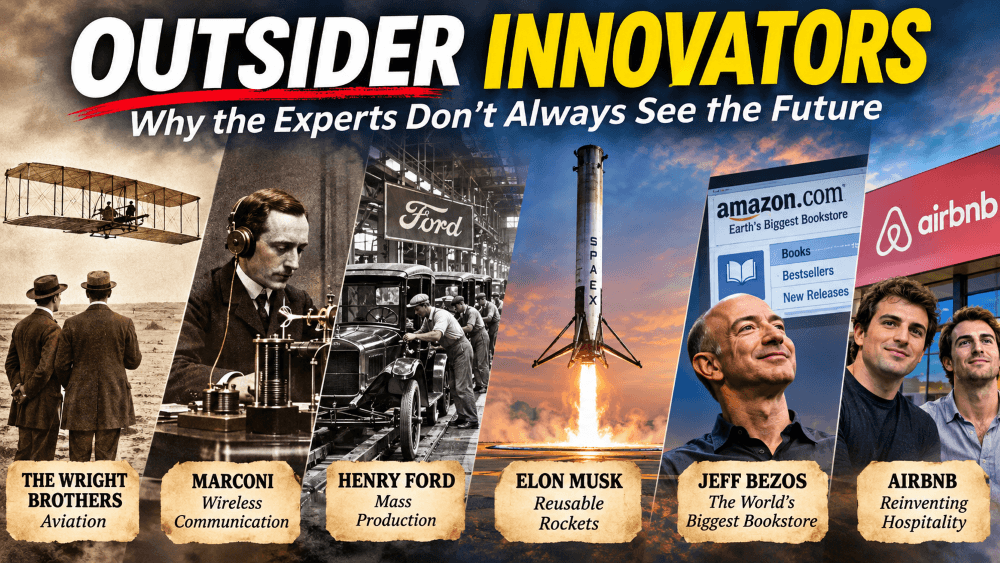
The entrepreneurs who change the world are often the people who refuse to accept how the world is supposed to work.
Throughout history, outsider innovators have challenged conventional wisdom, ignored established industry practices, and created entirely new markets. From the Wright brothers to Airbnb, some of the greatest entrepreneurial breakthroughs have come from people who lacked the credentials, connections, or professional backgrounds traditionally associated with their industries.
There is a fascinating pattern in the history of entrepreneurship: the people who understand an industry best are not always the people who transform it.
Experts know how things work. Entrepreneurs ask why they cannot work differently.
This distinction is central to two ongoing series on AlainGuillot.com: The History of Entrepreneurship and Self-Made Entrepreneurs.
Both reveal an important lesson: Knowledge is valuable, but expertise can become a liability when it prevents people from imagining something new.
Why Outsider Innovators See Opportunities Experts Miss
Experts accumulate knowledge through education, research, and experience. Society needs that knowledge, particularly in fields where mistakes can be costly or dangerous.
However, expertise can also encourage intellectual conformity.
When professionals spend decades working within an established system, they naturally develop assumptions about what is possible, profitable, and practical.
An outsider may not share those assumptions.
Someone entering an industry for the first time might ask questions that established professionals stopped asking years ago.
- Why must customers purchase this product instead of renting it?
- Why must people visit a physical store?
- Why can’t ordinary homeowners compete with hotels?
- Why can’t machines perform tasks previously considered impossible?
- Why must businesses operate according to rules established generations ago?
- Why don’t we create a rehusable rocket instead of destroying a rocket every time we use them?
These questions often sound naive.
But sometimes the supposedly naive question becomes the foundation of a billion-dollar industry.
1. The Wright Brothers: Bicycle Mechanics Who Conquered the Sky
In December 1903, two brothers from Dayton, Ohio, accomplished something extraordinary.
Wilbur and Orville Wright achieved the first successful sustained, controlled flight of a powered, heavier-than-air aircraft.
Neither brother possessed a university engineering degree. They operated a bicycle business.
Meanwhile, Samuel Langley, a respected scientist and secretary of the Smithsonian Institution, had access to substantial funding and institutional support for his own aviation experiments.
Langley’s highly publicized attempts failed shortly before the Wright brothers succeeded.
The brothers did not defeat scientific knowledge. They studied existing research, performed systematic experiments, developed their own wind-tunnel tests, and solved the critical problem of controlling an aircraft.
Their advantage was not ignorance.
It was their willingness to experiment independently, question existing assumptions, and learn through repeated failure.
Importantly, the Wright brothers did not prove that all scientists considered powered flight impossible. Aviation researchers were actively pursuing the problem.
What they demonstrated was that practical ingenuity could outperform greater credentials and funding.
2. Guglielmo Marconi: The Young Inventor Who Connected Continents
At the end of the nineteenth century, long-distance communication depended heavily on physical telegraph cables.
Guglielmo Marconi imagined something different: transmitting messages through the air using radio waves.
He lacked a conventional university education in physics, although he studied scientific discoveries and worked with technically knowledgeable collaborators.
His ambition to transmit radio signals across the Atlantic faced serious skepticism.
Many scientists believed the Earth’s curvature would prevent radio waves from traveling such enormous distances.
In December 1901, Marconi and his team reported receiving a radio signal transmitted from Cornwall, England, to Newfoundland.
The original experiment was difficult to verify conclusively, but subsequent demonstrations established the feasibility of long-distance wireless communication.
Marconi helped create the commercial wireless communications industry.
Today, radio, broadcasting, and modern wireless technologies form part of the legacy of this pioneering work.
Marconi’s achievement reminds us that scientific understanding sometimes follows successful experimentation rather than preceding it.
3. Henry Ford: A Farm Boy Who Transformed Manufacturing
Henry Ford did not invent the automobile.
Nor did he invent the assembly line.
His contribution was recognizing how existing technologies could be combined and improved to make automobiles affordable to ordinary Americans.
Born on a Michigan farm, Ford worked as a machinist and engineer before establishing his automobile company.
At the time, cars were expensive products largely reserved for wealthy customers.
Ford envisioned something radically different: an automobile for the masses.
The Model T, introduced in 1908, and the moving assembly line adopted in 1913 transformed automobile manufacturing.
Lower production costs helped make car ownership accessible to millions.
Ford’s greatest innovation was arguably not mechanical but organizational.
He changed how products were manufactured, priced, and distributed.
The lesson is that entrepreneurial innovation often involves discovering a better business model rather than inventing a new technology.
4. George Mitchell: The Independent Entrepreneur Behind the Shale Revolution
For decades, energy analysts warned that conventional oil and gas resources were finite and that production would eventually decline.
The concept of peak oil became influential in energy discussions.
Geologist M. King Hubbert famously predicted that conventional U.S. oil production would peak around 1970, a forecast that proved broadly accurate for that historical phase.
But technological innovation changed the picture.
George Mitchell, an independent oil and gas entrepreneur, spent years pursuing commercially viable natural gas production from shale formations.
Unlike some other examples in this article, Mitchell was not an outsider to the petroleum industry. He was a trained petroleum engineer.
He was, however, an independent operator challenging the industry’s conventional economics.
Hydraulic fracturing already existed, having been commercially developed decades earlier. Mitchell’s achievement was helping make shale gas extraction economically viable through persistent experimentation and technological improvements.
His company’s breakthroughs in the Barnett Shale during the 1990s helped lay the foundation for the American shale energy revolution.
The consequences were enormous.
The United States dramatically expanded its oil and natural gas production, changing global energy markets and challenging earlier forecasts based on existing technology.
Mitchell’s story illustrates a crucial principle:
A resource that is uneconomical to extract today may become economically accessible tomorrow.
Scarcity is not determined by geology alone. Technology, prices, entrepreneurship, and human ingenuity also matter.
5. Airbnb: Designers Who Challenged the Hotel Industry
When Brian Chesky and Joe Gebbia began renting space in their San Francisco apartment in 2007, they were not experienced hotel executives.
They were designers trying to solve a practical problem: how to earn extra money.
Together with Nathan Blecharczyk, they developed what eventually became Airbnb.
Traditional hospitality businesses focused on owning, leasing, or managing hotel properties.
Airbnb challenged that model.
Why build another hotel when millions of existing homes have unused rooms?
The company created a platform connecting travelers with property owners.
It did not need to own the rooms being rented.
Airbnb helped transform the accommodation marketplace by introducing a new way to organize supply, demand, payments, and trust.
Of course, its success also generated controversies involving housing affordability, neighborhood impacts, safety, and local regulations.
But the entrepreneurial lesson remains powerful.
The founders were not asking how to operate hotels more efficiently.
They were asking whether the hotel industry’s traditional structure was necessary at all.
6. Steve Jobs: The Outsider Who Reimagined Personal Technology
Steve Jobs was not a conventional computer engineer.
He dropped out of Reed College and relied heavily on the technical brilliance of Steve Wozniak and the many engineers who later worked at Apple.
His exceptional ability was recognizing what technology could mean to ordinary consumers.
While many computer companies emphasized specifications and technical capabilities, Jobs focused on simplicity, design, and user experience.
Apple helped popularize personal computers with the Apple II and Macintosh.
Later, the iPod transformed digital music consumption, while the iPhone redefined the smartphone market.
Jobs did not invent every technology inside these products.
Instead, he recognized how existing technologies could be integrated into experiences consumers would love.
His career demonstrates that innovation requires more than scientific invention.
It also requires understanding human behavior.
7. Elon Musk: Why Throw Away a Rocket After Using It Once?
For decades, the space industry operated under an extraordinarily expensive assumption: rockets were largely disposable.
NASA and other space agencies spent enormous sums developing rockets that would launch into space, deliver their payloads, and then be discarded.
Imagine if airlines operated the same way.
What if Boeing built a $200 million airplane, flew it from New York to London, and then destroyed it after landing?
Air travel would be prohibitively expensive.
Yet this was essentially the economic model of orbital rocket launches for decades.
When Elon Musk founded SpaceX in 2002, he had no professional experience designing or manufacturing rockets.
He was an entrepreneur who had made his fortune in software and online payments.
But Musk asked a deceptively simple question:
Why do we throw away a rocket after using it once? Why not land it, refuel it, and fly it again?
The idea was not entirely new. NASA’s Space Shuttle had already demonstrated reusable spacecraft and rocket boosters, although refurbishment was expensive and the system never achieved airline-like operating economics.
Other engineers and companies had also experimented with reusable rockets.
What made SpaceX different was its determination to make rocket reusability commercially practical.
Many established aerospace organizations considered the technical and economic challenges formidable.
SpaceX nevertheless pursued reusable rocket boosters through years of engineering development, testing, and spectacular failures.
In December 2015, SpaceX successfully landed a Falcon 9 first-stage booster after launching a payload into orbit.
In March 2017, the company achieved another historic milestone: launching and landing a previously flown Falcon 9 orbital-class booster.
This was not the first reusable rocket technology in history, but it was a major breakthrough in making orbital launch vehicles routinely reusable.
SpaceX subsequently demonstrated that boosters could fly repeatedly, substantially reducing the need to manufacture a new first stage for every mission.
The implications extended far beyond one company.
Lower launch costs helped make satellite deployment, commercial space services, and ambitious space exploration projects more economically feasible.
Musk did not personally engineer the Falcon 9. SpaceX’s achievements depended on thousands of highly skilled engineers, technicians, and scientists.
His entrepreneurial contribution was challenging an established industry’s economics, assembling the resources to pursue an unconventional solution, and accepting repeated failures along the way.
The lesson is powerful: Sometimes the greatest innovation comes not from inventing something entirely new, but from asking why we continue doing something so inefficiently.
SpaceX illustrates the central theme of outsider innovation.
The aerospace industry knew how to build rockets.
Musk questioned why its business model required throwing so much of them away.
8. Jeff Bezos: Building the World’s Biggest Bookstore Without Owning a Single Store
In 1994, Jeff Bezos was working at a Wall Street investment firm when he noticed that internet usage was growing at an extraordinary rate. He had no experience operating a traditional bookstore, yet he recognized an opportunity that established booksellers such as Barnes & Noble and Borders had largely overlooked. Why build expensive physical bookstores, pay rent, and maintain limited shelf space when you could offer millions of books through a website? In 1995, Bezos launched Amazon as an online bookstore, giving customers access to a selection that no conventional bookstore could easily match. His vision was to create the world’s largest bookstore without building a single physical bookstore. Traditional retailers had decades of experience selling books, but Bezos questioned the necessity of their business model. Amazon eventually expanded far beyond books, becoming one of the world’s largest companies and transforming retail, logistics, and cloud computing. The lesson: Sometimes the greatest competitive advantage comes from being an outsider who asks why an entire industry operates the way it does.
9. Other Outsider Innovators Who Changed Entire Industries
The pattern extends far beyond these famous examples.
Madam C. J. Walker — Beauty and Personal Care
Born to formerly enslaved parents, Walker built a successful hair-care business serving Black women at a time when established manufacturers largely neglected their needs.
She created products, developed a sales network, and helped expand opportunities for women entrepreneurs.
Ingvar Kamprad — Furniture Retailing
The founder of IKEA challenged traditional furniture retailing through flat-pack products, self-service stores, and affordable designs.
He transformed furniture shopping from a high-cost experience into a mass-market business.
James Dyson — Household Appliances
Dyson, trained in design engineering rather than established vacuum-cleaner manufacturing, challenged conventional vacuum technology.
After thousands of prototypes, he commercialized bagless cyclonic vacuum cleaners and built a global consumer-products company.
Reed Hastings and Marc Randolph — Entertainment Distribution
Netflix began as a DVD-by-mail business rather than a traditional Hollywood studio or video-rental chain.
It later helped accelerate the transition toward streaming entertainment, disrupting established distribution models.
Sara Blakely — Women’s Apparel
Blakely was selling fax machines before developing Spanx.
Without a background in fashion manufacturing, she identified a consumer problem, developed a product, and built a successful apparel company.
Amancio Ortega — Fashion Retailing
Ortega helped build Zara around rapid product development, responsive supply chains, and frequent inventory changes.
Rather than following the industry’s traditional seasonal model, Zara made speed and responsiveness central to its competitive advantage.
Michael Dell — Personal Computers
As a university student, Dell challenged the conventional computer distribution system by selling directly to customers.
The direct-sales model helped reduce inventory costs and allowed customers to configure their computers.
These entrepreneurs came from different backgrounds and operated in different industries.
Yet they shared a common characteristic: they challenged assumptions that established competitors often took for granted.
10. When Experts Get the Future Wrong
One of the most interesting aspects of entrepreneurship is its relationship with forecasting.
Economists, scientists, business executives, and government institutions regularly attempt to predict the future.
Sometimes they succeed.
Other times, their predictions fail because they underestimate technological change, market incentives, or human adaptability.
Peak Oil: When Technology Changes the Forecast
Peak oil provides an instructive example.
Oil is finite, and individual fields inevitably decline. But forecasts about when global production would peak have repeatedly been affected by new discoveries, prices, and extraction technologies.
The shale revolution demonstrated how innovation can expand economically recoverable supplies.
That does not mean oil resources are infinite.
It means predictions that treat current technology as permanent can become obsolete.
Population Growth and Food Shortages
In 1968, biologist Paul Ehrlich published The Population Bomb, warning of catastrophic population-driven food shortages.
Some of its most dramatic predictions did not materialize.
Agricultural productivity increased enormously through improved crop varieties, fertilizers, irrigation, mechanization, and international trade.
The Green Revolution, associated with scientists such as Norman Borlaug, helped increase food production in many countries.
Global population grew, but agricultural output also expanded.
This does not mean hunger disappeared. Poverty, war, political instability, environmental degradation, and unequal access to food remain serious problems.
Nevertheless, the history of agriculture demonstrates that human innovation can change the relationship between population growth and resource availability.
Environmental Predictions and Climate Change
For more than three decades, figures such as Bernie Sanders, Al Gore, and Greta Thunberg—along with a parade of self-described experts—have repeatedly warned of imminent climate catastrophe: ice-free Arctic summers within a few years, vanishing glaciers and snowcaps on tight deadlines, irreversible tipping points that would end civilization as we know it, and the need for emergency-level action lest the planet become unlivable. Many of those specific, time-bound predictions have come and gone without the prophesied collapse. The planet continues to function, with human life expectancy, food production, and material prosperity still rising overall even as temperatures have warmed and weather patterns shift.
11. Why Silicon Valley Produces So Many Outsider Innovators
Silicon Valley offers a compelling example of what happens when entrepreneurship, capital, talent, and experimentation reinforce one another.
Companies such as Apple, Google, Nvidia, and Meta emerged in an ecosystem where ambitious founders could raise capital, recruit talent, and challenge established competitors.
One important ingredient has been the relative freedom to experiment with new business models.
In some industries, American entrepreneurs have faced fewer regulatory obstacles than their European counterparts.
That can make it easier to launch products, attract investment, and scale operations.
However, European regulation is only part of the explanation.
Silicon Valley also benefits from world-class universities, venture capital, skilled immigration, large domestic markets, public research funding, and networks of experienced entrepreneurs.
The European Union has produced extraordinary scientific discoveries and successful companies, but European startups often face fragmented markets and difficulties obtaining the large financing rounds necessary for rapid expansion.
An IMF study published in 2025 identified limited market-based financing, smaller effective markets, and shortages of specialized skills as important constraints on European business growth.
The implication is not that eliminating every regulation automatically creates innovation.
Property rights, competition rules, safety standards, and predictable institutions can help markets function.
But unnecessary barriers can protect existing companies at the expense of new competitors.
The best environment for innovation is one where entrepreneurs can challenge incumbents without having to ask those incumbents for permission.
12. Why Experts Sometimes Resist Disruptive Innovation
Why do established professionals sometimes fail to recognize important breakthroughs?
Several explanations help make sense of this recurring phenomenon.
The Innovator’s Dilemma
Business scholar Clayton Christensen popularized the concept of disruptive innovation.
Successful companies often focus on improving products for their existing, profitable customers.
This can leave them vulnerable to newcomers offering cheaper, simpler, or more convenient alternatives.
The established company may understand its market extremely well.
That knowledge can actually make it harder to abandon a successful business model.
Institutional Incentives
Employees, executives, regulators, and industry associations operate within systems that reward certain behaviors.
A corporate executive may face greater career risk from supporting an unconventional idea than from following accepted industry practices.
Entrepreneurs often face different incentives.
They can pursue opportunities that established organizations consider too small, risky, or unconventional.
The Curse of Conventional Wisdom
Experts develop mental models based on past experience.
These models are useful until the underlying conditions change.
An entrepreneur entering the industry may recognize that a supposedly permanent limitation is merely a habit, a business convention, or an outdated technological constraint.
Fear of Failure
Established organizations frequently have reputations, existing customers, and profitable operations to protect.
Startups usually have much less to lose.
This difference can make entrepreneurs more willing to experiment.
Of course, most startups fail, and most unconventional ideas never become successful businesses.
The famous success stories represent a small minority of all entrepreneurial attempts.
Still, society benefits when people are free to test competing ideas rather than relying exclusively on established authorities.
12. The Importance of Creative Destruction
Economist Joseph Schumpeter described capitalism as a process of creative destruction.
New technologies, products, and business models continuously replace older ones.
The automobile displaced much of the horse-drawn transportation industry.
Digital photography undermined traditional film photography.
Streaming services transformed video distribution.
Smartphones disrupted multiple industries, including standalone cameras, portable music players, and GPS navigation devices.
Creative destruction can be painful for businesses and workers whose skills or investments become less valuable.
But it also creates new opportunities, improves productivity, and gives consumers access to products that earlier generations could scarcely imagine.
Outsider innovators are often central participants in this process because they have fewer commitments to existing industry structures.
They do not necessarily want to improve the old system.
Sometimes they want to replace it.
13. The Real Lesson: Challenge Authority, but Respect Evidence
There is an important distinction between questioning experts and rejecting expertise.
The Wright brothers did not succeed by ignoring physics.
Marconi did not succeed by denying electromagnetic theory.
George Mitchell did not revolutionize energy production by disregarding geology.
They succeeded by combining knowledge with experimentation and persistence.
In fact, many apparent outsiders eventually became experts in their chosen fields.
Others assembled teams whose technical knowledge complemented their entrepreneurial vision.
The most successful innovators are rarely people who refuse to learn.
They are people who refuse to stop learning.
A healthy society needs scientists, engineers, experienced professionals, and independent entrepreneurs.
But it also needs competition between ideas.
No institution, profession, or industry should have a monopoly on imagining the future.
Conclusion: The Future Belongs to Those Willing to Question the Present
Looking back through the history of entrepreneurship, one pattern becomes clear.
Progress frequently begins when someone questions an assumption that everybody else accepts.
The Wright brothers challenged the limitations of aviation.
Marconi challenged the limitations of communication.
Henry Ford challenged the economics of automobile production.
George Mitchell challenged the economics of shale gas.
Airbnb challenged the traditional structure of hospitality.
Steve Jobs challenged the relationship between people and technology.
These individuals did not all begin as outsiders, and they certainly did not succeed without specialized knowledge.
But each demonstrated a willingness to challenge conventional thinking.
Their stories also reveal why economic freedom matters.
When people can establish businesses, experiment with new ideas, attract investment, and compete against powerful incumbents, society gains access to discoveries that no central authority could reliably predict.
Not every unconventional idea deserves to succeed.
Not every expert prediction is wrong.
But the future is too complicated for any single group of experts to determine in advance.
The greatest danger is not that experts sometimes make mistakes. It is that we create institutions that prevent anyone else from proving them wrong.
That is why entrepreneurship matters.
And that is why the next great industry may be created by someone who has never worked in it.
Frequently Asked Questions About Outsider Innovators
1. What are outsider innovators?
Outsider innovators are entrepreneurs or inventors who introduce important changes to industries in which they lack traditional credentials, established positions, or conventional experience. Their fresh perspectives can help them recognize opportunities overlooked by established professionals.
2. Why do outsiders sometimes innovate better than experts?
Outsiders may be less constrained by existing business models, industry traditions, and organizational incentives. However, successful innovation usually still requires acquiring technical knowledge, testing ideas, and collaborating with experienced specialists.
3. Does excessive government regulation discourage innovation?
Regulations can discourage innovation when compliance costs, licensing requirements, or restrictions on market entry disproportionately burden new businesses. Well-designed regulations can also support innovation by protecting consumers, ensuring competition, and creating predictable market conditions.
4. What can entrepreneurs learn from outsider innovators?
Entrepreneurs can learn to question conventional assumptions, identify overlooked customer needs, experiment inexpensively, and remain open to evidence. The goal is not to reject expertise but to combine independent thinking with practical knowledge and persistence.
Leave a Reply