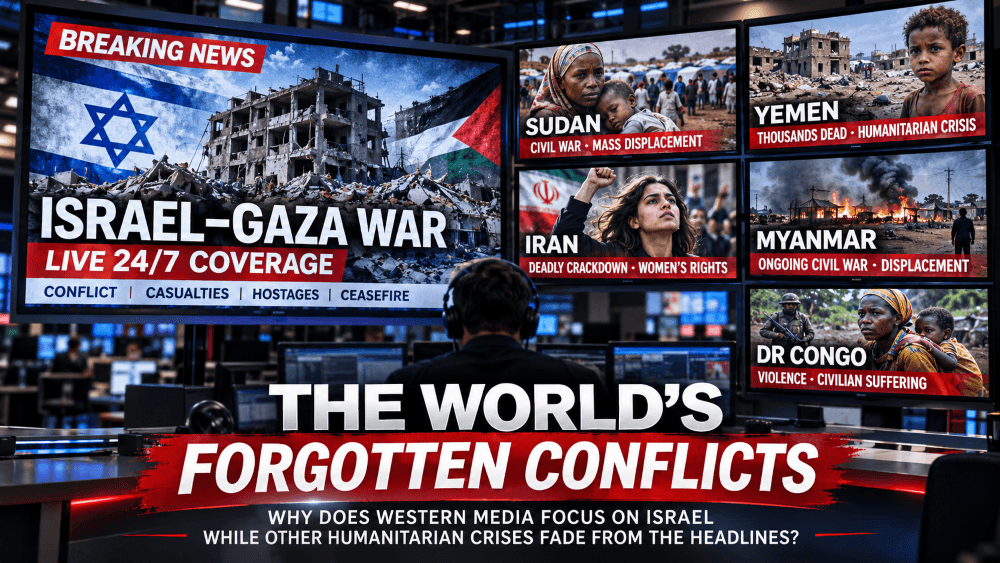
Why do Israel and Gaza dominate international headlines while millions suffer in Sudan, Yemen, Iran, Myanmar, and elsewhere?
Western media bias is often discussed in terms of whether journalists are too sympathetic to Israel or too sympathetic to Palestinians. But there is another question that deserves just as much attention: Why does one conflict receive such extraordinary international scrutiny while other humanitarian catastrophes struggle to remain in the headlines?
Israel is a small country of approximately 10 million people. Yet its conflicts generate enormous international media attention, political debate, university demonstrations, and diplomatic controversy.
Meanwhile, millions of people are displaced in Sudan. Civilians are dying in Yemen. Iranian protesters face violent repression. Wars continue in Myanmar and the Democratic Republic of Congo.
The issue is not whether Israelis and Palestinians deserve international attention. Of course they do.
The question is why other victims of war, repression, and political violence so often receive less sustained attention.
Western Media Bias: Is Israel Being Judged Differently?
Consider how the Israeli-Palestinian conflict is frequently presented.
Israel is often described through the language of occupation, settlements, colonialism, military power, and Palestinian suffering. These are legitimate subjects of journalistic investigation, particularly given the longstanding disputes over territory.
But there is another essential dimension to the story.
Israel faces security threats from Iran and several armed organizations that have attacked Israeli civilians, military positions, or infrastructure.
Understanding those threats provide context without which readers cannot fully understand the conflict.
Israel Is Confronting More Than Hamas
The conflict cannot be understood simply as a confrontation between Israel and the Palestinian population.
Iran has spent decades building relationships with armed organizations across the Middle East, supplying varying combinations of money, weapons, training, and logistical assistance.
These relationships are often described as the Axis of Resistance.
Important actors include:
- Iran and the Islamic Revolutionary Guard Corps: Iran has provided military and financial support to organizations confronting Israel, particularly through the IRGC and its Quds Force.
- Hezbollah in Lebanon: An Iranian-backed political and military organization that has maintained a substantial arsenal and fought repeated conflicts with Israel.
- Hamas in Gaza: The Palestinian Islamist organization responsible for the October 7, 2023 attacks, including the killing, rape and abduction of civilians.
- Palestinian Islamic Jihad: An Iranian-supported Palestinian armed organization operating in Gaza and the West Bank.
- The Houthis in Yemen: An Iran-aligned movement that has launched missiles and drones toward Israel and attacked commercial shipping.
- Iranian-aligned Iraqi militias: Organizations including Kata’ib Hezbollah and Harakat Hezbollah al-Nujaba that have participated in attacks connected to regional conflicts.
Other organizations, including the Afghan Fatemiyoun and Pakistani Zainebiyoun brigades, have historically served Iranian military objectives in Syria. Syria itself was an important logistical corridor under the former Assad government.
These groups are not interchangeable. They differ in ideology, organization, local objectives, and the degree of control Iran exercises over them.
Nevertheless, the broader regional threat to Israel is a documented reality.
A complete explanation of Israeli security policy must acknowledge this reality. Israel is fighting multiple war for their right of existance, in many fronts.
October 7 Cannot Be Erased From the Story
On October 7, 2023, Hamas-led attackers killed approximately 1,200 people in Israel and abducted about 250 hostages.
These attacks, including the deliberate targeting of civilians, were grave violations of international humanitarian law.
The subsequent war in Gaza caused devastating Palestinian civilian casualties, widespread destruction, and displacement, mostly because Hamas initiates its attacks from civilian facilities such as hospitals and schools.
Yemen: Thousands of Casualties, Far Less Attention
Consider Yemen.
For more than a decade, Yemen has experienced war, political fragmentation, economic collapse, and repeated humanitarian emergencies.
The country’s suffering is not a minor regional story. It is a major international humanitarian crisis.
According to the World Health Organization, the escalation of fighting between August 6 and September 18, 2026, caused 3,672 reported casualties, including 674 deaths and 2,998 injuries.
More than 122,000 people were displaced during that escalation across eight governorates.
Hospitals have struggled with shortages of medicine, damaged infrastructure, and overwhelming medical needs.
Yet Yemen rarely sustains the same level of international political discussion as Israel and Gaza.
Where are the weeks of continuous television debates? Where are the large-scale university demonstrations focused specifically on Yemen’s civilians? Why does international attention so often fade before the humanitarian emergency has ended?
These questions are not intended to deny the existence of journalists, activists, and humanitarian organizations working tirelessly on Yemen.
They are questions about visibility, public attention, and the priorities of international news organizations.
A Yemeni child’s life is no less valuable than an Israeli or Palestinian child’s life.
Sudan: One of the World’s Largest Humanitarian Catastrophes
If there is a conflict that illustrates the enormous gap between human suffering and international visibility, Sudan provides a compelling example.
Since April 2023, Sudan has been devastated by fighting between the Sudanese Armed Forces and the Rapid Support Forces.
The conflict has involved mass displacement, attacks on civilians, widespread sexual violence, destruction of infrastructure, and severe food insecurity.
The precise death toll remains uncertain because insecurity and the collapse of reporting systems make comprehensive documentation extremely difficult.
But the humanitarian scale is undeniable.
According to UNICEF’s 2026 reporting:
- 33.7 million people needed humanitarian assistance.
- 17.3 million children required humanitarian support.
- More than 9.1 million people were internally displaced as of mid-2026.
These figures describe a catastrophe affecting an extraordinary proportion of the country’s population.
And yet Sudan does not consistently command the same attention from Western audiences as Israel and Gaza.
The atrocities in Darfur, including the violence surrounding El Fasher, demand serious international investigation and accountability.
Why is a humanitarian catastrophe of this magnitude not an enduring central subject of international debate?
One possible explanation is that Sudan lacks the same combination of Western strategic involvement, established advocacy networks, historical symbolism, and intense political identification.
But whatever the explanation, the consequences of limited visibility can be severe.
International attention helps mobilize humanitarian funding, diplomatic pressure, and public accountability.
When a crisis disappears from the headlines, its victims risk disappearing from the public imagination.
Iran: Where Is the Sustained Outrage Over Repression?
Iran presents another important test of international media priorities.
The Iranian government supports armed organizations that confront Israel while also exercising extensive coercive power over its own population.
Women have faced restrictions on dress, personal freedoms, and public life. Protesters, dissidents, journalists, and activists have faced imprisonment and repression.
The death of Mahsa Amini in police custody in 2022 triggered the Woman, Life, Freedom protest movement, attracting significant international coverage and solidarity.
But the repression did not end.
The Deadly Crackdown of 2025–2026
In late December 2025, protests erupted over Iran’s deteriorating economic conditions and expanded into demands for political change.
Security forces responded with a violent crackdown, while restrictions on communications complicated efforts to document events.
In January 2026, Reuters reported that the human rights organization HRANA had verified thousands of deaths.
Different sources published substantially different totals, and the full extent of the violence remained difficult to establish independently.
The fundamental fact is clear: large numbers of Iranians died during a major government crackdown.
These events received coverage from Reuters, the BBC, and other international organizations. It would therefore be inaccurate to claim that Western journalists ignored them entirely.
But there is a legitimate question about whether the international attention was sustained in proportion to the scale of repression.
Where is the continuing international conversation about Iranian women’s freedoms, political prisoners, and the families of those killed?
The struggle of Iranian women should not become visible only when it intersects with a larger geopolitical confrontation.
Myanmar, Congo, and the Sahel: Other Wars That Struggle for Visibility
The same questions arise elsewhere.
Myanmar’s Civil War
Since the military coup in February 2021, Myanmar has experienced extensive armed conflict, aerial attacks, displacement, and repression.
The fighting has affected millions of civilians, including ethnic minorities already facing longstanding persecution.
Yet developments in Myanmar frequently struggle to remain prominent in Western news cycles.
The Democratic Republic of Congo
Eastern Congo has experienced repeated cycles of armed conflict involving M23 and numerous other armed groups.
Civilians face displacement, killings, sexual violence, and severe humanitarian insecurity.
The conflict also has important regional dimensions, including disputes involving neighboring countries.
Despite the extraordinary human cost, sustained international public attention remains difficult to maintain.
Mali, Burkina Faso, and the Sahel
Across parts of the Sahel, jihadist insurgencies, military operations, and political instability have produced extensive civilian suffering.
Communities have been displaced, schools closed, and local economies disrupted.
These crises deserve rigorous reporting even when they do not involve Israel, the United States, or another major focus of Western political debate.
Why Does Israel Receive So Much Attention?
There are several possible explanations for the intensity of Israel-related coverage.
First, Western governments are deeply involved.
The United States provides extensive military and diplomatic support to Israel. European governments also maintain significant relationships with Israel and the Palestinian territories.
Consequently, events in Israel and Gaza are directly connected to domestic political debates in Western countries.
Second, the conflict carries enormous historical and religious significance.
Jewish history, the Holocaust, Palestinian displacement, Jerusalem, and competing national claims create powerful connections for audiences around the world.
Third, the conflict has established advocacy networks.
Israeli, Jewish, Palestinian, Arab, Muslim, and human rights organizations all contribute to public debate, although they frequently disagree about the conflict’s causes and appropriate responses.
Fourth, news organizations respond to audience demand.
Stories that attract substantial public engagement often generate more follow-up reporting.
This can create a feedback loop: intensive coverage increases public interest, which in turn encourages additional coverage.
Fifth, some conflicts are much harder to report.
Journalists face extreme access restrictions, communications blackouts, insecurity, and direct threats in places such as Sudan, Myanmar, and Iran.
These obstacles can reduce the quantity and quality of international reporting.
None of these explanations establishes a deliberate conspiracy to ignore other victims.
But they do suggest that media attention is shaped by forces other than the number of people killed, displaced, or deprived of basic freedoms.
There has always been sentiments of antisemitism throughout history
Throughout history, Jews have alwasy been murdered, raped, expelled, robbed. Now, they are still living the same reality. Here are some historic events:
The Seleucid Persecution and Maccabean Revolt (167–160 BCE) Emperor Antiochus IV Epiphanes outlawed Jewish religious practices—including Sabbath observance, dietary laws, and circumcision—and desecrated the Second Temple in Jerusalem by erecting an altar to Zeus. This systematic attempt to eradicate Judaism provoked the Maccabean Revolt.
The European Crusades and Medieval Expulsions (1096–1492 CE) The Middle Ages saw widespread state- and church-sanctioned anti-Jewish violence across Europe. Highlights include the violent massacres of Jewish communities along the Rhine during the First Crusade (1096), the Edict of Expulsion expelling all Jews from England (1290), widespread massacres during the Black Death (1348–1351) driven by well-poisoning accusations, and the Alhambra Decree (1492), which forced the mass expulsion or conversion of Spain’s Jewish population.
The Tsarist Pogroms and Russian Empire Restrictions (1881–1921) Systemic persecution in the Russian Empire restricted millions of Jews to the Pale of Settlement under severe economic and educational quotas. Following the assassination of Tsar Alexander II in 1881, state-tolerated violent mob attacks (pogroms) swept through Jewish towns. Violence escalated during the 1903 Kishinev pogrom, the 1905 revolution, and the Russian Civil War, leading to the murder of over 100,000 Jews and triggering a mass migration of more than two million people.
The Holocaust (1941–1945) The state-sponsored, industrial genocide perpetrated by Nazi Germany and its collaborators resulted in the murder of six million European Jews—two-thirds of Europe’s Jewish population—in extermination camps, ghettos, and mass shootings across occupied Europe. It represents the single deadliest instance of antisemitism in history.
The AMIA Bombing (1994) On July 18, 1994, a suicide bomber detonated an explosive-laden vehicle at the Asociación Mutual Israelita Argentina (AMIA) Jewish community center in Buenos Aires, Argentina. The terror attack killed 85 people and injured over 300, targeting Latin America’s largest Jewish community in one of the deadliest international antisemitic strikes of the modern era.
Now, the horrendous attacks of October 7
Why Is The Western Media Coverage of Israel Biased?
It’s a story easy to sell: Israel = bad; Palestinians = poor defenceless victims.
Most news organizations, countries, and political audiences have an anti-Israel bias. In particular:
1. Major News Agencies & Wire Services
These outlets supply foundational reporting, photos, and video feeds to thousands of newsrooms around the globe, all of them following the same narrative.
- The Associated Press (AP) (United States)
- Reuters (United Kingdom / United States)
- Agence France-Presse (AFP) (France)
2. U.S. Television & Cable Networks
- CNN
- NBC News / MSNBC
- CBS News
- ABC News
- PBS (PBS NewsHour, Frontline)
Some media critics argue that Israeli security concerns, Hamas’s actions, and the role of Iranian-backed organizations receive insufficient attention.
A useful analysis must distinguish between several different questions:
- Is Israel receiving more coverage than comparable conflicts?
- Is that coverage disproportionately negative or positive?
- Are Israeli and Palestinian civilian deaths described differently?
- Are military threats, humanitarian consequences, and legal obligations explained consistently?
- Are other international crises being neglected?
These are separate empirical questions, and they require different kinds of evidence.
Selective Outrage and the University Protest Movement
University demonstrations have become an important part of the international response to the war in Gaza.
Students at institutions such as Columbia and Harvard have organized protests, demanded institutional changes, and challenged their universities’ financial or political relationships with Israel.
Peaceful protest is a legitimate form of civic participation.
But these movements also raise questions about how particular causes become central to student activism.
Why does one international conflict inspire prolonged campus mobilization while other devastating wars receive comparatively little organized attention?
There may be reasonable explanations.
Students often organize around issues where they believe their universities or governments have direct influence. American military assistance to Israel provides one such connection. Also, many people simply hate Jews.
Sudan, Myanmar, and Yemen may not present the same immediately identifiable institutional targets.
Nevertheless, the broader question remains important.
If the guiding principle is universal human rights, how can public institutions and civil society give sustained attention to victims whose suffering receives less political visibility?
That is a challenge worth directing not only at students, but also at journalists, universities, politicians, and the wider public.
What More Consistent International Journalism Would Look Like
The objective should be to apply rigorous journalistic standards more consistently across international conflicts.
That means:
- Providing complete context: Explain Israel’s security threats, Palestinian civilian suffering, the role of Iran-backed armed groups, and the obligations of every party under international law.
- Giving neglected crises sustained attention: Report regularly on Sudan, Yemen, Myanmar, Congo, and Iran rather than waiting for a particularly dramatic atrocity.
- Using consistent language: Apply clear and defensible standards when describing civilian killings, hostage-taking, indiscriminate attacks, displacement, and repression.
- Separating civilians from political and military actors: Palestinians are not synonymous with Hamas, Israelis are not synonymous with their government, and Iranians are not synonymous with the Islamic Republic.
- Investing in difficult reporting: Support journalists working in places where access restrictions and insecurity make independent verification particularly challenging.
- Being transparent about uncertainty: Clearly distinguish independently verified casualty figures from government statements, advocacy estimates, and unconfirmed reports.
These standards would improve reporting on Israel and Palestine while also expanding the public’s understanding of other crises.
Conclusion: Human Rights Should Not Depend on Headlines
Israel’s security threats are real. The attacks of October 7 were real. Palestinian civilian suffering is real.
So are the humanitarian disasters in Sudan and Yemen, the repression of Iranian protesters, and the devastating wars in Myanmar and Congo.
Recognizing one tragedy does not require minimizing another.
The most important question is not whether Israel deserves less scrutiny.
It is whether other governments, armed groups, and perpetrators of atrocities deserve more.
News organizations inevitably make editorial choices. They cannot devote equal attention to every conflict every day.
But those choices deserve examination, especially when immense humanitarian emergencies struggle to remain visible.
A consistent commitment to human rights should not depend on a victim’s nationality, religion, ethnicity, or the political popularity of their cause.
The lives of Israelis, Palestinians, Yemenis, Sudanese, Iranians, Congolese, and Burmese people all matter.
Our understanding of the world should reflect that principle.
Frequently Asked Questions
1. Why does Western media cover Israel so extensively?
Israel’s relationship with the United States and Europe, the conflict’s historical and religious significance, its international political consequences, and strong public engagement all contribute to intensive coverage. The precise balance of these factors varies across news organizations.
2. Does Israel face threats from Iran and Iranian-backed groups?
Yes. Iran has provided financial, military, and logistical assistance to organizations including Hezbollah, Hamas, Palestinian Islamic Jihad, and several Iraqi militias. These groups differ in their objectives and independence, but they have contributed to Israel’s regional security challenges.
3. Why do Sudan and Yemen receive less sustained international attention?
Factors may include limited reporting access, competing news priorities, differences in Western political involvement, audience interest, and weaker international advocacy visibility. More comparative research is needed to measure the precise differences in coverage.
4. Is there evidence of media bias against Israel?
Yes there is. There are repeated patterns such as selective omissions, inconsistent language, unequal sourcing, and differences in how comparable events are reported.
Sources and Further Reading
- UNICEF — Sudan Humanitarian Mid-Year Situation Report 2026
- World Health Organization — Yemen Health Emergency, September 2026
- Norwegian Refugee Council — World’s Most Neglected Displacement Crises
- Reuters Institute — Reporting Iran’s Protest Crackdown
- Reporting on Victims in the Israel-Gaza War: A Comparative Analysis of CNN, Al Jazeera, and CGTN (2026)
Editorial note: Casualty and displacement figures are time-sensitive and may change as new information becomes available. The figures cited above are attributed to the reporting periods identified in the article.
Leave a Reply