November 28, 2026
Wall Street stages a spectacular comeback as chip stocks rebound
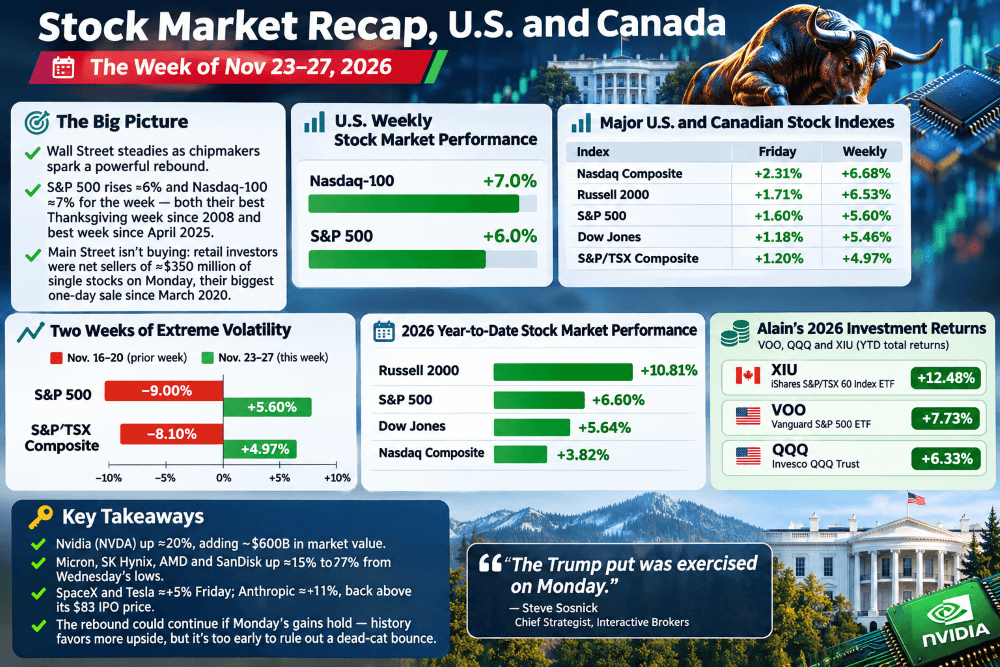
After one of the most brutal selloffs of 2026, Wall Street staged a remarkable recovery during the Thanksgiving-shortened trading week. Semiconductor stocks led the rebound, restoring trillions of dollars in market value and easing fears of a prolonged bear market.
The S&P 500 gained nearly 6% for the week, recording its strongest Thanksgiving week since 2008 and its best weekly performance since April 2025. Meanwhile, the Nasdaq-100 advanced nearly 7%, as investors returned to artificial intelligence and semiconductor stocks.
However, persistent inflation, proposed tariffs, uncertainty surrounding interest rates, and declining retail investor confidence suggest that the market remains vulnerable.
1. U.S. weekly stock market performance
U.S. Weekly Stock Market Performance
November 23–27, 2026
Approximate weekly returns | Source: Yahoo Finance
AlainGuillot.com
The recovery followed a devastating previous week in which the S&P 500 lost nearly 9%, wiping out approximately $6 trillion in market capitalization.
On Monday alone, the index recovered roughly $3 trillion, marking its strongest trading session since April 2025.
The rally was interrupted Wednesday when a hotter-than-expected inflation report and new tariff proposals sent stocks sharply lower. The Nasdaq-100 briefly entered bear market territory, falling 20% below its record closing high.
However, buyers returned before Wednesday’s closing bell, and Friday’s shortened trading session helped secure an impressive weekly recovery.
Major U.S. and Canadian stock indexes
| Index | Friday close | Friday | Weekly |
|---|---|---|---|
| S&P 500 | 7,297.49 | +1.60% | +5.60% |
| Dow Jones | 50,774.94 | +1.18% | +5.46% |
| Nasdaq Composite | 24,129.50 | +2.31% | +6.68% |
| Russell 2000 | 2,750.30 | +1.71% | +6.53% |
| S&P/TSX Composite | 34,839.87 | +1.20% | +4.97% |
2. Nvidia and semiconductor stocks lead the recovery
The biggest catalyst for Monday’s rally was the reinstatement of Jensen Huang as Nvidia’s CEO, following his brief departure from the company.
The announcement restored some confidence in the artificial intelligence industry and triggered aggressive buying across the semiconductor sector.
According to Yahoo Finance’s reporting:
- Nvidia (NVDA): Gained approximately 20% for the week, recovering roughly $600 billion in market capitalization.
- Micron (MU), AMD (AMD), SK Hynix and SanDisk (SNDK): Rebounded between approximately 15% and 27% from Wednesday’s lows.
- Tesla (TSLA) and SpaceX (SPCX): Advanced approximately 5% on Friday.
- Anthropic (ANT): Surged approximately 11% on Friday, recovering above its $83 IPO price.
The recovery illustrates how heavily the U.S. stock market depends on the artificial intelligence investment cycle. When confidence in AI improves, trillions of dollars can return to equity markets in a matter of days. The opposite is equally true.
3. Canadian stock market: TSX records its best week in three years
TSX Composite
34,839.87
+412.99 points Friday
Weekly return
+4.97%
Best week since October 2023
Canadian equities participated in the global recovery, with the S&P/TSX Composite Index gaining 4.97% for the week after losing 8.1% the previous week. Reuters+1
Unlike the technology-driven American rally, Canada’s recovery benefited considerably from strengthening commodity prices, particularly gold and copper.
Mining companies, industrial businesses and technology stocks contributed to the recovery. Investors were also encouraged by the possibility of renewed Canada-U.S. trade negotiations. The Motley Fool Canada+1
Canada’s exposure to natural resources continues to provide investors with an alternative to the technology-heavy U.S. market.
4. Commodities, interest rates and market volatility
| Asset | Friday level | Weekly change |
|---|---|---|
| Gold futures | $3,668 | +4.36% |
| WTI crude oil | $83.08 | −1.07% |
| Bitcoin | $59,569 | −0.87% |
| U.S. 10-year Treasury yield | 4.94% | +2 basis points |
| U.S. Dollar Index | 104.01 | +0.20% |
| VIX volatility index | 23.81 | −33.66% |
Gold’s strong performance suggests that investors continue to seek protection against economic and geopolitical uncertainty, even as equity markets recover.
Meanwhile, elevated Treasury yields remain a significant obstacle for growth stocks. Higher interest rates reduce the present value of future corporate earnings and make fixed-income investments more competitive.
The sharp decline in the VIX indicates that investor anxiety has diminished considerably, although uncertainty remains higher than during calmer market conditions.
5. Wall Street is buying, but retail investors are selling
One of the most concerning developments this week was the divergence between the market’s recovery and the behavior of individual investors.
According to Vanda Research, excluding Nvidia and Anthropic, retail investors sold approximately $350 million worth of individual stocks on Monday.
It was their largest single-day net sale since March 2020, even as technology stocks experienced an extraordinary rally.
This represents a potential change in investor psychology.
Throughout much of the post-pandemic bull market, individual investors enthusiastically purchased stocks during market declines. The popular strategy of buying the dip became a powerful source of demand.
However, after several weeks of extreme volatility, some retail investors appear increasingly reluctant to commit additional capital.
If this trend continues, the market may lose an important source of support during future downturns.
6. A sustainable recovery or a dead-cat bounce?
The central question facing investors is whether this week’s rally marks the beginning of a sustained recovery or merely a temporary rebound within a declining market.
Historical evidence offers mixed signals.
According to the Yahoo Finance analysis, the S&P 500 has experienced only seven other similarly powerful recoveries following weekly declines of at least 8% since 1950.
Historical outcomes
2
of 7 marked the market bottom
5
of 7 were followed by further losses
Historical observations supplied by Yahoo Finance; the sample is too small to establish reliable predictive probabilities.
The encouraging news is that markets retained a substantial portion of Monday’s gains despite Wednesday’s intense selling pressure.
However, the fundamental challenges that triggered the selloff have not disappeared. Inflation remains elevated, tariff uncertainty persists, and investors continue to question whether massive AI infrastructure investments will generate sufficient profits.
A powerful rally is not necessarily evidence that a market correction has ended.
7. 2026 year-to-date stock market performance
2026 Year-to-Date Stock Market Performance
January 1 – November 27, 2026
Small-cap stocks are outperforming large-cap and technology-heavy indexes in 2026.
Index price returns | AlainGuillot.com
Despite the recent correction, the major U.S. indexes remain positive for the year.
| Index | 2026 YTD |
|---|---|
| Russell 2000 | +10.81% |
| S&P 500 | +6.60% |
| Dow Jones | +5.64% |
| Nasdaq Composite | +3.82% |
Portfolio Terminal
Interestingly, smaller American companies have outperformed the technology-heavy Nasdaq this year. This is a reminder that market leadership can change rapidly and that diversification remains valuable.
8. Alain’s year-to-date investment returns: VOO, QQQ and XIU
Alain’s 2026 Year-to-Date Investment Returns
VOO, QQQ and XIU | November 2026
iShares S&P/TSX 60 Index ETF — CAD
Long-term core holding
Vanguard S&P 500 ETF — USD
Long-term core holding
Invesco QQQ Trust — USD
Tactical investment position
XIU continues to outperform my U.S. ETF holdings in their respective trading currencies. My long-term strategy remains unchanged: hold VOO and XIU for life while managing QQQ as a tactical investment.
ETF total returns, including distributions.
VOO and QQQ through November 27, 2026.
XIU through November 26, 2026.
Returns are in local currencies and do not represent personal account performance.
© 2026 AlainGuillot.com | My Investment Journey
As November approaches its conclusion, the three ETFs in my investment portfolio remain profitable for 2026. The iShares S&P/TSX 60 Index ETF (XIU) is leading the way with a reported year-to-date total return of 12.48%, followed by the Vanguard S&P 500 ETF (VOO) at 7.73% and the Invesco QQQ Trust (QQQ) at 6.33%. Canadian equities have demonstrated remarkable resilience relative to American technology stocks. My long-term strategy remains unchanged: VOO and XIU are my permanent core holdings, while QQQ represents a more tactical investment position. Despite the recent market turbulence, I remain committed to long-term wealth creation through disciplined investing rather than reacting emotionally to short-term market movements.Finance Charts+2
These are ETF total returns, including distributions, in their respective trading currencies, not my personal account returns. VOO and QQQ figures are through November 27. The latest reported XIU total return is through November 26. Currency fluctuations, borrowing costs and transaction timing may affect my actual investment performance.
9. What investors should watch next week
As December begins, investors will be paying particular attention to several developments:
- Federal Reserve policy: Persistent inflation could reduce the likelihood of monetary easing or increase the possibility of further tightening.
- Technology stocks: Whether semiconductor companies can sustain their recent gains.
- Artificial intelligence spending: Whether corporate earnings justify current investment levels and valuations.
- Canada-U.S. trade relations: New tariff announcements and potential progress in negotiations.
- Retail investor participation: Whether individual investors regain confidence and return to the market.
- Market technical indicators: Whether major indexes can recover above their 50-day moving averages.
December has historically been associated with favorable stock market seasonality, but economic conditions and corporate fundamentals will ultimately determine whether the recovery continues.
Final thoughts: A welcome recovery, but the danger has not passed
This Thanksgiving week delivered a much-needed reprieve for investors on both sides of the border.
The S&P 500 gained 5.6%, the Nasdaq Composite advanced 6.7%, and Canada’s TSX climbed nearly 5%. Semiconductor companies recovered substantial market value, while strengthening metal prices supported Canadian equities.
Nevertheless, the extraordinary swings of the past two weeks demonstrate how fragile investor confidence remains.
For long-term investors, volatility can create attractive buying opportunities. For short-term traders, it reinforces the importance of risk management and maintaining a disciplined investment strategy.
The market has recovered some lost ground, but the battle between optimism surrounding artificial intelligence and concerns about inflation, interest rates and valuations is far from over.
Other Stock Market blog posts
Leave a Reply