Friday, November 27, 2026
Introduction: Wall Street Ends Thanksgiving Week on a Positive Note
U.S. and Canadian stocks rallied on Friday, November 27, 2026, as investors returned to technology stocks following a turbulent November marked by concerns about artificial intelligence valuations, inflation, and rising interest rates.
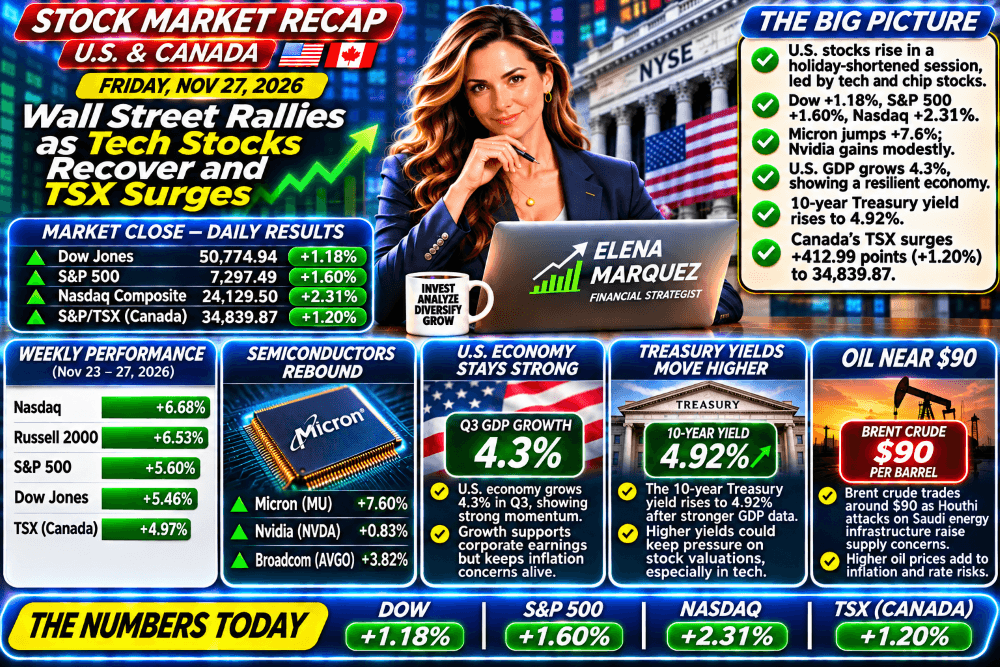
During the holiday-shortened trading session, the Dow Jones Industrial Average gained 1.2%, the S&P 500 climbed 1.6%, and the Nasdaq Composite jumped 2.3%.
Semiconductor stocks recovered, with Micron Technology surging more than 7% and Nvidia recording modest gains.
Meanwhile, reported U.S. third-quarter economic growth of 4.3% pointed to a resilient economy but raised concerns about persistent inflation and higher interest rates. The 10-year Treasury yield climbed to 4.92%.
Canada also delivered a strong performance, with the S&P/TSX Composite gaining 412.99 points, or 1.20%, to close at 34,839.87.
Despite the encouraging finish, investors continue to face uncertainty surrounding AI profitability, international trade, monetary policy, and geopolitical tensions.
1. How the Major Stock Indexes Performed
U.S. & Canadian Stock Market Performance
The Nasdaq led Friday’s recovery as investors returned to semiconductor and technology stocks.
All four major North American indexes finished in positive territory, providing some relief following the substantial losses experienced earlier in November.
However, a single strong trading session does not necessarily signal the end of the recent market correction.
Final closing figures
| Index | Closing value | Points gained | Daily return |
|---|---|---|---|
| Dow Jones | 50,774.94 | +591.99 | +1.18% |
| S&P 500 | 7,297.49 | +114.71 | +1.60% |
| Nasdaq Composite | 24,129.50 | +543.70 | +2.31% |
| S&P/TSX Composite | 34,839.87 | +412.99 | +1.20% |
| Russell 2000 | 2,750.30 | +46.24 | +1.71% |
The final U.S. closing figures were reported by the Associated Press. AP News+1
2. Wall Street Records Its Strongest Week Since April 2025
Despite several volatile trading sessions, Wall Street delivered an exceptionally strong weekly performance.
The S&P 500 recorded its biggest weekly gain since April 2025, recovering a substantial portion of last week’s losses.
Monday’s extraordinary rally and Friday’s technology sector recovery more than compensated for the weakness experienced on Tuesday and Wednesday.
Weekly Stock Market Performance
Weekly Stock Market Performance
The Nasdaq led the major U.S. indexes with a weekly gain of approximately 6.7%, followed closely by the Russell 2000. Yahoo Finance
The strong performance across both large-cap and small-cap companies suggests that the recovery extended beyond the artificial intelligence sector.
Nevertheless, the major U.S. indexes remain below their recent highs.
3. Micron Technology Surges 7.6% as Semiconductor Stocks Rebound
Semiconductor companies were among Friday’s strongest performers as concerns surrounding artificial intelligence profitability temporarily eased.
Micron Technology was particularly impressive, gaining 7.6%.
Other major technology companies also participated in the recovery.
Technology Stocks Lead Friday’s Rally
Amazon, Tesla, Broadcom, and Micron were among the largest positive contributors to the S&P 500 on Friday. Portfolio Terminal
Why Micron matters to the artificial intelligence industry
Advanced AI systems require enormous amounts of high-performance memory to process information efficiently.
Micron is positioned to benefit from growing demand for high-bandwidth memory, data-center storage, and advanced computing infrastructure.
However, the semiconductor industry remains highly cyclical. Rapid capacity expansion can eventually lead to oversupply, declining prices, and reduced profit margins.
Friday’s rally suggests that investors remain interested in the industry’s long-term growth potential despite recent concerns about excessive AI investment.
4. Nvidia and the Artificial Intelligence Investment Debate
Nvidia remained at the center of investor attention following an extraordinary week of volatility.
After Monday’s spectacular rally, the company experienced consecutive declines on Tuesday and Wednesday.
Friday’s broader semiconductor recovery offered some relief, although Nvidia’s performance was less dramatic than Micron’s.
The fundamental debate surrounding artificial intelligence remains unresolved.
Investors are no longer simply asking whether AI will transform the economy. They increasingly want to know whether companies can generate enough revenue to justify the hundreds of billions of dollars being committed to infrastructure.
There is a significant distinction between technological success and investment success.
An industry can transform society while simultaneously disappointing investors who paid excessively high prices for its stocks.
The history of railroads, telecommunications, and the internet provides numerous examples of revolutionary technologies that created enormous economic value but also produced substantial investment losses.
Artificial intelligence could experience similar challenges.
5. U.S. Economic Growth Reaches 4.3%
According to today’s market reporting, U.S. gross domestic product expanded at an annualized rate of 4.3% during the third quarter.
The reported growth rate indicates considerable resilience in the American economy. TPE Hub
U.S. Economic Indicators
Q3 GDP growth
4.3%
Annualized rate
10-year Treasury yield
4.92%
Reported market level
October core PCE inflation
3.3%
Year over year
Fed inflation target
2.0%
Long-term objective
GDP and Treasury figures from Friday’s market reporting. Core PCE from Wednesday’s newsletter.
When good economic news becomes bad news for investors
Strong economic growth is generally beneficial for businesses. It can support consumer spending, corporate revenues, employment, and investment.
However, when inflation remains elevated, rapid economic growth can complicate monetary policy.
A strong economy may reduce the Federal Reserve’s willingness to lower interest rates and could strengthen the argument for additional monetary tightening.
This creates a paradox for investors: encouraging economic data can sometimes produce unfavorable conditions for stock valuations.
6. U.S. Treasury Yields Approach 5%
The 10-year U.S. Treasury yield climbed to approximately 4.92%, while another published closing-data report placed it at 4.932%. TPE Hub+1
The approach toward 5% represents another challenge for equity investors.
When government bonds offer attractive yields, investors may become less willing to accept the additional risks associated with expensive technology stocks.
Higher Treasury yields can also translate into more expensive mortgages, corporate borrowing, and infrastructure financing.
For artificial intelligence companies, which require substantial investments in computing capacity and electricity infrastructure, the cost of capital is particularly important.
The market is therefore attempting to balance two competing forces: strong economic growth and increasingly expensive financing.
7. Brent Crude Oil Trades Near $90 per Barrel
Global benchmark Brent crude traded near US$90 per barrel Friday as investors monitored geopolitical tensions in the Middle East.
Reported attacks on Saudi Arabian energy infrastructure have raised concerns about potential disruptions to global petroleum supplies. Yahoo Finance
Global energy markets · November 27, 2026
US$90/barrel
Brent crude oil
Key market factors: geopolitical uncertainty, potential supply disruptions, strong economic activity and inflation concerns.
Higher oil prices have important implications for both the United States and Canada.
For Canadian energy producers, stronger petroleum prices can improve revenue and profitability.
For consumers and businesses, however, rising energy costs can increase transportation, manufacturing, and household expenses.
Persistent strength in oil prices could also complicate central banks’ efforts to bring inflation under control.
8. Canada: TSX Surges 413 Points
Canada’s S&P/TSX Composite continued its recovery on Friday, gaining 412.99 points, or 1.20%, to close at 34,839.87.
Canadian mining and technology companies were among the sectors supporting the market during Friday’s session. Investcom
The Canadian stock market has now recorded a substantial recovery from the previous week’s selloff.
Canada’s TSX: Selloff and Recovery
The TSX has recovered 1,650.02 of the 2,916.05 points lost during the previous week. Another 1,266.03 points are needed to regain its November 13 closing level.
How much of last week’s losses has Canada recovered?
Previous week’s point losses recovered
56.6%
1,650.02 points
Recovered: 1,650.02 pointsRemaining: 1,266.03 points
The TSX has regained more than half of the points lost during the week of November 16–20.
Although the Canadian market has not fully recovered, its performance demonstrates how quickly financial markets can reverse following periods of extreme pessimism.
9. November Remains a Difficult Month for Wall Street
Despite this week’s strong recovery, November continues to be a challenging month for American equities.
November Stock Market Performance
The Nasdaq remains the weakest performer among these four indexes for November, reflecting the particularly severe pressure on technology stocks. Portfolio Terminal
With one trading session remaining in November, the market is on track to finish the month in negative territory unless another substantial rally occurs.
10. 2026 Year-to-Date U.S. Stock Market Returns
Despite the recent correction, all four major U.S. indexes remain positive for 2026.
Smaller American companies continue to outperform their larger counterparts.
2026 Year-to-Date Stock Market Returns
Price returns exclude dividends. Sources: Associated Press and Portfolio Terminal.
The Russell 2000 has gained approximately 10.8% this year, compared with 3.8% for the technology-heavy Nasdaq Composite. Portfolio Terminal+1
This performance challenges the assumption that artificial intelligence stocks are necessarily the best investment opportunity of 2026.
Diversification across industries and company sizes can provide exposure to opportunities that receive considerably less media attention.
11. The S&P 500 Moves Out of Correction Territory
Friday’s recovery has brought the S&P 500 considerably closer to its previous record high.
The index closed at 7,297.49, compared with its October 6 record of 7,818.93. Portfolio Terminal
S&P 500: Distance From Record High
November 27, 2026
October 6 record
7,818.93
Current closing value
7,297.49
The S&P 500 is currently 6.67% below its reported record high.
A stock market correction generally refers to a decline of at least 10% from a recent peak.
The S&P 500 has now moved above that threshold, although this does not guarantee that the recent downturn is over.
12. Black Friday and the Holiday Shopping Season
Friday’s trading session was unusually short because of the American Thanksgiving holiday.
U.S. equity markets closed at 1 p.m. Eastern time, while the bond market closed at 2 p.m.
Beyond Wall Street, Black Friday marked an important period for American retailers.
Investors will be monitoring holiday spending to determine whether consumers remain financially resilient despite persistent inflation and elevated borrowing costs.
Strong retail sales could support expectations for continued economic growth. However, exceptionally strong demand could also reinforce inflation concerns.
Retailers must also demonstrate that holiday discounts can generate profitable sales rather than simply increase revenue at the expense of margins.
13. What Investors Should Watch Next Week
As December approaches, several developments could influence North American financial markets:
- Artificial intelligence stocks: Whether semiconductor companies can sustain Friday’s recovery.
- Federal Reserve: Expectations surrounding a potential December interest rate increase.
- Treasury yields: Whether the 10-year yield reaches or exceeds 5%.
- Oil prices: Potential supply disruptions and geopolitical tensions in the Middle East.
- Holiday retail spending: Early Black Friday and Cyber Monday sales results.
- International trade: Developments surrounding the recently announced U.S. tariffs.
- Canadian equities: Whether the TSX can continue recovering toward its November highs.
December could remain volatile as investors reassess corporate earnings expectations, monetary policy, and their portfolio allocations heading into 2027.
14. The Biggest Investment Lesson of November 27
The danger of selling during periods of extreme pessimism
Last Friday, investors were confronting a stock market correction, collapsing semiconductor valuations, and mounting concerns about artificial intelligence.
One week later, the Nasdaq has gained approximately 6.7%, the S&P 500 has recovered 5.6%, and Canada’s TSX has climbed nearly 5%.
Nothing about this recovery guarantees that stocks will continue rising.
However, it illustrates one of the greatest difficulties of market timing: some of the strongest market rallies can occur shortly after substantial declines.
Investors who sell during periods of panic must subsequently make another difficult decision about when to return to the market.
Long-term investors holding diversified index funds such as VOO or XIU may find that maintaining a disciplined investment strategy is more practical than attempting to anticipate every market reversal.
The objective is not to eliminate volatility but to establish a financial strategy capable of surviving it.
Conclusion: A Strong Recovery, but Uncertainty Remains
November 27, 2026, provided an encouraging conclusion to an exceptionally volatile week for North American investors.
The Dow gained 1.18%, the S&P 500 rose 1.60%, and the Nasdaq climbed 2.31%.
Micron Technology surged 7.6%, semiconductor stocks recovered, and Canada’s TSX advanced nearly 413 points.
Meanwhile, reported U.S. economic growth of 4.3% highlighted the resilience of the American economy, even as Treasury yields approached 5% and Brent crude traded near $90 per barrel.
Despite the strong weekly recovery, inflation, rising borrowing costs, geopolitical tensions, tariffs, and artificial intelligence profitability remain important sources of uncertainty.
The key takeaway: Financial markets can recover remarkably quickly, but sustainable long-term returns ultimately depend on corporate profitability, reasonable valuations, and investment discipline.
Other Stock Market blog posts
Leave a Reply