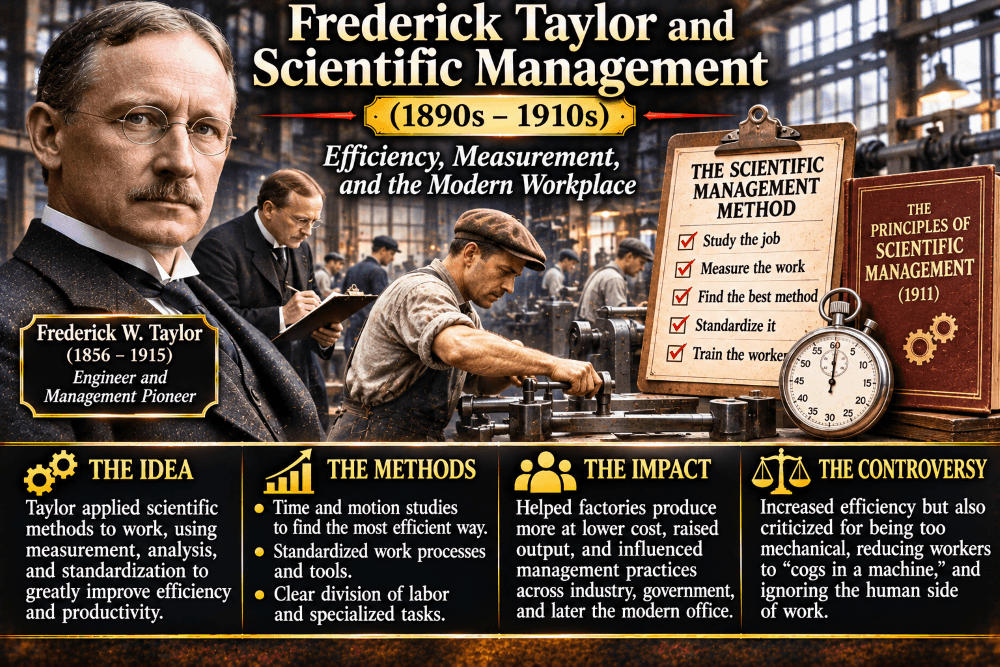
In the late 19th century, factories were growing fast, but most work was still organized by habit and experience. Frederick Winslow Taylor believed there was a better way. His system of scientific management, built on stopwatches, measurement, and standardized methods, became one of the most influential and controversial ideas in business history. It helped create modern management and industrial engineering, and it still shapes debates about work today.
Who Was Frederick Taylor?
Frederick Winslow Taylor was born in 1856 into a well-off Philadelphia family.
- He did not attend college, in part because of eyesight problems, and instead trained as an apprentice machinist and patternmaker.
- In 1878, he joined the Midvale Steel Company, where he rose from laborer to chief engineer.
- He later worked as a consultant, including at Bethlehem Steel, and became a tireless promoter of his ideas.
His experience on the shop floor gave him strong views about how factories were run.
The Problem Taylor Saw
“Soldiering”
Taylor was struck by what he called “soldiering,” workers deliberately working slower than they could.
- He believed workers held back to avoid raising expectations or risking layoffs.
- He thought managers did not know how long tasks should take, so they could not challenge this.
- Work methods were often based on rules of thumb passed down by experience.
Management by Guesswork
In Taylor’s view, factories wasted resources because neither managers nor workers had a scientific understanding of the work. He set out to measure and improve it.
Taylor’s Experiments
Time Studies
At Midvale, Taylor began using a stopwatch to measure how long tasks took, breaking jobs into small steps.
- He aimed to find the best method and set a fair standard for a day’s work.
- He introduced the idea of paying higher rates to workers who met the standard, known as a differential piece rate.
Pig Iron and Shoveling
At Bethlehem Steel, Taylor and his team conducted experiments that became famous.
- In the pig iron handling study, he reportedly increased the amount a worker could load in a day from around 12 tons to nearly 48 tons, while raising pay, according to Taylor’s own account.
- In shoveling studies, he concluded that different materials required different shovel sizes and loads, and he reportedly found an ideal load of around 21 pounds.
- Taylor’s results helped make his case, though some historians have questioned the accuracy of his famous accounts.
The Four Principles
In his 1911 book The Principles of Scientific Management, Taylor summarized his approach. In simplified form:
- Replace rules of thumb with science. Study tasks and determine the best method.
- Select and train workers scientifically. Match people to jobs and teach them the standard method.
- Cooperate to ensure the work follows the method. Managers and workers should work together to apply the science.
- Divide the work. Managers plan and design the work, and workers carry it out.
The last principle was the most controversial, since it shifted decision-making from workers to management.
How Scientific Management Spread
The Eastern Rate Case
In 1910, lawyer Louis Brandeis argued before the Interstate Commerce Commission, discussed in our chapter on the Sherman Act and the ICC, that railroads could save huge sums through efficiency. He popularized the term “scientific management.”
- The publicity helped make Taylor’s ideas famous.
- Companies and consultants rushed to adopt the methods.
The Disciples
Taylor attracted followers who extended his ideas.
- Frank and Lillian Gilbreth studied motion, breaking tasks into basic movements. Lillian Gilbreth also pioneered the study of the human side of work and became a leading figure in industrial psychology.
- Henry Gantt developed the Gantt chart, still used for project planning.
Taylor’s ideas also traveled abroad, influencing factories in Europe, Japan, and elsewhere.
The Backlash
Workers’ Resistance
Many workers and unions resented the methods.
- They saw time studies as speeding up work and taking away skill and control.
- They feared that gains from efficiency would not be shared fairly.
- In 1911, a strike at the Watertown Arsenal in Massachusetts was triggered when molders objected to stopwatch timing. It led to a congressional investigation in 1912, at which Taylor testified.
Criticism
Critics raised several concerns.
- Dehumanization: Treating workers as parts of a machine.
- Deskilling: Separating thinking from doing reduced workers’ autonomy.
- Evidence: Questions about the reliability of Taylor’s data.
Defenders argued that he aimed to benefit both employers and workers through higher productivity and pay.
Legacy
Management as a Discipline
Scientific management helped establish management as a profession.
- It led to industrial engineering and operations management.
- It influenced early business schools.
- It built on organizational ideas like those in our chapter on the birth of modern management.
Mass Production
Taylor’s emphasis on standardization and measurement fit with the rise of mass production, including the assembly lines that Henry Ford later developed, though historians debate how directly Ford drew on Taylor.
Echoes Today
Debates about measuring work continue.
- Some critics use the term “digital Taylorism” to describe workplace monitoring and algorithmic management.
- Defenders argue that data can improve safety, fairness, and efficiency.
- The balance between productivity and autonomy remains an open question.
Lessons from Scientific Management
- Measure what matters. Data can reveal waste and opportunities.
- Efficiency has human costs. Ignoring workers’ perspectives breeds resistance.
- Share the gains. Productivity improvements need to be perceived as fair.
- Ideas outlive their creators. Taylor’s methods still shape management practice.
Frequently Asked Questions
What is scientific management? It is a management approach developed by Frederick Taylor that uses measurement, time studies, and standardized methods to improve efficiency in the workplace.
What was Taylor’s pig iron experiment? At Bethlehem Steel, Taylor studied loading pig iron and reportedly increased a worker’s daily output dramatically with better methods and higher pay, though historians question the accuracy of the account.
Who were the Gilbreths? Frank and Lillian Gilbreth were pioneers of motion study who analyzed work movements, with Lillian also helping found industrial psychology.
Why was Taylorism controversial? Critics said it treated workers like machines, reduced their autonomy, and sped up work, while supporters argued it increased productivity and could raise wages.
Related Articles
- Jesse Livermore: The Boy Plunger of Wall Street
- Heinz, Kellogg, and Hershey: Inventing Packaged Food
- J.P. Morgan: The Banker Who Rescued Gold and Built Steel
- Homestead and Pullman Strikes: Labor vs. Capital
- F.W. Woolworth and the A&P: Birth of the Chain Store
- Gospel of Wealth: Carnegie and Modern Philanthropy
- Sherman Antitrust Act: Rise of Trust-Busting in America
About The History of Entrepreneurship
This article is part of The History of Entrepreneurship, an ongoing series exploring how entrepreneurs, civilizations, technologies, financial institutions, and business innovations gradually created the modern economy.
Leave a Reply