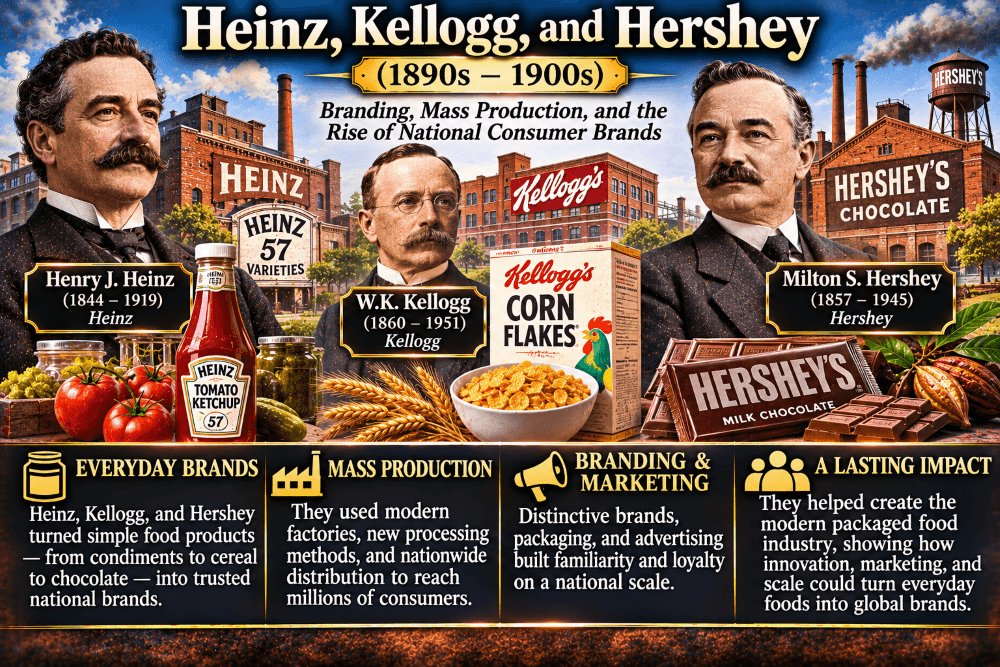
For most of history, food was local, unbranded, and sold by the scoop or pound. Around the turn of the 20th century, three American entrepreneurs helped change that. Heinz, Kellogg, and Hershey built national brands around purity, convenience, and mass production, turning ketchup, cereal, and chocolate into everyday staples. Their stories show how branding, factories, and trust transformed the way people ate, and they come with some uncomfortable footnotes.
The Problem: Food You Couldn’t Trust
Before the 1890s, buying food could be a gamble.
- Many foods were sold unpackaged, and quality varied from shop to shop.
- Adulteration was common, with fillers, dyes, and preservatives that buyers could not easily detect.
- Railroads, refrigeration, and growing cities were creating demand for food that could travel and keep.
This opened a space for companies that could promise consistency and safety under a recognizable name.
H.J. Heinz: Purity as a Brand
From Horseradish to Ketchup
Henry John Heinz began in Pittsburgh by selling bottled horseradish.
- He used clear glass bottles so customers could see the product was pure and not padded with cheap fillers.
- His first business went bankrupt in the 1870s, but he restarted with family and added products including ketchup.
- The company grew to offer a wide range of pickles, sauces, and condiments.
“57 Varieties”
In 1896, Heinz introduced the slogan “57 Varieties.”
- According to the commonly told story, he got the idea from an advertisement he saw on a train and picked the number 57 because he liked it.
- The company actually made more than 57 products, but the number stuck.
- It was a memorable piece of branding that conveyed variety and abundance.
Showmanship and Factory Pride
Heinz promoted his company creatively.
- At the 1893 World’s Columbian Exposition in Chicago, he reportedly drew crowds to a poorly placed booth by giving away souvenir pickle pins.
- He opened his clean, modern factories to public tours and offered employee amenities such as dining rooms and recreation.
- He supported the pure food movement and, with others, backed the Pure Food and Drug Act of 1906.
Kellogg: The Cereal Revolution
Battle Creek
Dr. John Harvey Kellogg ran the Battle Creek Sanitarium in Michigan, which promoted a regimen of diet, exercise, and rest.
- In the 1890s, he and his brother Will Keith Kellogg experimented with grains to create easy-to-digest foods.
- According to the story, a batch of cooked wheat was left sitting, and when rolled it formed flakes.
- They then applied the process to corn, creating corn flakes.
W.K. Kellogg Builds a Business
Will Keith Kellogg saw the commercial potential and founded his own company in 1906 to sell corn flakes to the public.
- He added sugar to improve the taste, which his brother opposed, leading to a long and bitter feud.
- He invested heavily in advertising, including large newspaper ads and giveaways of free sample boxes.
- He built a recognizable brand that turned cold cereal into a breakfast habit.
Battle Creek soon became a hub of cereal makers, with many companies seeking to capitalize on the boom.
A Complicated Legacy
John Harvey Kellogg’s legacy is mixed.
- He promoted ideas about healthy living that were ahead of their time in some respects.
- He also held views that included support for eugenics, and some of his treatments are regarded as unscientific or harmful.
Milton Hershey: Chocolate for the Masses
Failures Before Success
Milton Hershey failed in several candy ventures before succeeding in Lancaster, Pennsylvania.
- His Lancaster Caramel Company, using fresh milk, became very successful.
- At the 1893 Chicago exposition, he saw German chocolate-making machinery and bought it.
- He realized that chocolate could be made cheaply and sold to everyone.
The Hershey Bar
In 1900, Hershey sold the caramel business, reportedly for about 1 million dollars, to focus on chocolate.
- He developed a mass-produced milk chocolate bar that sold for a nickel.
- He introduced Hershey’s Kisses in 1907.
- Efficient production and standardization let chocolate move from luxury to everyday treat.
A Model Town and a School
Hershey built a town around his factory, starting in 1903.
- It included housing, parks, schools, a trolley, and an amusement park for workers and families.
- In 1909, he and his wife Catherine, who had no children, founded the Milton Hershey School for orphans.
- In 1918, he gave his stock in the company to a trust to support the school, ensuring that the company’s profits would help fund it.
What They Had in Common
- Branding: Distinctive names and packaging built trust and recognition.
- Standardization: Consistent quality at scale replaced local variation.
- Marketing: Slogans, giveaways, and public relations drove demand.
- Mass production: Factories made products affordable.
- Paternalism: Heinz and Hershey, like Cadbury and Lever discussed earlier in this series, offered benefits and amenities to workers.
The Costs and Critiques
- Control: Company towns offered amenities but also gave employers influence over workers’ lives. Labor disputes, including a 1937 strike at Hershey, showed that tensions existed.
- Health debates: Foods like sugary cereal and candy remain part of public health discussions, and people disagree about how to balance convenience, taste, and nutrition.
- Supply chains: Chocolate relies on cocoa, and cocoa farming has long been linked to labor abuses, including child labor, a problem the industry still faces.
Lessons from Heinz, Kellogg, and Hershey
- Trust sells. Purity and consistency became selling points.
- Branding scales local products. A name and slogan can carry a product nationwide.
- Think systems. Factories, distribution, and marketing worked together.
- Look beyond the product. The ethics of labor, health, and sourcing matter.
Frequently Asked Questions
Why did Heinz use clear bottles? Heinz used clear glass so customers could see that his horseradish was pure and not filled with cheaper ingredients, a way to build trust at a time when adulteration was common.
How were corn flakes invented? John Harvey Kellogg and his brother Will Keith Kellogg experimented with cooked grains at the Battle Creek Sanitarium and created flaked cereals, with Will later turning corn flakes into a mass-market business.
How did Hershey make chocolate affordable? After seeing German chocolate-making machinery in 1893, Hershey developed mass production methods for milk chocolate, selling a bar for a nickel.
What is the Milton Hershey School? It is a school founded in 1909 for orphan boys, later expanded, and supported by a trust that owns a controlling stake in the Hershey company.
Related Articles
- J.P. Morgan: The Banker Who Rescued Gold and Built Steel
- Homestead and Pullman Strikes: Labor vs. Capital
- F.W. Woolworth and the A&P: Birth of the Chain Store
- Gospel of Wealth: Carnegie and Modern Philanthropy
- Sherman Antitrust Act: Rise of Trust-Busting in America
- Lever Brothers and Cadbury: Model Villages and Brands
- George Eastman and Kodak: Making Photography Simple
About The History of Entrepreneurship
This article is part of The History of Entrepreneurship, an ongoing series exploring how entrepreneurs, civilizations, technologies, financial institutions, and business innovations gradually created the modern economy.
Leave a Reply