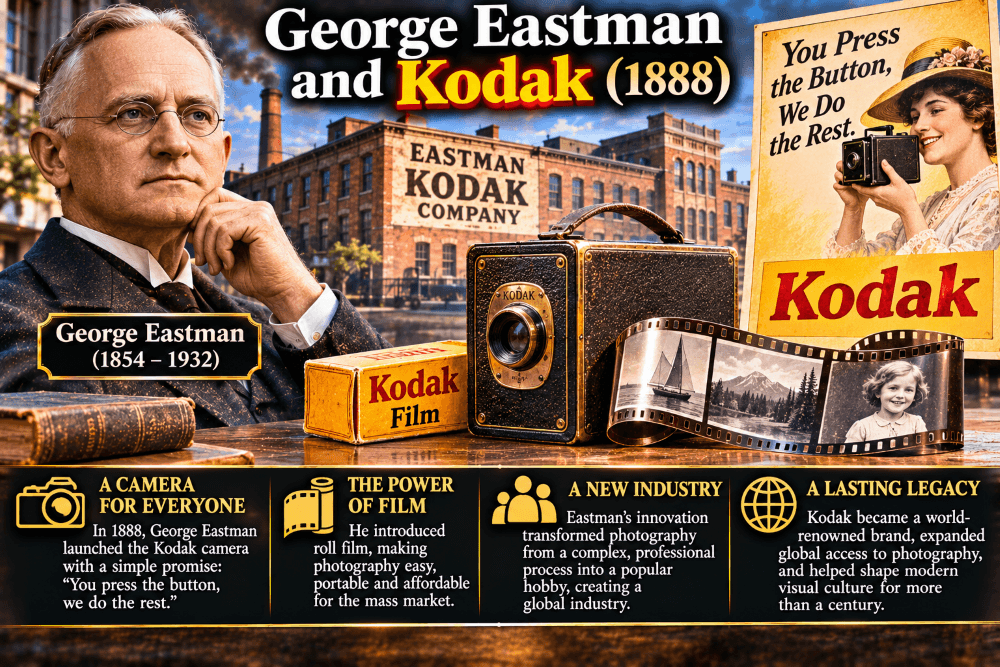
Before 1888, taking a photograph was a chore reserved for experts and serious hobbyists. George Eastman and Kodak changed that by turning photography into something anyone could do. By simplifying the process and building a business around film and processing, Eastman created a mass market and a business model that would be studied for generations. His company’s later fate also offers one of the most famous cautionary tales in modern business.
The Problem: Photography Was Hard
In the 1870s, the dominant photographic method was the wet-plate process.
- Photographers had to coat glass plates with chemicals just before shooting and develop them immediately.
- This meant carrying a portable darkroom, chemicals, and fragile glass plates.
- It required skill, time, and equipment, which kept photography out of reach for most people.
George Eastman, a bank clerk in Rochester, New York, and an amateur photographer, found the process frustrating. He decided to simplify it.
Eastman’s Early Innovations
Dry Plates
In the late 1870s, Eastman developed a method for making dry photographic plates, which could be prepared in advance and developed later.
- He invented a machine for coating the plates and patented it.
- In 1881, with the help of an investor, Henry Strong, he started a company to produce them.
- Dry plates made photography more convenient and opened the door to a larger market.
The Move to Roll Film
Eastman realized that glass plates were still a barrier.
- He worked on a flexible roll film, initially based on paper, that could be loaded into a camera and wound after each exposure.
- He developed holders and a system for using it.
- The goal was a system simple enough for everyday users.
The 1888 Kodak Camera
How It Worked
In 1888, Eastman introduced the first Kodak camera, a small box camera preloaded with a roll of film for about 100 exposures.
- The camera sold for about 25 dollars.
- After taking the pictures, the customer mailed the entire camera back to Rochester.
- The company developed the film, printed the photographs, loaded a new roll, and returned the camera for an additional fee.
“You Press the Button, We Do the Rest”
The slogan captured the product’s promise. The customer’s only job was to point and press a button. The complicated parts were handled by the company.
This service-based approach removed the technical barriers that had kept most people from photography.
Why “Kodak”?
Eastman invented the name himself. He liked the letter K and wanted a short, distinctive word that could not be easily mispronounced and did not mean anything in any language. The name became one of the most recognizable brands in the world.
A Business Model Built on Film
Eastman’s insight was that the real business was not just selling cameras but the ongoing sale of film and processing.
- Cameras were priced affordably, sometimes at low margins, to get them into customers’ hands.
- Film and developing services generated repeat revenue each time customers took pictures.
- This approach is often compared to the “razor and blades” model, where the main product is cheap and the refills are profitable.
The Brownie
In 1900, Kodak introduced the Brownie camera, priced at one dollar, with rolls of film costing about 15 cents.
- It was aimed at the mass market, including children.
- Its simplicity and low price made photography truly accessible.
- Kodak’s advertising, including the “Kodak Girl” campaign, promoted photography as a fun, everyday activity for families and travelers.
Film and the Movies
In 1889, Eastman introduced transparent flexible film made from celluloid, which was more durable and easier to use than paper-based film.
- This film became essential to the new motion picture industry.
- Inventors, including Thomas Edison’s team, used Eastman’s film in early motion picture experiments.
- Kodak became a key supplier to a growing entertainment business.
Eastman also faced patent disputes over film technology, including a claim tied to inventor Hannibal Goodwin, which later led to a large settlement.
Eastman as a Builder and Philanthropist
Eastman built Kodak into a large, research-driven company.
- He invested in laboratories and scientific research.
- He was known for generous philanthropy, supporting institutions such as the University of Rochester, MIT, and health and music programs.
- He died in 1932.
The Cautionary Ending
Kodak dominated photography for most of the 20th century. But its later history is a lesson in disruption.
- In 1975, a Kodak engineer, Steven Sasson, built one of the first digital cameras.
- The company was reluctant to fully embrace it, since film was the core of its profits.
- As digital photography spread, Kodak’s film business collapsed, and the company filed for bankruptcy protection in 2012.
The same business model that made Kodak so successful made it hard to pivot.
The Innovator’s Dilemma
Coined by Harvard Business School professor Clayton Christensen, this is the most famous concept explaining cases like Kodak.
- What it means: Successful, established companies often fail because they are too good at listening to their current customers and protecting their current profit margins.
- The trap: Kodak actually invented the digital camera. However, committing to the new technology meant cannibalizing their highly profitable existing cash cows (film rolls). Choosing to protect today’s profits blinded them to tomorrow’s market.
Lessons from George Eastman and Kodak
- Simplify the customer’s job. Removing complexity opened a huge new market.
- Own the recurring revenue. Film and processing produced steady income after the camera sale.
- Brand names matter. A short, memorable name and slogan built a global brand.
- Beware of your own success. Protecting a profitable core business can blind a company to disruption.
Frequently Asked Questions
What did George Eastman invent? Eastman developed dry photographic plates, flexible roll film, and the Kodak camera, and he built a company that made photography accessible to ordinary people.
How did the first Kodak camera work? It came preloaded with film for about 100 exposures, and after shooting, the customer mailed the camera to Rochester for the company to develop and print the photos and reload the camera.
What does “You press the button, we do the rest” mean? It was Kodak’s slogan, promising that customers only needed to take the pictures while the company handled the technical work of developing and printing.
Why did Kodak decline? Kodak invented an early digital camera in 1975 but was slow to shift away from its profitable film business, and it filed for bankruptcy protection in 2012 as digital photography took over.
Related Articles
- Coca-Cola: From Patent Medicine to Global Brand
- War of the Currents: Edison, Tesla and Westinghouse
- Standard Oil Trust: How a Legal Device Built a Monopoly
- Cecil Rhodes and De Beers: Building a Diamond Monopoly
- Krupp and Siemens: Steel, Electricity and Empire
- German Chemical Industry: The Birth of Corporate R&D
- Zaibatsu: Iwasaki Yataro and Meiji Japan’s Mitsubishi
About The History of Entrepreneurship
This article is part of The History of Entrepreneurship, an ongoing series exploring how entrepreneurs, civilizations, technologies, financial institutions, and business innovations gradually created the modern economy.
Leave a Reply