Introduction: Wall Street Stages a Powerful Comeback
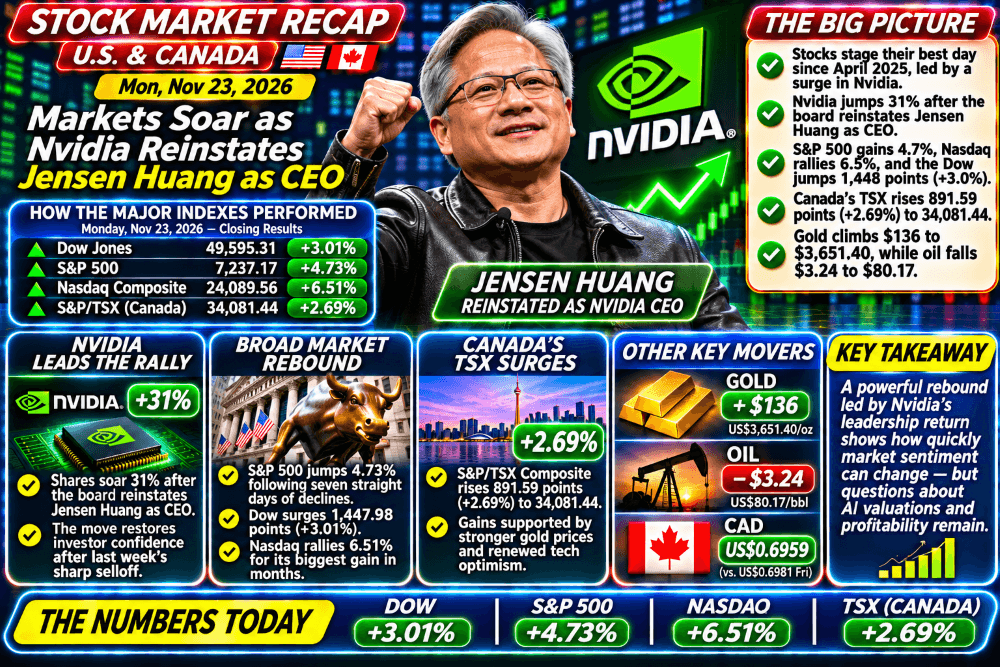
After one of the most difficult weeks for financial markets in years, U.S. and Canadian stocks staged a dramatic recovery on Monday, November 23, 2026.
The Dow Jones Industrial Average surged 1,447.98 points, or approximately 3.0%, closing at 49,595.31.
The S&P 500 gained 4.73%, while the Nasdaq Composite jumped 6.51%, leading the major indexes higher.
The rally marked the strongest day for U.S. stocks since April 2025, according to the supplied market reporting.
At the center of the rebound was Nvidia.
The artificial intelligence chipmaker reportedly reinstated its founder, Jensen Huang, as chief executive officer. Nvidia shares surged approximately 31% following the announcement.
Investors welcomed the return of leadership continuity after weeks of uncertainty surrounding the company and the broader AI industry.
Canada participated in the recovery.
The S&P/TSX Composite climbed 891.59 points, or 2.69%, closing at 34,081.44.
Gold prices also advanced sharply, while crude oil prices declined and the Canadian dollar weakened against the U.S. dollar.
Monday’s rebound offered welcome relief after the previous week’s selloff, but it did not eliminate concerns about AI valuations, rising financing costs, and future profitability.
The central question: Does Monday’s rally signal the beginning of a sustained recovery, or is it a temporary rebound in a market still struggling with fundamental uncertainties?
1. How the Major Stock Indexes Performed
U.S. & Canadian Stock Market Performance
Monday, November 23, 2026 | Daily Closing Results
+1,447.98 points
+326.78 points
+1,471.83 points
+891.59 points
| Index | Point change | Daily change | Closing value |
|---|---|---|---|
| Dow Jones Industrial Average | +1,447.98 | +3.01% | 49,595.31 |
| S&P 500 | +326.78 | +4.73% | 7,237.17 |
| Nasdaq Composite | +1,471.83 | +6.51% | 24,089.56 |
| S&P/TSX Composite | +891.59 | +2.69% | 34,081.44 |
The Nasdaq leads the recovery
Technology stocks experienced the strongest gains Monday.
The Nasdaq’s 6.51% increase reflected renewed enthusiasm for artificial intelligence companies and semiconductor manufacturers.
The S&P 500 also benefited from the rally, while the Dow recovered a portion of its previous week’s losses.
A major reversal in investor sentiment
Only days earlier, investors were selling technology stocks aggressively because of concerns about AI valuations and infrastructure spending.
Monday’s rally demonstrates how quickly financial-market sentiment can change.
However, a single strong trading session does not necessarily establish a sustained upward trend.
2. Nvidia Surges 31% Following Jensen Huang’s Reported Reinstatement
Nvidia was the biggest story on Wall Street Monday.
According to the supplied reporting, Nvidia’s board reinstated Jensen Huang as president, chief executive officer, and board director, effective immediately.
The company’s shares surged approximately 31% following the announcement.
The move came after a period of leadership uncertainty and substantial declines in Nvidia’s share price.
Why investors welcomed the announcement
Jensen Huang co-founded Nvidia in 1993 and has played a central role in transforming the company from a graphics-chip manufacturer into a leading supplier of artificial intelligence computing technology.
Under his leadership, Nvidia became one of the world’s most valuable companies.
Investors may associate Huang’s leadership with Nvidia’s technological strategy, product development, and relationships with major customers.
The reported decision to reinstate him was interpreted as a positive development for the company’s future.
A dramatic recovery after last week’s losses
Nvidia reportedly declined approximately 23% during the previous week.
Monday’s 31% increase therefore represented a substantial reversal.
A 31% gain following a 23% loss would leave a stock approximately 0.87% above its price before the decline, assuming those were the only two changes.
This illustrates why large percentage gains and losses must be evaluated carefully.
Does the leadership change solve Nvidia’s challenges?
Leadership continuity can improve investor confidence.
However, Nvidia still faces important business questions.
These include competition from other chipmakers, restrictions on semiconductor exports, and the long-term profitability of AI infrastructure spending.
The company’s financial performance will ultimately depend on demand for its products and its ability to maintain competitive advantages.
3. The AI Trade Rebounds After a Brutal Week
Monday’s rally was particularly strong among technology and artificial intelligence companies.
The rebound followed a difficult week during which investors questioned whether the enormous spending on AI infrastructure could generate adequate financial returns.
Why AI stocks are so influential
Companies associated with artificial intelligence account for a substantial portion of U.S. stock-market capitalization.
Nvidia and other large technology companies therefore have significant influence on major indexes.
When these stocks rise or fall sharply, they can move the broader market.
A recovery in confidence
The reported reinstatement of Nvidia’s CEO helped restore confidence in the AI sector.
Investors appeared more willing to purchase technology stocks following the previous week’s steep declines.
However, the underlying questions about AI profitability remain unresolved.
The difference between sentiment and fundamentals
Stock prices can change rapidly because of investor expectations.
Business fundamentals generally evolve more slowly.
A strong market rally may reflect improving confidence, but investors should also examine earnings, cash flow, capital spending, and valuations.
4. Anthropic Falls Despite the Technology Rally
Not every AI-related company participated in Monday’s rally.
According to the supplied report, Anthropic shares declined after experiencing volatile trading earlier in the session.
The company had recently completed a highly publicized initial public offering.
Why Anthropic moved differently
Anthropic develops advanced AI models, including Claude.
Its business differs from Nvidia’s because it focuses primarily on AI software and model development rather than supplying semiconductor hardware.
The company’s valuation depends on expectations for future revenue, profitability, and competition.
The challenge of a newly public company
Newly listed stocks can experience substantial volatility.
Investors are still determining how much the business is worth.
Early shareholders may also choose to realize profits following an IPO.
Anthropic’s weakness during a strong technology rally illustrates that companies within the same industry do not always move together.
5. Canada: TSX Gains Nearly 900 Points
Canada’s S&P/TSX Composite rose sharply Monday.
The index gained 891.59 points, or 2.69%, closing at 34,081.44.
The rebound followed a difficult week during which the TSX lost more than 2,900 points.
How much of last week’s decline has been recovered?
Canada’s TSX: Selloff and Rebound
November 13–23, 2026 | Daily Closing Values
The TSX recovered approximately 30.6% of the points lost during the previous week’s decline, but remained 5.61% below its November 13 close.
Why Canadian stocks rallied
The supplied report attributes Canada’s rebound to two important factors.
First, renewed enthusiasm for technology stocks improved investor sentiment across North American markets.
Second, higher gold prices supported Canadian mining companies.
Canada’s stock market has substantial exposure to mining and resource businesses, making commodity prices particularly important.
The recovery is encouraging, but incomplete
Monday’s gains reversed part of the previous week’s losses.
However, the TSX remained significantly below its level before the selloff.
Investors will be watching whether the rebound continues or whether renewed selling pressure emerges.
6. Gold Jumps $136 per Ounce
Gold futures rose sharply Monday.
The December gold contract gained US$136.00, closing at US$3,651.40 per ounce.
This represented a gain of approximately 3.87%.
Why gold prices matter for Canada
Canada is home to several major gold-mining companies.
When gold prices rise, investors may anticipate stronger revenue and profitability for producers.
This can support mining shares and contribute to gains in the TSX.
Gold and investor sentiment
Gold prices are influenced by interest rates, currency movements, inflation expectations, and demand for defensive assets.
Monday’s increase occurred alongside a substantial stock-market rally.
This illustrates that gold and equities do not always move in opposite directions.
7. Oil Falls $3.24 per Barrel
Oil prices moved in the opposite direction from stocks and gold.
The January crude oil contract declined US$3.24, closing at US$80.17 per barrel.
That represents a decline of approximately 3.88%.
Why oil prices matter for Canada
Energy companies represent an important portion of the Canadian stock market.
Lower oil prices can reduce revenue expectations for producers.
However, the relationship between oil prices and individual energy stocks also depends on production costs, financial strength, and company-specific factors.
What falling oil prices may indicate
Oil prices respond to global supply and demand.
A decline can reflect expectations for weaker economic growth, increased supply, or changes in geopolitical risk.
Without additional evidence, it is difficult to identify one specific cause for Monday’s decline.
8. Canadian Dollar Weakens Against the U.S. Dollar
The Canadian dollar declined Monday despite the rebound in Canadian equities.
It traded at approximately US$0.6959, compared with US$0.6981 Friday.
That represents a decline of approximately 0.32%.
Why the Canadian dollar matters
Currency movements influence the returns Canadian investors earn on foreign investments.
For example, an investor holding U.S.-dollar assets may benefit in Canadian-dollar terms when the Canadian dollar weakens.
Conversely, a stronger Canadian dollar can reduce the Canadian-dollar value of U.S. investments.
Currency diversification
Investors holding assets in multiple currencies should understand how exchange-rate movements affect their portfolios.
Currency fluctuations can either increase or reduce investment returns.
They are an additional consideration when comparing Canadian and U.S. investments.
9. The U.S. Thanksgiving Holiday Shortens the Trading Week
This week will be shorter than usual for U.S. investors.
U.S. stock markets will be closed Thursday, November 26, for Thanksgiving.
Trading will resume Friday, November 27, with an early close.
Why shortened trading weeks matter
Trading volume can be lower during holiday periods.
With fewer market participants, individual trades may have a greater influence on prices.
This can sometimes contribute to unusual price movements.
However, lower trading volume does not automatically mean higher volatility.
Earnings reports to watch
Hewlett Packard Enterprise and Zoom Communications were scheduled to report quarterly results Monday.
Investors will examine these results for information about corporate technology spending and business demand.
10. Why Monday’s Rally Does Not Eliminate the Risks
Despite Monday’s impressive gains, investors still face several important uncertainties.
AI valuations remain elevated
Some technology companies continue trading at valuations that assume substantial future growth.
If earnings fail to meet expectations, share prices may remain vulnerable.
AI infrastructure spending remains expensive
Developing and operating advanced AI systems requires substantial investment.
Companies must eventually generate enough revenue to justify these costs.
Interest rates influence valuations
Higher interest rates increase financing costs and can reduce the present value investors assign to future earnings.
This is particularly important for high-growth companies.
Economic growth remains uncertain
Slower economic growth could affect corporate earnings and investment spending.
Technology companies are not immune to broader economic conditions.
Regulatory uncertainty
Governments continue evaluating how artificial intelligence should be regulated.
Changes in export controls, competition policy, and AI regulation could affect business opportunities.
11. What Investors Should Watch Next
Nvidia and semiconductor stocks
Investors will watch whether Monday’s rally continues and whether Nvidia can maintain its recovery.
S&P 500 and Nasdaq momentum
A sustained recovery would require continued buying beyond a single trading session.
Interest-rate expectations
Changes in Federal Reserve expectations could influence technology valuations.
Gold and oil prices
Commodity movements will remain important for Canadian equities.
Thanksgiving trading conditions
Holiday-related changes in trading activity may affect market liquidity.
12. The Biggest Investment Lesson of November 23
Monday’s rally demonstrates how quickly financial markets can reverse direction.
Only days earlier, investors were selling technology stocks aggressively.
By Monday, buyers had returned, pushing major indexes sharply higher.
The danger of emotional investing
Sharp market declines can encourage investors to sell because they fear further losses.
However, market recoveries can begin unexpectedly.
Investors who sell after substantial declines may miss some of the strongest rebound days.
Why market timing is difficult
Predicting short-term stock-market movements is extremely challenging.
Even professional investors struggle to identify market turning points consistently.
A disciplined investment strategy generally focuses on financial objectives, risk management, and long-term fundamentals rather than attempting to anticipate every market movement.
The importance of perspective
A 6.5% Nasdaq rally is significant.
However, it must be evaluated in the context of the previous week’s losses.
Large percentage gains following steep declines do not necessarily restore an investment to its previous value.
Why diversification matters
Investors who concentrate their portfolios in a small number of technology companies may experience substantial volatility.
Diversification across industries, countries, and asset classes can reduce dependence on any single investment theme.
However, diversification cannot eliminate market risk.
The lesson: A powerful market rebound is encouraging, but one strong day does not establish a new long-term trend.
Conclusion: Nvidia Ignites a Rally, but Questions Remain
Monday, November 23, 2026, delivered a dramatic rebound for U.S. and Canadian financial markets.
The Dow surged nearly 1,448 points, the S&P 500 gained 4.73%, and the Nasdaq rallied 6.51%.
Canada’s TSX advanced 891.59 points.
Nvidia reportedly surged 31% following the reinstatement of Jensen Huang as chief executive.
Gold prices also rose sharply, while crude oil declined and the Canadian dollar weakened.
The recovery offered welcome relief following a difficult week for investors.
However, concerns about AI valuations, infrastructure spending, interest rates, and economic growth remain unresolved.
The key takeaway: Financial markets can rebound quickly after sharp declines, but sustainable investment returns ultimately depend on corporate profitability, reasonable valuations, and disciplined long-term investing.
Other Stock Market blog posts
Leave a Reply