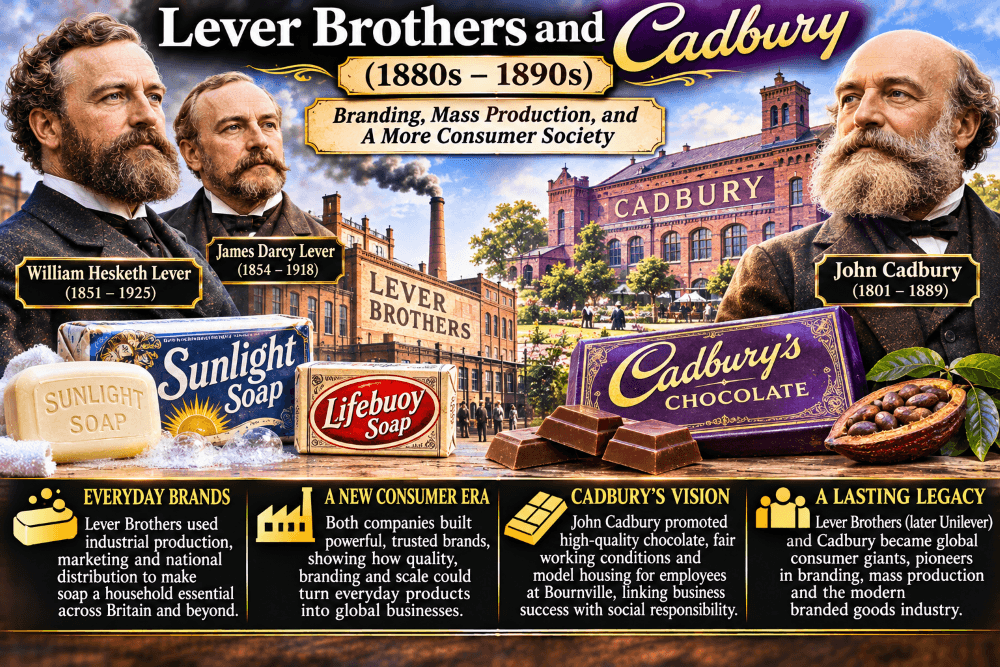
In the 1880s and 1890s, two British family firms set out to prove that a company could sell everyday goods, treat its workers well, and still make a profit. Lever Brothers and Cadbury both built strong consumer brands and, remarkably, entire villages for their employees. Their story captures the idealism and the contradictions of Victorian business, where genuine social concern and corporate control often went hand in hand.
The Setting: Victorian Britain’s Consumer Boom
Britain’s industrial cities were crowded, smoky, and unhealthy, and everyday consumer goods were often poor in quality.
- Soap was commonly sold in large blocks that grocers cut up, with varying quality.
- Cocoa and other foods were frequently adulterated with cheaper substances.
- Many workers lived in cramped, unsanitary housing.
These problems created opportunities for entrepreneurs who could offer clean, reliable, branded products, and who believed in doing so with a social conscience.
Lever Brothers: Selling Cleanliness
Sunlight Soap
William Hesketh Lever and his brother James came from a family of grocers in Lancashire. William saw that soap could be marketed in a new way.
- In 1884, they launched Sunlight Soap, and in 1885 the company Lever Brothers began operations.
- Instead of selling soap in anonymous blocks, they sold wrapped, branded bars of consistent quality.
- Their soap used vegetable oils, such as palm oil, rather than animal fat, which gave it a milder quality.
Marketing Hygiene
Lever invested heavily in advertising.
- Ads linked cleanliness with health, respectability, and home life.
- The brand name and packaging made the product easy to recognize.
- Sales grew rapidly as soap became a daily household item.
The approach echoes the branding and advertising innovations discussed elsewhere in this series, from Wedgwood to early patent medicines.
Port Sunlight
As the business grew, Lever built a new factory on the Wirral peninsula near Liverpool, beginning in 1888, and a village for the workers alongside it.
- Port Sunlight offered houses with gardens, along with schools, a hospital, a church, recreation facilities, and later an art gallery.
- Lever believed that decent housing and surroundings would produce healthier, more loyal workers.
- He also experimented with profit-sharing ideas.
Cadbury: Pure Chocolate and Quaker Values
From Tea Shop to Cocoa Essence
Cadbury began in Birmingham in 1824, when John Cadbury opened a shop selling tea, coffee, and drinking chocolate. His sons George and Richard took over in the 1860s when the business was struggling.
- In 1866, Cadbury introduced Cocoa Essence, made using a press that removed excess cocoa butter and produced a purer product.
- The firm advertised it as pure, in contrast with adulterated competitors.
- Purity and quality became core to the brand.
Bournville
In 1879, Cadbury moved production to a new site outside Birmingham, which became Bournville.
- The setting was green and spacious compared with the crowded city.
- From the mid-1890s, George Cadbury developed a model village nearby with quality housing.
- In 1900, he set up the Bournville Village Trust, and the village was open to people from different backgrounds, not only Cadbury employees.
Values at Work
The Cadbury family were Quakers, and their religious beliefs shaped their business.
- They emphasized temperance, education, and the welfare of employees.
- They provided benefits such as medical care, recreation facilities, and a shorter working week for the time.
- Later, they introduced Cadbury’s milk chocolate, a major commercial success.
Two Models of Enlightened Business
Both firms are often described as examples of paternalism, in which employers take responsibility for workers’ well-being.
- Lever: Combined strong marketing with a self-directed village and profit-sharing ideas.
- Cadbury: Emphasized Quaker principles and a village trust designed to be more open.
They echoed earlier experiments like Robert Owen’s at New Lanark, and parallel efforts seen with companies such as Krupp in Germany.
The Limits and the Costs
Control and Conditions
Paternalism had a downside.
- Village life could involve rules and expectations about behavior.
- Benefits tied employees closely to the company, which could limit independence.
- Critics argued that welfare programs were partly a way to keep workers loyal and discourage unions.
Colonial Supply Chains
The raw materials for these goods came from distant colonies, often under harsh conditions.
- Lever’s pursuit of palm oil led to plantations in Africa and the Pacific, including in the Belgian Congo, where forced labor was widely reported.
- Cadbury was criticized for purchasing cocoa from plantations in São Tomé that used coerced labor, and the company acted only after public pressure, eventually boycotting that source in 1909.
These stories show that good treatment at home did not always extend to workers overseas.
Legacy
- Lever Brothers merged with a Dutch margarine company in 1929 to form Unilever, one of the world’s largest consumer goods firms.
- William Lever became Lord Leverhulme.
- Cadbury remained an iconic British brand until Kraft acquired it in 2010.
- Port Sunlight and Bournville remain visited and lived-in communities.
Lessons from Lever Brothers and Cadbury
- Branding and quality build trust. Packaged, consistent products replaced unbranded goods.
- Values can shape business. Quaker principles guided Cadbury’s approach.
- Welfare can be both generous and strategic. Village life improved conditions and also served company interests.
- Look at the whole supply chain. Ethics at home can be undermined by exploitation abroad.
Frequently Asked Questions
What was Sunlight Soap? Sunlight Soap was the branded soap launched by Lever Brothers in 1884, sold in wrapped bars of consistent quality and promoted through heavy advertising.
What is Port Sunlight? Port Sunlight is the model village built by Lever Brothers near Liverpool from 1888 to house workers, with amenities such as schools, a hospital, and recreation.
What is Bournville? Bournville is the factory site and model village developed by the Cadbury family near Birmingham, known for quality housing and Quaker-influenced welfare.
Why were these companies criticized? Critics noted that paternalism could limit workers’ independence, and that both companies sourced raw materials from colonial plantations where coerced labor was reported.
Related Articles
- George Eastman and Kodak: Making Photography Simple
- Coca-Cola: From Patent Medicine to Global Brand
- War of the Currents: Edison, Tesla and Westinghouse
- Standard Oil Trust: How a Legal Device Built a Monopoly
- Cecil Rhodes and De Beers: Building a Diamond Monopoly
- Krupp and Siemens: Steel, Electricity and Empire
- German Chemical Industry: The Birth of Corporate R&D
About The History of Entrepreneurship
This article is part of The History of Entrepreneurship, an ongoing series exploring how entrepreneurs, civilizations, technologies, financial institutions, and business innovations gradually created the modern economy.
Leave a Reply