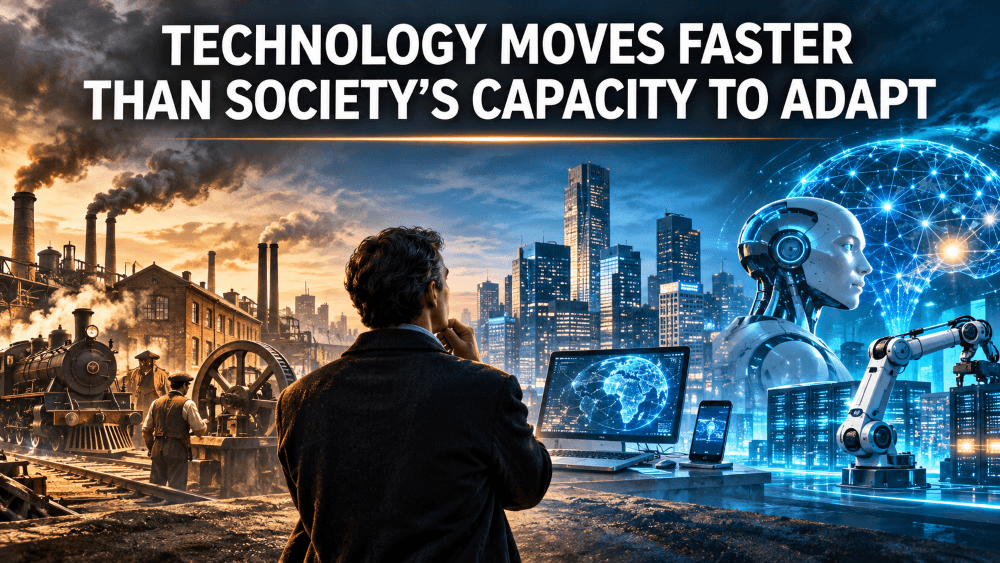
From the Industrial Revolution to artificial intelligence, humanity has become extraordinarily good at inventing new technologies. But have we become equally good at living with them?
Imagine someone born in 1800 suddenly transported to the year 1900.
They would discover railroads, electric lights, telephones, factories, and cities transformed by industrialization. The world they knew would be almost unrecognizable.
Now imagine someone from the year 2000 arriving in 2026. They would find smartphones, social media, artificial intelligence, and computers capable of performing tasks once considered exclusively human.
The difference is that transformations that once unfolded over generations can now spread around the world in a matter of years.
Technological progress is accelerating, but our institutions, cultural norms, and human psychology are struggling to keep pace.
This tension may be one of the defining challenges of the twenty-first century.
Technological Progress Has Always Changed Society
Henry Adams, a historian born in 1838, lived through an extraordinary period of technological transformation. During his lifetime, humanity moved from a world largely powered by human muscles, animals, wind, and water toward one increasingly powered by steam and electricity.
Adams noticed something remarkable: technological change wasn’t simply continuing. It appeared to be accelerating.
He tried to illustrate this acceleration by examining the amount of physical power humanity could command.
For thousands of years, improvements were relatively gradual. Then came the Industrial Revolution, and the curve began climbing dramatically.
Adams speculated that this acceleration could eventually reach a point where the future would become almost impossible to imagine using the experiences of the past.
Today, some futurists describe such a hypothetical transformation as a technological singularity.
Whether or not such a singularity ever occurs, Adams identified something important: our capacity to invent may be growing faster than our capacity to adjust.
The Industrial Revolution: Progress Came at a Price
The Industrial Revolution offers perhaps the clearest historical example of this problem.
Beginning in eighteenth-century Britain, inventions such as the steam engine, mechanized spinning machines, and improved manufacturing techniques dramatically increased productivity.
Entrepreneurs built factories, expanded trade, and created entirely new industries.
James Watt improved the steam engine, while his business partner Matthew Boulton helped commercialize it. Richard Arkwright developed factory-based textile production that transformed the economics of manufacturing.
These innovations eventually contributed to enormous improvements in living standards.
But the transition was anything but painless.
Millions of people moved from rural communities into rapidly growing industrial cities. Traditional occupations disappeared or changed dramatically.
Factory workers often endured dangerous conditions, exhausting schedules, and low wages. Children worked in mines and mills. Pollution contaminated industrial neighborhoods.
Society had not yet developed the regulations, educational systems, public infrastructure, and labor protections necessary for an industrial economy.
The machines arrived before the institutions needed to manage their consequences.
Over time, governments and communities responded through public education, sanitation, labor legislation, and other reforms.
The Industrial Revolution eventually helped create a wealthier world, but the benefits were unevenly distributed, and many people suffered during the transition.
This is an important historical lesson: technological progress can improve humanity’s long-term prospects while creating serious short-term hardships.
Artificial Intelligence Is Our New Industrial Revolution
Today, artificial intelligence may be creating a comparable transformation.
But there is an important difference.
The Industrial Revolution primarily expanded humanity’s physical capabilities. Machines could lift heavier objects, manufacture products faster, and transport goods over longer distances.
Artificial intelligence expands our ability to perform cognitive tasks.
AI systems can write software, analyze information, translate languages, generate images, assist scientific research, and produce written content.
Tasks that previously required years of specialized training can sometimes be completed with a few instructions.
For entrepreneurs, this is an extraordinary opportunity.
A small business owner can use AI to create marketing materials, improve customer service, analyze competitors, and automate administrative tasks.
An individual entrepreneur can now access capabilities that once required an entire team.
Yet these same technologies create uncertainty.
What happens to workers whose skills become less valuable? How should schools teach students when AI can complete many assignments? How can we distinguish authentic information from convincing fabrications?
And who should be responsible when an AI system makes a costly mistake?
We are developing powerful technologies faster than we can establish widely accepted answers to these questions.
Why Society Struggles to Adapt to Technological Progress
Inventing a better tool is often easier than reorganizing society around that tool.
Consider the smartphone.
The modern smartphone became mainstream remarkably quickly. Within a relatively short period, it transformed communication, navigation, shopping, entertainment, dating, and work.
But our social customs have struggled to catch up.
Is it acceptable to check your phone during dinner? Should employers expect workers to answer messages outside business hours? At what age should children have unrestricted access to social media?
We still disagree about these questions, even after years of living with smartphones.
The problem is that technology and society operate on different timelines.
Technology can advance through experimentation, investment, and competition.
Social change requires something more complicated: trust, negotiation, education, legislation, and cultural acceptance.
A company can release a new product overnight. A society cannot establish new norms overnight.
Three Reasons Adaptation Takes Longer
- Institutions change slowly. Schools, governments, and legal systems operate through established procedures that can take years to reform.
- People depend on existing arrangements. Workers build careers, businesses make investments, and families organize their lives around technologies and economic structures that already exist.
- Social agreement is difficult. People disagree about what constitutes progress, which risks are acceptable, and who should bear the costs of change.
These difficulties are not necessarily signs of failure. They reflect the complexity of coordinating millions of human beings with different interests and values.
Entrepreneurs Accelerate Change—and Help Society Adapt
Entrepreneurs occupy a particularly interesting position in this story.
They are among the principal drivers of technological progress.
Entrepreneurs identify opportunities, experiment with new business models, and introduce innovations that challenge established industries.
Consider Henry Ford.
Ford did not invent the automobile, but his innovations in mass production helped make cars affordable to a much larger population.
The automobile created enormous economic opportunities in manufacturing, construction, tourism, and transportation.
But it also forced society to redesign cities, build highways, establish traffic regulations, and rethink how people lived and worked.
Similarly, the internet enabled companies such as Amazon and Google to transform commerce and information.
Today, AI entrepreneurs are introducing another wave of disruption.
However, entrepreneurship is not simply about replacing old technologies with new ones.
Some of the most valuable business opportunities emerge from helping people adapt.
New industries develop around education, cybersecurity, professional training, compliance, and technological integration.
For example, as AI becomes more common, businesses may need specialists who can help employees use it effectively, protect sensitive information, and verify automated decisions.
The entrepreneurs who succeed may not be those who invent the most powerful technology, but those who make powerful technology useful, trustworthy, and accessible.
The Hidden Cost of Constant Innovation
Economic statistics can tell us how much productivity has increased, how many businesses have been created, or how much wealth has been generated.
But they cannot fully capture the psychological experience of living through constant disruption.
People need more than material prosperity.
We also need stability, belonging, purpose, and a sense that our skills and contributions matter.
A factory worker displaced by automation may eventually find another job. But that does not erase the emotional and financial difficulties of losing a career.
A professional who spent decades developing expertise may feel threatened when an AI system performs similar tasks in seconds.
Even people who benefit economically from innovation can feel overwhelmed by the constant pressure to learn new tools and adjust to new expectations.
This helps explain why technological optimism and social anxiety can coexist.
A society can become richer while some of its members feel less secure.
Can We Slow Down Technological Progress?
One possible response is to restrict innovation.
Governments can regulate technologies, establish safety standards, and sometimes prohibit particularly dangerous applications.
Such measures can be justified, especially when technologies create serious risks for public safety, privacy, or democratic institutions.
But completely stopping technological progress is unlikely to be practical.
If one country restricts AI development, others may continue advancing. Businesses and governments face powerful incentives to remain competitive.
Human curiosity also plays a role.
Throughout history, people have continually experimented, invented, traded, and searched for better ways of doing things.
Rather than choosing between unrestricted innovation and technological stagnation, we need a more thoughtful approach.
We should encourage experimentation while building institutions capable of responding to its consequences.
That means investing in education, supporting workers through economic transitions, protecting individual rights, and updating regulations when necessary.
It also means recognizing that not every technological possibility represents an improvement in human well-being.
Examples from history when nations slowed down progress
One possible response to rapid technological change is to restrict innovation or isolate ourselves from its consequences.
But history provides some powerful warnings about the dangers of falling behind.
China and the Opium Wars: The Cost of Falling Behind
For centuries, China was one of the world’s most advanced civilizations, responsible for innovations such as gunpowder, printing, paper, and the compass.
However, during the Qing dynasty, China maintained strict controls over foreign trade and was relatively slow to adopt some of the military technologies developed during Europe’s Industrial Revolution.
By the nineteenth century, this technological gap had become dangerous.
During the First Opium War (1839–1842), Britain deployed modern warships, including armed steamships, against Chinese forces equipped with older weapons and less capable naval vessels.
Despite China’s enormous population and long military history, British forces achieved a decisive victory.
The resulting Treaty of Nanjing forced China to open additional ports to foreign trade and surrender Hong Kong to Britain.
The war also demonstrated the destructive potential of industrial technology when used by imperial powers. Britain’s military intervention served commercial interests connected to the deeply harmful opium trade.
China’s defeat was not simply the consequence of rejecting technology. Military organization, political decisions, financial weaknesses, and imperial aggression also played important roles.
Nevertheless, the conflict demonstrated how dangerous a widening technological gap could become.
Japan and the Black Ships: A Different Response
Japan provides another fascinating example, but with a very different outcome.
Beginning in the seventeenth century, the Tokugawa shogunate imposed strict limitations on foreign contact and trade, although some exchange continued through Dutch and Chinese merchants.
For more than two centuries, Japan remained relatively insulated from many developments taking place in Europe.
Then, in 1853, American Commodore Matthew Perry arrived in Japan with a squadron of warships, including steam-powered vessels.
The Japanese authorities quickly recognized that their military capabilities were insufficient to resist a major confrontation with Western naval powers.
Rather than fight a war they were poorly positioned to win, Japan agreed to the Convention of Kanagawa in 1854, opening two ports to American vessels.
The encounter helped expose the limitations of Japan’s isolationist policies and contributed to a period of political upheaval.
Following the Meiji Restoration of 1868, Japan embarked on an ambitious modernization program.
It invested in railroads, factories, modern education, industrial production, and military technology.
Within a few decades, Japan had transformed itself into a major industrial and military power.
Unlike China, which struggled through repeated foreign interventions and internal crises, Japan managed to adopt foreign technologies while preserving its political independence.
Its modernization was not without serious consequences, however. Japan would eventually use its growing military strength to pursue imperial expansion of its own.
What China and Japan Teach Us About Artificial Intelligence
These historical examples illustrate an important principle: a country can attempt to limit technological change within its borders, but it cannot prevent technological advances elsewhere.
China and Japan did not simply reject all innovation. Both possessed sophisticated economies and technological traditions.
But when industrialized foreign powers arrived with superior military capabilities, their governments faced pressures they could no longer ignore.
Today, artificial intelligence presents a different kind of challenge.
If one country decides to halt AI development while others (China) continue investing in it, the country that stops may eventually find itself at an economic, scientific, or military disadvantage.
That does not mean governments should abandon regulation, but countries should not regulate themselves into extition, like Europe is doing.
On the contrary, responsible oversight may be essential to preventing dangerous applications and protecting citizens.
But there is a difference between managing technological progress and pretending that it can be permanently stopped.
History suggests that the more practical strategy is to understand emerging technologies, adapt our institutions, and prepare society for their consequences.
The greatest danger may not be technological progress itself, but allowing the world to change while refusing to change with it.
How Can We Prepare for a Faster-Changing Future?
We cannot predict exactly how artificial intelligence will reshape the economy.
But history suggests several principles worth considering.
First, education should emphasize adaptability rather than preparing students for a single occupation. Critical thinking, communication, creativity, and the ability to learn remain valuable even as specific tools change.
Second, governments should make it easier for people to move between occupations. Accessible training and effective transition support can reduce the human costs of disruption.
Third, entrepreneurs should consider the social consequences of their innovations. Building a profitable business and creating long-term value for society need not be opposing objectives.
Finally, individuals should resist both technological panic and blind optimism.
History gives us reasons for hope, but not guarantees.
Conclusion: Progress Is More Than Better Technology
The Industrial Revolution transformed the physical world. The digital revolution transformed how we communicate and access information. Artificial intelligence may transform how we think, create, and work.
Each technological revolution has expanded human possibilities while introducing new challenges.
The central problem is not that technological progress is inherently good or bad.
It is that our inventions often advance faster than our ability to understand their consequences.
Progress has never been a smooth journey toward a perfect society.
Human beings are extraordinarily inventive, but we are also imperfect, emotional, and deeply attached to familiar ways of life.
Perhaps the greatest challenge of the coming decades will not be developing more intelligent machines.
It will be developing the wisdom, institutions, and social habits necessary to live alongside them.
The future will depend not only on what technology allows us to do, but on what we decide is worth doing.
Frequently Asked Questions
1. Why is technological progress accelerating?
Technological progress can accelerate because new inventions build on previous discoveries. Computing power, global communication, scientific collaboration, and investment make it possible to develop and distribute innovations more rapidly, although the pace varies across industries.
2. How did the Industrial Revolution change society?
The Industrial Revolution transformed manufacturing, transportation, employment, and urban life. It contributed to long-term economic growth but also created difficult working conditions, displacement, and social problems that required institutional reforms.
3. Will artificial intelligence replace human workers?
AI is likely to automate some tasks, transform many occupations, and create new kinds of work. The overall effect on employment will depend on how businesses adopt AI, whether new opportunities emerge, and how effectively workers can adapt.
4. How can society adapt to rapid technological change?
Society can adapt through better education, lifelong learning, flexible institutions, thoughtful regulation, and support for people affected by economic disruption. The goal should be to capture the benefits of innovation while reducing unnecessary harm.
Leave a Reply