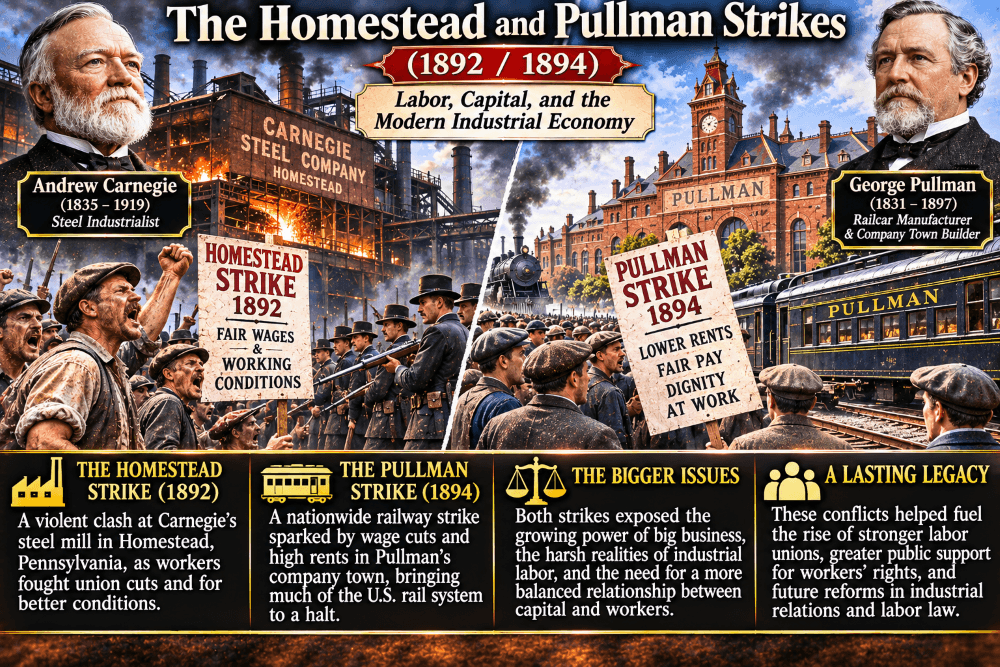
The great fortunes of the Gilded Age were built on a workforce that endured long hours, dangerous conditions, and wages that could be cut at will. On the other hand, employees were always free to quit if they found the contiditions so unbearable. In the early 1890s, workers pushed back in two of the most dramatic labor conflicts in American history. The Homestead and Pullman Strikes of 1892 and 1894 pitted unions against two of the era’s most famous industrialists, and the outcomes shaped relations between business, labor, and government for decades.
The Context: Scale and Conflict
As companies grew larger, the relationship between employers and workers changed.
- Giant firms like Carnegie Steel employed thousands of workers, and owners often lived far from the factory floor.
- Mechanization reduced the power of skilled workers and made labor more interchangeable.
- Workers formed unions to bargain collectively, but employers often resisted, and the law frequently favored management.
- Economic downturns, such as the Panic of 1893 covered in our earlier discussion of railway bond bubbles, increased pressure to cut costs.
These tensions exploded at Homestead and Pullman.
The Homestead Strike (1892)
The Setting
The Homestead Works, a major steel plant near Pittsburgh, belonged to Carnegie Steel.
- Its skilled workers belonged to the Amalgamated Association of Iron and Steel Workers.
- Wages were tied to a sliding scale linked to the price of steel. This is a contidition that every employee knew when they started working for the company.
- Andrew Carnegie, the company’s owner, was in Scotland during the dispute, while Henry Clay Frick, the company chairman, handled negotiations.
The Lockout
In 1892, as the union contract was expiring, Frick sought wage cuts and a new contract that would weaken the union.
- Negotiations failed, and the company locked workers out of the plant. A company has all the right to lock out employees. This is totally legal.
- Frick had a high fence topped with barbed wire built around the works.
- He arranged for a private force of Pinkerton agents to be brought in to protect the plant and allow replacement workers to enter. There were always people willing to work for the company.
The Battle
On July 6, 1892, roughly 300 Pinkerton agents arrived by barge on the Monongahela River.
- Workers and townspeople gathered on the shore, and a gun battle erupted.
- Around ten people were killed, including both workers and Pinkertons.
- The Pinkertons surrendered and were roughed up as they were escorted away.
The Aftermath
The state responded with force.
- Pennsylvania’s governor sent thousands of National Guard troops, who took control of the town and allowed the plant to reopen with replacement workers, as the company is legally allwed to do.
- A few weeks later, an anarchist named Alexander Berkman, who was not part of the union, shot and stabbed Frick, who survived. The attack turned public opinion against the strikers.
- The strike collapsed by the fall, and the union was crushed at Homestead. Work conditions, including long shifts, worsened in the following years, but eventually the conditions improved, and more people wanted to work at the steel plant.
The Pullman Strike (1894)
A Model Company Town
George Pullman made his fortune with the Pullman sleeping car and built a large company town south of Chicago.
- Pullman, Illinois, offered orderly housing, shops, a library, and a theater.
- The company owned everything and set rents and prices.
- It was admired by some as a model, and criticized by others as a form of control.
Wage Cuts, Same Rents
When the Panic of 1893 reduced demand for his cars, Pullman cut wages sharply but did not lower rents in the company town.
- Workers faced deep hardship, with little left after paying rent.
- Efforts to negotiate failed, and a workers’ committee was reportedly fired.
- In May 1894, workers walked out. This is as it should be done. If a worker doen’t like the work, he/she can always walk out.
The Boycott Spreads
The American Railway Union, led by Eugene V. Debs, backed the strikers.
- In June 1894, the union launched a boycott, refusing to handle trains with Pullman cars.
- The action spread across the country, involving a large number of railroad workers, estimated at roughly 250,000.
- Railroads organized together to resist the boycott.
Government Intervention
The federal government sided with the railroads.
- Attorney General Richard Olney obtained a court injunction against the strike, citing interference with the mail and interstate commerce.
- President Grover Cleveland sent federal troops to Chicago, over the objection of Illinois Governor John Peter Altgeld.
- Violence and unrest followed, with roughly 30 deaths reported.
- Debs was arrested and jailed for violating the injunction, and the Supreme Court upheld the action in 1895.
The strike was broken, and the union collapsed, and justice prevailled.
Two Perspectives
Historians generally describe the conflicts as complex.
- Management’s view: Companies faced falling prices, intense competition, and economic crisis. Owners argued they had the right to set wages and run their businesses, and that unions interfered with property and the flow of commerce.
- Workers’ view: Wage cuts, long hours, unsafe conditions, and company control left workers vulnerable. Unions were the only way to gain a voice. Workers can always express their voice, but if they don’t like their job, their option is to walk out, not sabotage the company.
Both episodes showed the clash between property rights and the right to organize. Workers have the right to organize, but not the right to sabotage the company. Also, if they walk out, the company has the right to employ someone else who would be happy to work there.
The Impact
- Injunctions: Courts used injunctions, in part under antitrust law, as a tool against strikes, a use that surprised many who had seen the Sherman Act as aimed at corporate monopolies, as discussed in our chapter on antitrust.
- Labor Day: Congress and President Cleveland made Labor Day a national holiday in 1894, shortly after the Pullman unrest, in part as a gesture to workers.
- Company towns: In 1898, the Illinois Supreme Court ordered the Pullman Company to sell off the town’s non-industrial property.
- Debs: He was radicalized by the experience and became a leading American socialist.
- Later reforms: Over the following decades, labor protections grew, culminating in the National Labor Relations Act of 1935.
Lessons from the Homestead and Pullman Strikes
- Labor relations are a business issue. Cost-cutting without regard for workers can trigger costly conflict.
- Paternalism without voice fails. Pullman’s model town gave workers amenities but no say.
- Reputation lasts. Carnegie’s philanthropy, discussed earlier, remains shadowed by Homestead.
- Law and power matter. Courts and governments played decisive roles in shaping outcomes.
Frequently Asked Questions
What was the Homestead Strike? It was a 1892 labor conflict at Carnegie Steel’s Homestead Works in Pennsylvania, in which a lockout led to a deadly clash with Pinkerton guards and the eventual defeat of the union.
What caused the Pullman Strike? Pullman cut wages during the Panic of 1893 without lowering rents in its company town, leading workers to strike and the American Railway Union to launch a nationwide boycott.
Who was Eugene Debs? Debs was the leader of the American Railway Union who was jailed after the Pullman Strike and later became a prominent socialist and presidential candidate.
Why were these strikes significant? They showed the power of employers and the state against unions, led to the use of injunctions against strikes, and helped set the stage for later labor reforms.
Related Articles
- F.W. Woolworth and the A&P: Birth of the Chain Store
- Gospel of Wealth: Carnegie and Modern Philanthropy
- Sherman Antitrust Act: Rise of Trust-Busting in America
- Lever Brothers and Cadbury: Model Villages and Brands
- George Eastman and Kodak: Making Photography Simple
- Coca-Cola: From Patent Medicine to Global Brand
- War of the Currents: Edison, Tesla and Westinghouse
About The History of Entrepreneurship
This article is part of The History of Entrepreneurship, an ongoing series exploring how entrepreneurs, civilizations, technologies, financial institutions, and business innovations gradually created the modern economy.
Leave a Reply