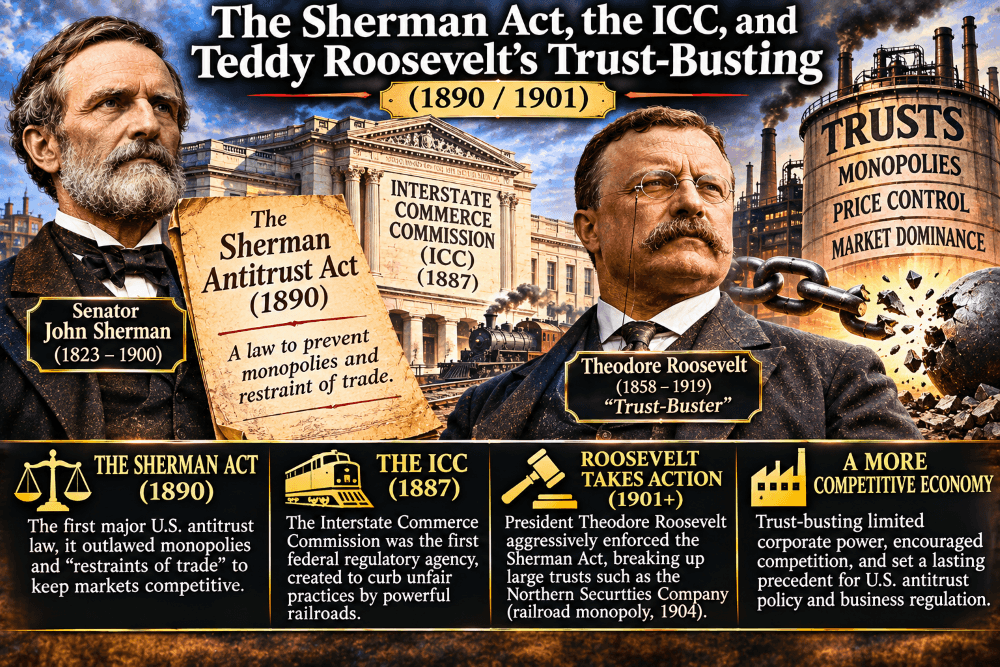
By the late 19th century, American business had grown so large that the law struggled to keep up. Giant trusts controlled oil, sugar, railroads, and more, and ordinary people worried about prices, power, and fairness. The Sherman Antitrust Act of 1890, along with the Interstate Commerce Commission and Theodore Roosevelt’s aggressive use of the law, marked the moment when government began to push back, and the era of federal business regulation began.
The Problem: Giants Without Guardrails
The Gilded Age produced enormous companies, as seen in earlier chapters on Standard Oil and the Erie War.
- Trusts and holding companies allowed businesses to consolidate across state lines.
- Railroads, essential to commerce, often charged different customers different prices and gave secret rebates to favored shippers.
- Farmers, small businesses, and consumers felt squeezed and organized for reform.
The existing legal system was mostly state-based, and it was poorly equipped to regulate national companies.
The Interstate Commerce Act and the ICC (1887)
The First Federal Regulatory Agency
Railroads were the first industry targeted for federal oversight.
- In 1886, the Supreme Court ruled in the Wabash case that states could not regulate rates on interstate rail shipments, creating a gap that only federal action could fill.
- In 1887, Congress passed the Interstate Commerce Act, creating the Interstate Commerce Commission (ICC).
- It was the first federal regulatory agency of its kind.
What It Aimed to Do
The law targeted common abuses.
- Unreasonable or discriminatory rates.
- Secret rebates to favored customers.
- Practices that favored some shippers over others.
Weak at First
The early ICC had limited power. It often lacked the authority to set rates directly, and courts frequently narrowed its decisions. It took later laws, including the Elkins Act of 1903 and the Hepburn Act of 1906, to strengthen it.
The Sherman Antitrust Act (1890)
What It Said
Named after Senator John Sherman, the Sherman Antitrust Act was the first federal law aimed at restraining monopolies and anticompetitive combinations.
- Section 1: Prohibited contracts, combinations, and conspiracies in restraint of trade.
- Section 2: Prohibited monopolization or attempts to monopolize.
- It passed with overwhelming support, reflecting broad public anger.
Early Enforcement Problems
The law’s early record was disappointing.
- The language was broad and vague, leaving enforcement to the courts.
- In the 1895 case United States v. E.C. Knight Co., the Supreme Court narrowly interpreted the law, allowing a dominant sugar company to stand, on the grounds that manufacturing was not interstate commerce.
- The act was sometimes used against labor unions, which many reformers saw as ironic.
For a decade, trusts continued to grow, and a major merger wave reshaped industries, including the formation of United States Steel in 1901.
Theodore Roosevelt Takes On the Trusts
A New President
Theodore Roosevelt became president in 1901 after President McKinley’s assassination. He believed the federal government should oversee large corporations in the public interest.
Northern Securities
His first major antitrust action targeted the Northern Securities Company.
- It was a holding company created by J.P. Morgan and other financiers to control major railroads in the Northwest.
- In 1902, Roosevelt’s administration sued to break it up.
- In 1904, the Supreme Court ruled against the company, and it was dissolved.
According to a widely told story, J.P. Morgan went to Roosevelt and suggested they settle the matter privately, and Roosevelt refused. The episode signaled that even the most powerful financier could be challenged by the government.
“Good” Trusts and “Bad” Trusts
Roosevelt is remembered as a trust-buster, but his approach was more nuanced.
- He distinguished between large companies that behaved responsibly and those that abused their power.
- He favored regulation and oversight rather than breaking up every large firm.
- In 1903, he created the Bureau of Corporations to investigate corporate practices.
Other Cases and Reforms
His administration pursued a number of cases and reforms.
- Suits against the meatpacking industry, including Swift and Company, discussed earlier in this series.
- A suit against Standard Oil, filed in 1906, leading to the 1911 breakup.
- Strengthening railroad regulation through the Elkins Act and the Hepburn Act.
- Meat inspection and food safety laws in 1906, following public outrage over conditions in the industry.
He also helped settle the 1902 coal strike through mediation, part of what he called a “Square Deal” for both labor and business.
The Rule of Reason
In 1911, the Supreme Court ordered the breakup of Standard Oil and the American Tobacco Company, but it also introduced the “rule of reason.”
- Under this approach, only “unreasonable” restraints of trade were illegal.
- This gave courts flexibility, and also uncertainty for businesses.
In 1914, Congress passed the Clayton Act and created the Federal Trade Commission to provide clearer rules and a dedicated agency.
The Impact on Business
- A shift in philosophy: The government became an active referee of the economy.
- Corporate adaptation: Businesses learned to work within or around the new rules, hiring lawyers and lobbyists.
- Ongoing debate: Some argued the laws were too weak, while others said they interfered with efficient large-scale enterprise.
Antitrust Today
The questions raised in this era still echo.
- How large is too large?
- When does market power harm consumers or competition?
- How should the law apply to new kinds of companies and technologies?
People hold different views on these questions, and debates continue in courts and legislatures.
Antitrust in the Digital Age: What If Monopolies Benefit Consumers?
Today, antitrust law faces a fascinating dilemma. Historically, monopolies were feared because they could raise prices, restrict production, and exploit consumers. But what happens when the largest companies actually make our lives cheaper and more convenient? Amazon has transformed retail by offering competitive prices, enormous selection, and fast delivery. Google provides services such as Google Maps, Gmail, and Search without charging users directly. Facebook allows billions of people to communicate, share photographs, and connect with friends for free. If consumers are benefiting, where is the harm? The answer is more complicated than price alone.
Modern antitrust authorities increasingly examine whether dominant companies suppress competition, disadvantage smaller businesses, limit consumer choice, collect excessive amounts of personal data, or prevent future innovation. A service may be free in dollars but still involve trade-offs involving privacy, advertising, and market power. The central question of modern antitrust is no longer simply whether a company charges too much, but whether its dominance ultimately makes markets less competitive, even when consumers appear to benefit in the short term.
Lessons from the Sherman Antitrust Act Era
- Success invites scrutiny. As firms grow dominant, governments and the public respond.
- Laws evolve. The original Sherman Act was weakly enforced until political will and legal tools developed.
- Leadership matters. Roosevelt’s willingness to challenge powerful interests changed expectations.
- Balance is hard. The debate over efficiency versus competition continues.
Frequently Asked Questions
What did the Sherman Antitrust Act do? Passed in 1890, it prohibited contracts and combinations in restraint of trade and monopolization, making it the first federal antitrust law.
What was the ICC? The Interstate Commerce Commission, created in 1887, was the first federal regulatory agency, set up to oversee railroad rates and practices.
Was Theodore Roosevelt really a trust-buster? He brought notable antitrust cases, such as Northern Securities, but he generally favored regulating large companies and distinguishing between good and bad trusts, not eliminating all large firms.
What is the rule of reason? It is a legal standard from the 1911 Standard Oil decision under which only unreasonable restraints of trade are illegal under the Sherman Act.
Related Articles
- Lever Brothers and Cadbury: Model Villages and Brands
- George Eastman and Kodak: Making Photography Simple
- Coca-Cola: From Patent Medicine to Global Brand
- War of the Currents: Edison, Tesla and Westinghouse
- Standard Oil Trust: How a Legal Device Built a Monopoly
- Cecil Rhodes and De Beers: Building a Diamond Monopoly
- Krupp and Siemens: Steel, Electricity and Empire
About The History of Entrepreneurship
This article is part of The History of Entrepreneurship, an ongoing series exploring how entrepreneurs, civilizations, technologies, financial institutions, and business innovations gradually created the modern economy.
Leave a Reply