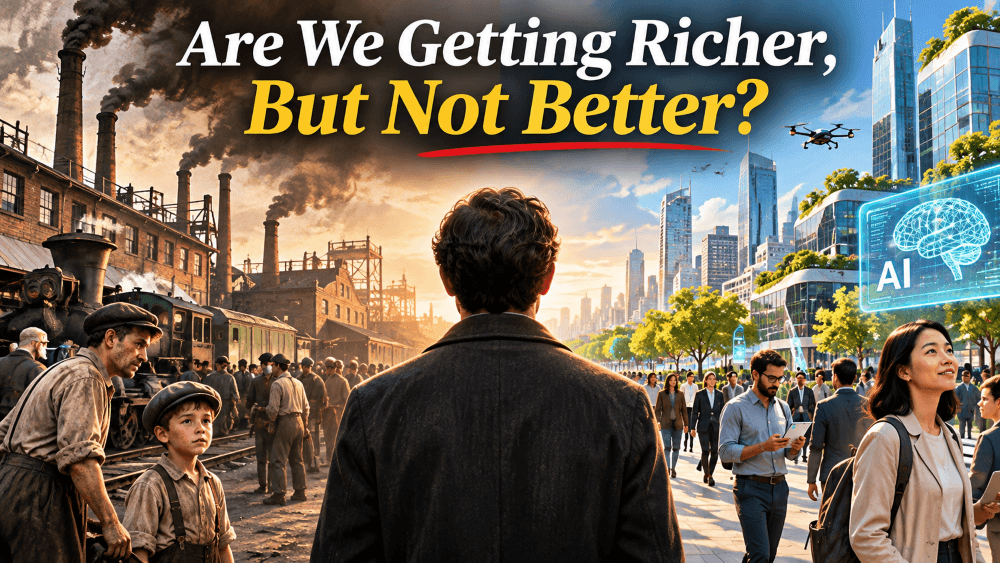
Imagine bringing someone from the year 1800 into the modern world. They would be astonished by our airplanes, smartphones, hospitals, and supermarkets. They might conclude that humanity has achieved something close to paradise.
But after watching the evening news, scrolling through social media, or witnessing another war, they might reconsider.
Economic progress has transformed how we live, but has it transformed who we are?
We have become wealthier, healthier, and more technologically sophisticated than our ancestors. Yet we continue to struggle with greed, cruelty, prejudice, and violence.
This raises a fascinating question: Does material prosperity make us better human beings, or does it simply give us more powerful tools to express the same human nature?
The Industrial Revolution: A Triumph and a Tragedy
Before the Industrial Revolution, most people lived in conditions we would consider extreme poverty.
Life expectancy was relatively short, childhood mortality was high, and ordinary families spent much of their income simply trying to survive.
The Industrial Revolution changed everything.
Steam engines, factories, railroads, and eventually electricity dramatically increased productivity. Goods that had once been expensive luxuries became accessible to ordinary people.
Over time, economic progress helped deliver remarkable improvements:
- Longer life expectancy and lower infant mortality.
- Better housing, sanitation, and medical care.
- Greater access to education and information.
- More affordable food, clothing, and transportation.
- More opportunities for economic independence.
But the Industrial Revolution also had a darker side.
Factories employed children under dangerous conditions. Workers endured exhausting schedules, industrial pollution damaged communities, and enormous fortunes sometimes depended on exploitation.
The same civilization that produced unprecedented wealth also participated in colonial domination, slavery, and devastating wars.
Economic progress was real, but moral progress was far less straightforward.
The Contradiction of Human Achievement
The Industrial Revolution was a combination of extraordinary achievement and terrible human suffering that nevertheless propelled humanity forward.
History rarely offers simple stories of good triumphing over evil.
Human beings are capable of magnificent creativity and astonishing cruelty, sometimes within the same society and even the same individual.
The lesson is uncomfortable: Technological sophistication does not automatically produce moral sophistication.
Economic Progress and Moral Progress Are Different Things
Economic progress is relatively easy to measure.
We can examine GDP per capita, productivity, life expectancy, household consumption, and poverty rates.
Moral progress is much harder to quantify.
How do we measure compassion, honesty, generosity, tolerance, or respect for human dignity?
Consider two societies.
One has a high standard of living, advanced technology, and enormous wealth, but its citizens are deeply divided, distrustful, and indifferent to the suffering of others.
Another is materially poorer but has strong communities, mutual trust, and a culture of helping neighbors.
Which society is more advanced?
Economically, the answer might be obvious. Morally, the answer is considerably more complicated.
Are We More Compassionate Than Our Ancestors?
There are legitimate reasons to believe that humanity has made moral progress.
Slavery, once widely accepted and legally protected, is now prohibited throughout the world, even though modern slavery and forced labor persist.
Women have gained voting rights, educational opportunities, and legal protections that were denied to them in many societies just a few generations ago.
Civil rights movements have challenged racial discrimination, while democratic institutions and human rights organizations have expanded protections for individuals.
These achievements matter enormously.
However, they do not necessarily prove that human nature itself has improved.
Perhaps we have become better at building institutions that restrain our worst impulses.
A society can establish laws against discrimination without eliminating prejudice from the human heart.
And people who publicly support compassion can still behave selfishly when their personal interests are threatened.
Capitalism and Entrepreneurship: Engines of Prosperity, Not Moral Perfection
One of capitalism’s greatest achievements is its ability to encourage people to create value for others.
An entrepreneur who wants to become wealthy usually needs to offer something customers are willing to purchase.
Consider Henry Ford.
By improving automobile production methods, Ford helped make cars affordable to a much larger population. His business success depended partly on delivering a useful product at a lower cost.
Modern entrepreneurs follow similar principles.
They develop medical technologies, improve transportation, create educational platforms, and find ways to make everyday life more convenient.
In this sense, capitalism can align personal ambition with social benefits.
But capitalism does not automatically reward virtue.
A company can make money by developing lifesaving medicine. Another can make money by exploiting addiction, spreading misinformation, or encouraging excessive consumption.
Both may be profitable.
Markets Reflect Human Values
Markets are powerful tools for coordinating human activity, but they cannot independently determine what society should value.
Entrepreneurs respond to incentives, consumer preferences, regulations, and competition.
If consumers reward responsible businesses, entrepreneurs have reasons to behave responsibly.
If consumers prioritize convenience and low prices regardless of consequences, businesses may respond accordingly.
The moral quality of capitalism therefore depends partly on the moral choices of the people participating in it.
A prosperous economy needs more than efficient markets. It also needs trust, honesty, accountability, and ethical judgment.
Artificial Intelligence: The Next Great Test of Human Morality
The arrival of artificial intelligence makes the distinction between economic progress and moral progress more important than ever.
AI promises extraordinary benefits.
It could accelerate medical discoveries, improve education, reduce tedious work, and help entrepreneurs build businesses with fewer resources.
A small business owner can already use AI to perform tasks that previously required an entire team.
But the same technology can also be used to manipulate people, produce convincing misinformation, conduct surveillance, and automate harmful decisions.
The problem is not simply whether AI becomes more intelligent.
It is whether human beings become wise enough to use that intelligence responsibly.
Our Tools Are Advancing Faster Than Our Ethics
During the Industrial Revolution, societies needed decades to develop labor protections, public education systems, and regulations appropriate for industrial economies.
The digital revolution has created similar challenges at a much faster pace.
Social media transformed communication before society fully understood its psychological and political consequences.
Now artificial intelligence is advancing while governments, schools, businesses, and families are still debating the appropriate rules.
Technological development often moves faster than the social arrangements needed to manage it.
Creating a new technology can be easier than establishing the cultural norms required to use it wisely.
That gap creates enormous tension.
We can develop powerful machines in a few years, but building trust, responsibility, and shared ethical standards may take generations.
Why Technology Cannot Solve Every Human Problem
Throughout history, people have repeatedly imagined that new technologies would create better societies.
The printing press promised broader access to knowledge. Yet it also enabled the rapid circulation of propaganda and inflammatory ideas.
Radio and television connected entire populations, but they also became powerful instruments of political manipulation.
The internet promised to democratize information and bring humanity closer together.
It succeeded in making knowledge accessible to billions, but it also created new opportunities for fraud, harassment, misinformation, and polarization.
Every technological revolution expands what human beings can accomplish.
But it rarely eliminates the fundamental conflicts within human nature.
Technology can help us communicate, but it cannot force us to listen.
It can provide information, but it cannot guarantee wisdom.
It can increase wealth, but it cannot ensure generosity.
And it can give us extraordinary power without teaching us when that power should be restrained.
Can Economic Progress Create the Conditions for Moral Progress?
Despite these concerns, there are good reasons for optimism.
Material prosperity can make ethical improvements easier.
When people are struggling to survive, they may have fewer resources available to support education, charitable organizations, environmental protection, and public institutions.
As societies become wealthier, they can devote more resources to these priorities.
Economic security can also reduce certain pressures that contribute to conflict and exploitation.
But prosperity creates opportunities for moral progress rather than guaranteeing it.
A wealthy society can choose to invest in education and public health, or it can tolerate corruption and extreme inequality.
A powerful technology can be used to improve human welfare, or it can strengthen authoritarian control.
The difference comes down to human choices and institutions.
Five Ways to Turn Material Prosperity Into Human Progress
If we want economic progress to contribute to a more ethical society, we need to make deliberate choices.
- Teach ethics alongside technical skills. Education should develop judgment and responsibility, not merely employability.
- Reward responsible entrepreneurship. Business success should be compatible with honest dealing and respect for customers and workers.
- Build institutions that limit abuses of power. Laws, independent courts, and accountability mechanisms help protect people from exploitation.
- Encourage critical thinking. Citizens need the ability to question misinformation and resist manipulation.
- Preserve human relationships. Technology should support meaningful connections rather than replace them entirely.
None of these measures will produce moral perfection.
But they can help translate economic achievements into improvements in everyday human life.
The Most Important Progress May Be Within Ourselves
Perhaps the mistake is assuming that economic progress and moral progress must advance together.
They are related, but they are not the same.
We can become extraordinarily skilled at manipulating the physical world while remaining confused about how to treat one another.
We can create artificial intelligence capable of solving complex scientific problems while continuing to struggle with jealousy, selfishness, and intolerance.
History contains both extraordinary human achievement and extraordinary human failure.
Recognizing this contradiction does not require rejecting progress.
It requires developing a more mature understanding of what progress actually means.
We should celebrate the enormous material improvements produced by science, entrepreneurship, and capitalism.
But we should also recognize that a society’s greatness cannot be measured exclusively by its wealth or technological sophistication.
The ultimate test of progress is not simply what we can build, but how we choose to treat one another.
A civilization that can reach the stars but cannot practice compassion still has important work to do.
And perhaps that is the most important challenge of the twenty-first century.
Frequently Asked Questions
1. Does economic progress automatically lead to moral progress?
No. Economic progress improves material living conditions, but moral progress depends on cultural values, institutions, education, and individual choices. Wealth can create opportunities for ethical improvement without guaranteeing them.
2. Has humanity become more ethical over time?
Humanity has achieved important improvements in civil rights, legal equality, and protections against exploitation. However, cruelty, discrimination, and violence remain, making it difficult to determine whether human nature itself has fundamentally changed.
3. Can capitalism make people more compassionate?
Capitalism can encourage cooperation and the creation of products that benefit others. However, profit incentives do not always align with ethical behavior, which is why responsible entrepreneurship, consumer choices, and effective institutions matter.
4. Will artificial intelligence improve human morality?
AI can support education, healthcare, and better decision-making, but it can also enable manipulation and exploitation. Its moral impact will depend on how people design, regulate, and use it.
Leave a Reply