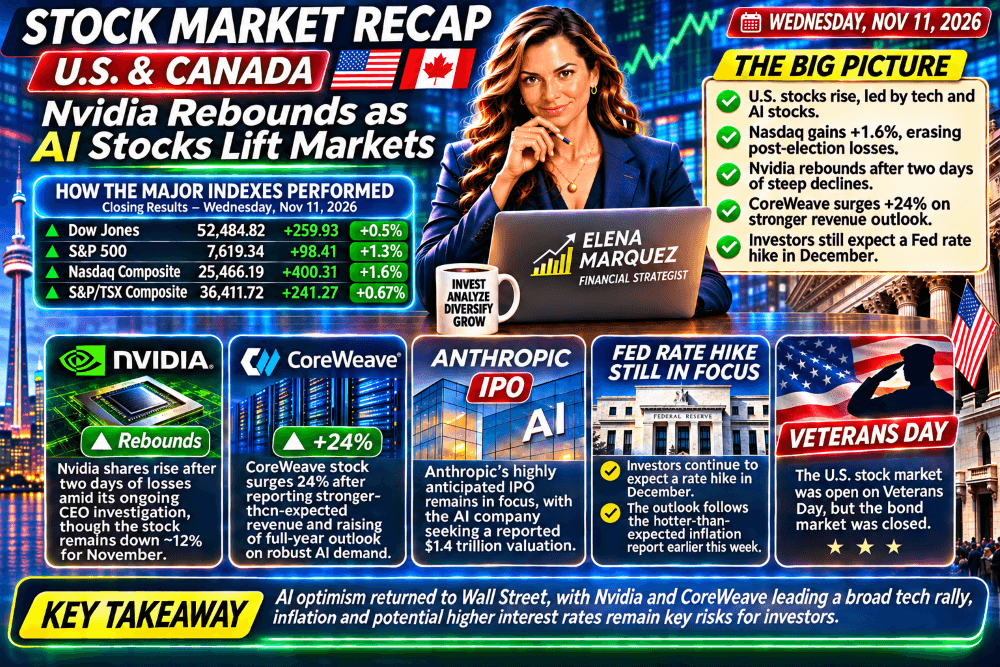
Wall Street finished higher on Wednesday, November 11, 2026, as investors returned to artificial intelligence stocks following several days of volatility.
The Nasdaq Composite gained approximately 1.6%, the S&P 500 climbed 1.3%, and the Dow Jones Industrial Average advanced 0.5%.
The rally was led by semiconductor and AI infrastructure companies, including Nvidia, which recovered after two consecutive sessions of substantial losses.
One of the day’s biggest winners was CoreWeave. Its shares surged 24% after the AI cloud computing company reported encouraging financial results and raised its full-year revenue outlook.
Wednesday’s rally was particularly significant because the Nasdaq erased its losses accumulated since the U.S. midterm elections.
However, the recovery came against a complicated economic backdrop. Investors continued adjusting their expectations for Federal Reserve interest-rate policy following Tuesday’s hotter-than-expected inflation report.
In Canada, the S&P/TSX Composite was also reported to have risen, although the complete closing information still needs confirmation.
The central story of November 11: Investors are rediscovering their enthusiasm for artificial intelligence, but inflation, higher interest rates, and uncertainty surrounding data center construction remain important risks.
1. How the Major Stock Indexes Performed
U.S. & Canadian Stock Market Performance
Wednesday, November 11, 2026 | Daily Change
U.S. percentage changes from the supplied market report. Canadian closing percentage not yet confirmed.
All three major U.S. indexes advanced, but technology stocks delivered the strongest performance.
The Nasdaq led the gains as semiconductor and AI infrastructure companies recovered from their recent selloff.
The S&P 500 also benefited from renewed enthusiasm for growth stocks.
The Dow’s smaller advance suggested that investors were particularly interested in technology rather than buying all sectors equally.
A remarkable three-day reversal
Monday’s powerful rally was followed by Tuesday’s decline after inflation exceeded expectations.
Wednesday brought another reversal, with technology stocks leading the market higher.
The Nasdaq’s recovery was especially important because it reportedly eliminated the index’s post-election losses.
This illustrates how quickly sentiment can change when investors reassess the outlook for individual industries.
2. Nvidia Rebounds After Two Difficult Trading Sessions
Nvidia shares rebounded Wednesday after experiencing substantial losses on Monday and Tuesday.
The company’s stock had come under pressure following reports concerning CEO Jensen Huang and a board investigation into a personal relationship.
Some reporting included national-security allegations, but those allegations should not be treated as established findings.
Despite Wednesday’s recovery, Nvidia remained approximately 12% lower for November, according to the supplied report.
Why Nvidia matters so much
Nvidia has become one of the central companies in the global artificial intelligence industry.
Its graphics processing units are essential for training and running many advanced AI models.
The company supplies technology to cloud providers, research institutions, and businesses building AI infrastructure.
As a result, Nvidia’s stock performance has become an important indicator of investor confidence in the broader AI trade.
When Nvidia declines sharply, other semiconductor and infrastructure companies can also come under pressure.
When Nvidia rebounds, enthusiasm often spreads across the technology sector.
A recovery does not eliminate uncertainty
Although Wednesday’s gains were encouraging, Nvidia still faces several challenges.
Investors are evaluating the sustainability of AI infrastructure spending, possible government restrictions, competition, and corporate governance concerns.
The company’s long-term success will depend primarily on demand for its products, technological leadership, and its ability to generate profits.
Short-term price movements do not necessarily resolve these underlying questions.
3. CoreWeave Surges 24% as AI Computing Demand Remains Strong
One of Wednesday’s biggest stock-market stories was the remarkable performance of CoreWeave.
Shares of the Nvidia-backed AI cloud computing company surged 24% after it reported stronger-than-expected revenue and raised its full-year outlook.
The results provided investors with evidence that demand for AI computing capacity remains strong.
What does CoreWeave do?
CoreWeave operates specialized cloud computing infrastructure designed for demanding workloads, particularly artificial intelligence.
Companies developing advanced AI models require enormous computing resources.
Rather than building all their own infrastructure, some businesses rent computing capacity from specialized cloud providers.
CoreWeave is positioned to benefit from this demand.
Why the stock surged
Investors responded positively to the company’s reported revenue performance and improved outlook.
These developments suggest that demand for AI computing services continues growing despite recent market concerns.
However, cloud infrastructure is a capital-intensive business.
Companies must invest substantial amounts in processors, data centers, electricity, networking equipment, and financing.
Rapid revenue growth does not automatically translate into equally rapid growth in free cash flow.
For investors, the important question is whether CoreWeave can convert strong demand into sustainable profitability.
CoreWeave’s rally was a reminder that the AI industry may face valuation concerns while still experiencing substantial commercial growth.
4. The Nasdaq Erases Its Post-Election Losses
Wednesday’s Nasdaq rally marked an important milestone.
According to the supplied report, the technology-heavy index had recovered all its losses since the U.S. midterm elections.
Last week’s market turbulence was driven partly by uncertainty surrounding the political future of AI infrastructure development.
Investors worried that restrictions on new data centers could slow spending on semiconductor chips, power equipment, construction, and cloud infrastructure.
These concerns triggered substantial selling across the technology sector.
However, the recovery suggests that investors are reconsidering how quickly such restrictions could affect actual business activity.
What does the rebound tell us?
The market appears to be distinguishing between political uncertainty and immediate corporate earnings.
Proposed restrictions do not necessarily translate into immediate reductions in demand.
Companies may continue spending heavily on AI infrastructure while policymakers debate future regulations.
Nevertheless, investors should not assume that all political risks have disappeared.
The regulatory environment remains an important consideration for companies investing billions of dollars in data centers.
5. Anthropic’s IPO Keeps the AI Trade in Focus
Anthropic’s anticipated initial public offering continued attracting investor attention Wednesday.
According to the supplied reporting, the AI company is pursuing a public-market debut amid considerable volatility in technology stocks.
Its proposed valuation has reportedly reached approximately $1.4 trillion.
If achieved, such a valuation would reflect enormous expectations for future growth.
Why investors are paying attention
Anthropic develops advanced artificial intelligence systems and competes in a rapidly expanding market.
Businesses are increasingly experimenting with AI for software development, research, customer service, and business operations.
However, building advanced AI models requires substantial computing power and financial investment.
Investors evaluating a potential IPO must consider several questions.
Can revenue grow fast enough to justify the valuation? Will the company eventually generate sustainable profits? How much capital will it need to remain competitive?
And perhaps most importantly, will customers continue increasing their AI spending at the pace investors anticipate?
The answers will help determine whether today’s enthusiasm translates into attractive long-term investment returns.
6. Inflation and the Federal Reserve Remain Major Concerns
Despite Wednesday’s market rally, inflation remains a central concern.
Tuesday’s U.S. Consumer Price Index report showed that consumer prices rose 0.4% in October, exceeding economists’ expectations of 0.3%.
Although inflation slowed from September’s 0.6% monthly increase, the result was higher than anticipated.
That strengthened market expectations that the Federal Reserve could raise interest rates in December.
Why higher rates are a challenge for technology stocks
Higher interest rates increase borrowing costs for businesses.
This can make large investments in data centers and other infrastructure more expensive.
Higher rates also affect how investors value companies expected to generate substantial profits in the future.
Growth-oriented businesses may therefore experience greater volatility when interest-rate expectations change.
This creates a complicated environment for AI companies.
Demand for their products may be growing rapidly, but the cost of financing expansion could also increase.
What investors should remember
The Federal Reserve has not yet made its December decision.
Market expectations can change as additional inflation, employment, and economic data become available.
Wednesday’s stock-market rally suggests that investors remain optimistic about AI earnings despite the possibility of tighter monetary policy.
Whether that optimism is sustainable will depend on future economic data and corporate results.
7. Canada: The TSX Participates in the Market Recovery
Canada’s stock market also featured in Wednesday’s trading session.
The supplied information states that the TSX closed at 241.27, but does not clarify whether this represents a point increase or a closing index value.
Given that the index closed Tuesday at 36,170.45, the figure appears more consistent with a daily point change than the index’s actual closing level.
For now, the precise Canadian closing result remains unconfirmed.
Why Canada’s market behaves differently
The Canadian stock market has a different composition from the U.S. Nasdaq.
Canada has substantial exposure to financial institutions, energy producers, mining companies, and other resource-related businesses.
Technology represents a smaller portion of the Canadian market than it does in the Nasdaq.
As a result, a rally led by AI and semiconductor companies does not necessarily produce an equally strong advance in Canadian stocks.
Canadian investors also need to monitor commodity prices, interest rates, and movements in the Canadian dollar.
These factors can significantly influence the performance of domestic investments.
8. Veterans Day: Stock Market Open, Bond Market Closed
Wednesday was Veterans Day in the United States.
Although the holiday affected some financial-market operations, the New York Stock Exchange and Nasdaq remained open for regular trading.
The U.S. bond market was closed.
This distinction matters because Treasury yields are important indicators of investor expectations for inflation and interest rates.
With the bond market closed, investors had less immediate information from Treasury trading to help assess changes in interest-rate expectations.
Normal bond-market activity is expected to resume following the holiday.
9. What Investors Should Watch Next
AI and semiconductor stocks
Can Nvidia sustain its rebound, and will CoreWeave’s strong outlook support confidence in AI infrastructure spending?
Federal Reserve policy
Will new economic data strengthen expectations of a December rate hike?
Data center construction
Will proposed restrictions affect the pace of AI infrastructure investment?
Anthropic’s IPO
Will investors embrace the reported valuation despite recent volatility in technology stocks?
Canadian markets
Will Canadian resource and financial stocks participate in a sustained global recovery?
10. The Biggest Investment Lesson of November 11
Wednesday’s rally illustrates the difference between stock-market sentiment and business fundamentals.
Last week, investors were worried that AI infrastructure spending could slow dramatically.
This week, CoreWeave reported encouraging results and raised its revenue outlook.
The contrast demonstrates that uncertainty and opportunity can exist simultaneously.
Artificial intelligence may continue transforming the global economy, but that does not mean every AI-related stock is attractively priced.
Some companies may become highly profitable.
Others may struggle with competition, enormous capital requirements, or unrealistic expectations.
For investors, the challenge is to identify businesses capable of generating sustainable earnings rather than simply following the latest market enthusiasm.
A promising industry does not automatically make every company in that industry a good investment.
Conclusion: AI Optimism Returns, but Important Risks Remain
Wednesday, November 11, 2026, brought renewed optimism to Wall Street.
The Nasdaq advanced 1.6%, the S&P 500 gained 1.3%, and the Dow climbed 0.5%.
Nvidia recovered from two difficult trading sessions, while CoreWeave surged 24% after delivering encouraging financial results.
The Nasdaq also erased its post-election losses, demonstrating the strength of the market’s rebound.
However, investors continue facing uncertainty surrounding inflation, Federal Reserve policy, data center regulation, and technology valuations.
The recovery is encouraging, but it does not guarantee that volatility has ended.
For long-term investors, the most important principles remain unchanged: diversification, reasonable valuations, financial discipline, and patience.
The key takeaway: Artificial intelligence continues creating extraordinary business opportunities, but investment success depends on distinguishing genuine economic value from excessive market expectations.
Other Stock Market blog posts
Leave a Reply