Daily Market Review | United States & Canada | Monday, November 9, 2026 | AlainGuillot.com
Wall Street began the new trading week with a powerful rally, recovering some of the losses suffered during last week’s dramatic post-election selloff.
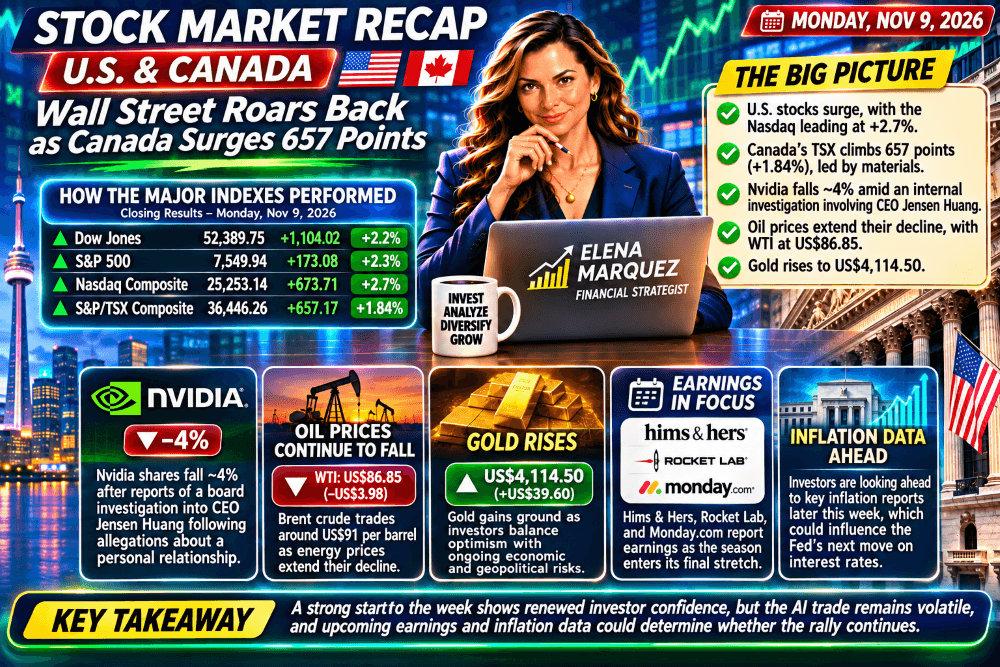
The Dow Jones Industrial Average surged 1,104 points, while the S&P 500 gained approximately 2.3% and the Nasdaq Composite climbed 2.7%.
Canadian stocks joined the rally. The S&P/TSX Composite jumped 657 points, supported by strength in the materials sector.
Investors returned to equities after a turbulent week in which concerns about artificial intelligence investments, data center regulations, and political uncertainty triggered substantial selling pressure.
However, the recovery was not universal.
Nvidia shares fell approximately 4% amid reports of an internal investigation involving CEO Jensen Huang, demonstrating that company-specific risks can outweigh broader market optimism.
Meanwhile, oil prices continued declining. Brent crude traded around $91 per barrel, while U.S. crude futures fell below $87.
Gold prices moved higher, and investors turned their attention toward corporate earnings and upcoming inflation data.
The central story of November 9: Investors are returning to stocks, but the AI sector remains volatile, and falling energy prices are creating new opportunities and risks across the economy.
1. How the Major Stock Indexes Performed
U.S. & Canadian Stock Market Performance
Monday, November 9, 2026 | Daily Change
| Index | Closing level | Point change |
|---|---|---|
| Dow Jones | 52,389.75 | +1,104.02 |
| S&P 500 | 7,549.94 | +173.08 |
| Nasdaq Composite | 25,253.14 | +673.71 |
| S&P/TSX Composite | 36,446.26 | +657.17 |
The Nasdaq led the recovery, indicating renewed appetite for technology and growth stocks.
The Dow also posted an impressive advance, rising more than 1,100 points.
In Canada, the TSX climbed to 36,446.26, helped by gains in mining and other basic materials companies.
Although Monday’s rally was encouraging, one strong session does not necessarily signal the end of market volatility.
2. Wall Street Recovers From Last Week’s AI Selloff
Monday’s rally followed an exceptionally difficult week for U.S. investors.
Last week, the Nasdaq declined 3.4%, the S&P 500 lost 2.7%, and the Dow slipped 0.9%.
The selloff accelerated after the Democratic Party’s midterm election victories raised questions about the future of AI infrastructure spending.
Investors became concerned that restrictions on new data center construction could reduce demand for processors, memory chips, electrical equipment, and other infrastructure.
Semiconductor companies experienced particularly severe losses.
However, Monday’s rebound suggests that some investors believe the previous week’s selling may have been excessive.
What changed?
Several factors likely contributed to the recovery:
- Investors returned to stocks after last week’s sharp declines.
- Lower oil prices helped ease inflation concerns.
- Attention shifted toward upcoming corporate earnings and economic data.
- Some investors may have viewed the correction as an opportunity to buy shares at lower prices.
Nevertheless, uncertainty surrounding AI spending and data center regulation remains unresolved.
The longer-term direction of technology stocks will depend on whether companies can justify their valuations through sustainable earnings growth.
3. Nvidia Falls Despite the Broader Market Rally
One of Monday’s most notable developments was the decline in Nvidia shares.
The stock fell approximately 4%, even as the Nasdaq gained about 2.7%.
The weakness followed reports that Nvidia’s board had opened an investigation involving CEO Jensen Huang and a reported personal relationship.
According to the reporting supplied, allegations concerning the relationship have raised questions about potential national-security implications.
Huang reportedly acknowledged marital infidelity in a communication to employees.
It is important to distinguish reported allegations from established facts. The allegations concerning intelligence connections and any potential wrongdoing have not been established by the information provided.
Why this matters for Nvidia investors
Nvidia has become one of the most influential companies in the global technology industry.
Its processors play a central role in artificial intelligence computing, and its business has benefited from extraordinary demand for AI infrastructure.
The company is also closely associated with its founder and CEO.
When a business depends heavily on a prominent executive, unexpected leadership controversies can create additional uncertainty.
Investors may worry about governance, reputational damage, regulatory scrutiny, or management distractions.
However, such concerns do not necessarily imply deterioration in the company’s products or financial performance.
For shareholders, the key questions are whether the reports lead to material business consequences and whether Nvidia can maintain its competitive advantages.
4. Canada: TSX Surges as Materials Stocks Lead
Canada’s stock market participated enthusiastically in Monday’s global equity rally.
The S&P/TSX Composite gained 657.17 points, closing at 36,446.26.
That represented an increase of approximately 1.84%.
The materials sector was an important contributor to the advance.
Why materials matter to Canada
The Canadian stock market has substantial exposure to mining, metals, and natural-resource companies.
These businesses can benefit from higher commodity prices, strong global demand, and favorable investor sentiment toward resource assets.
This gives the TSX a different character from the Nasdaq, which is more heavily concentrated in technology companies.
Canada’s market can therefore outperform during periods when investors rotate away from technology and toward other sectors.
However, resource stocks also face risks associated with commodity prices, global economic growth, and operating costs.
Monday’s performance demonstrated that Canada’s equity market can participate in a global rally even when some major U.S. technology companies struggle.
5. Oil Prices Continue Falling
Energy Market Update
Monday, November 9, 2026
Brent crude
~US$91
Per barrel
December WTI crude
US$86.85
−US$3.98
Oil prices extended their recent decline Monday.
Brent crude traded around $91 per barrel, while the December U.S. crude contract fell $3.98 to $86.85.
Energy markets have been particularly volatile because of uncertainty surrounding the war involving Iran.
Investors are assessing whether political developments in Washington could lead to a reduction in geopolitical tensions.
What lower oil prices mean for investors
Lower energy prices can have several positive effects on the economy.
They can reduce gasoline and transportation costs, improve business profit margins, and ease inflationary pressure.
This could support consumer spending and eventually influence interest-rate expectations.
However, falling oil prices can create challenges for energy producers.
For Canadian investors, the effects are especially important because energy companies represent a significant part of the domestic equity market.
Lower crude prices may benefit the broader economy while reducing revenue expectations for some oil and gas businesses.
6. Gold Rises as Investors Reassess Risks
December Gold Futures
US$4,114.50
Daily change
+US$39.60
Price per troy ounce, based on the supplied Canadian market report.
Gold prices moved higher Monday even as equity markets rallied.
December gold futures gained $39.60, finishing at $4,114.50 per ounce.
Gold is often viewed as a defensive asset during periods of political or economic uncertainty.
However, its price is also influenced by interest rates, currency movements, and investment demand.
The simultaneous rise in stocks and gold suggests that investors may be balancing optimism about economic conditions with continued concerns about financial-market risks.
For Canadian investors, gold-mining companies can provide exposure to rising precious-metal prices, although their share prices are also affected by production costs and operational performance.
7. Canadian Dollar Slips Slightly
Canadian Dollar vs. U.S. Dollar
Value of C$1 in U.S. cents
Friday, Nov. 6
70.86¢
Monday, Nov. 9
70.81¢
Daily change
−0.05 US¢
The Canadian dollar weakened slightly against its U.S. counterpart.
The loonie traded at 70.81 U.S. cents, compared with 70.86 cents on Friday.
For Canadians investing in U.S. equities, currency movements affect the value of their portfolios when translated into Canadian dollars.
A weaker Canadian dollar generally increases the Canadian-dollar value of U.S. investments, assuming the underlying share prices remain unchanged.
This currency effect can partially amplify or offset stock-market returns.
8. Corporate Earnings: Hims & Hers, Rocket Lab, and Monday.com
Hims & Hers Health (HIMS)
Investors are watching the company’s earnings for updates on telehealth demand, customer growth, profitability, and its expanding healthcare offerings.
Rocket Lab (RKLB)
The space technology company is attracting attention as investors evaluate launch activity, government contracts, and future growth opportunities.
Investors are focused on enterprise software spending, subscription revenue, customer retention, and the company’s outlook for business software demand.
Although the largest wave of third-quarter earnings reports has already passed, several companies remain on the reporting calendar.
Monday’s notable names included Hims & Hers, Rocket Lab, and Monday.com.
These companies operate in different industries, making their earnings useful indicators of demand across healthcare technology, aerospace, and business software.
The supplied information identifies them as reporting companies but does not include their actual earnings results.
Consequently, no conclusions about earnings surprises or management guidance can yet be drawn from the supplied figures.
9. Inflation Data Could Determine the Next Market Move
After Monday’s strong rally, investors are preparing for a week that includes important inflation-related economic releases.
Inflation remains a central concern because it influences Federal Reserve monetary policy.
If inflation continues moderating, investors may anticipate more favorable interest-rate conditions.
That could support stock valuations, particularly for growth-oriented companies.
However, unexpectedly strong inflation could reduce expectations for interest-rate cuts.
Higher interest rates generally increase borrowing costs and can place pressure on valuations.
Why technology stocks are sensitive
Technology companies are often valued based on expectations of substantial future earnings.
When interest rates rise, the present value of those future profits can decline.
This helps explain why growth stocks can experience particularly large price movements when interest-rate expectations change.
The upcoming economic reports will therefore be important for determining whether Monday’s rally can continue.
10. What Investors Should Watch Next
The coming trading sessions will test whether Monday’s recovery represents a sustainable improvement in investor confidence.
Important developments include:
- Nvidia: Whether the reported board investigation leads to material business or governance consequences.
- AI infrastructure: Whether proposed data center restrictions affect actual construction and investment decisions.
- Inflation: Whether upcoming reports support expectations of lower interest rates.
- Corporate earnings: Results and outlooks from Hims & Hers, Rocket Lab, Monday.com, and other reporting companies.
- Oil: Whether crude prices stabilize following their steep decline.
- Canada’s materials sector: Whether mining and resource companies can sustain their gains.
- Currency markets: Whether the Canadian dollar continues weakening against the U.S. dollar.
The market’s direction will depend on how these developments affect expectations for corporate profits and economic growth.
11. The Biggest Investment Lesson of November 9
Monday’s rally demonstrates why predicting short-term market movements is so difficult.
Last week, investors were selling technology stocks aggressively because of concerns about political developments and AI infrastructure spending.
Today, many of those same stocks recovered as buyers returned to the market.
Yet some of the underlying uncertainties remain unresolved.
This distinction is important.
A rising stock price does not necessarily mean that business risks have disappeared.
Similarly, a falling stock price does not automatically mean that a company’s long-term prospects have deteriorated.
Investors must distinguish between changes in market sentiment and changes in business fundamentals.
For long-term investors, diversification, financial strength, and reasonable valuations remain essential.
Maintaining a portfolio that can withstand periods of volatility is often more valuable than trying to predict the next market rally or correction.
Conclusion: A Strong Start to the Week, but Uncertainty Remains
Monday, November 9, 2026, delivered a powerful rebound for investors in both the United States and Canada.
The Dow gained more than 1,100 points, the S&P 500 advanced approximately 2.3%, and the Nasdaq climbed 2.7%.
Canada’s S&P/TSX Composite rose more than 657 points, supported by strength in the materials sector.
Lower oil prices helped ease inflation concerns, while gold prices moved higher and the Canadian dollar weakened slightly.
However, Nvidia’s decline demonstrated that company-specific risks remain important, even during broad market rallies.
Investors now face another critical week of earnings reports, economic data, and developments surrounding AI infrastructure.
The key takeaway: A strong market rebound is encouraging, but lasting investment success depends on earnings, valuations, and the ability of businesses to generate sustainable profits—not simply on the direction of stock prices over a few trading sessions.
Other Stock Market blog posts
Leave a Reply