Daily Market Review | Friday, November 6, 2026 | AlainGuillot.com
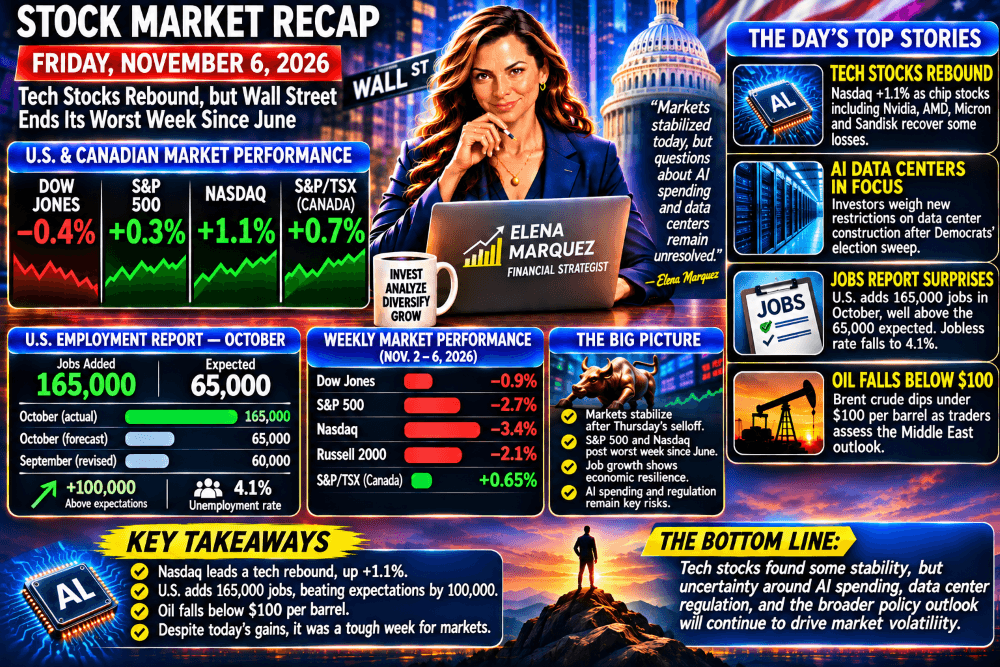
Wall Street ended a turbulent week on a mixed note Friday as technology stocks recovered some of Thursday’s dramatic losses, while the Dow Jones Industrial Average continued to struggle.
The S&P 500 gained approximately 0.3%, and the Nasdaq Composite advanced more than 1%, supported by renewed buying in semiconductor and artificial intelligence companies.
The Dow, however, declined approximately 0.4%.
Despite Friday’s recovery, the S&P 500 and Nasdaq recorded their worst weekly performances since June.
The week’s volatility reflected a significant reassessment of artificial intelligence investments following the Democratic Party’s sweeping victory in the U.S. midterm elections.
Investors are increasingly concerned that new restrictions on data center construction could slow the enormous spending that has supported semiconductor companies and AI infrastructure businesses.
Meanwhile, the latest employment report delivered an encouraging surprise: the U.S. economy added 165,000 jobs in October, substantially exceeding economists’ expectations of 65,000.
The central message of November 6: Technology stocks found some stability, but questions about AI spending, political uncertainty, and market valuations remain unresolved.
1. How the Major Indexes Performed
U.S. & Canadian Stock Market Performance
Friday, November 6, 2026 | Daily Change
Friday’s market performance showed that investors were willing to return to selected technology stocks after Thursday’s severe selloff.
However, the recovery was uneven.
The Nasdaq outperformed the other major indexes, while the Dow remained negative.
The S&P 500 posted a modest gain, suggesting that the rebound was concentrated in certain industries rather than representing a broad return of investor confidence.
The bigger picture: A difficult week
Friday’s gains were not sufficient to erase the losses accumulated earlier in the week.
The S&P 500 and Nasdaq both suffered their worst weekly performances since June.
Thursday had been particularly damaging, with the Nasdaq dropping approximately 5.5% and the semiconductor index falling roughly 12%.
The contrast between Thursday’s collapse and Friday’s rebound illustrates how quickly investor sentiment can change.
2. Semiconductor Stocks Rebound After Thursday’s Collapse
Technology investors returned to several semiconductor companies Friday, helping stabilize a sector that had experienced extraordinary selling pressure.
Among the companies recovering some of their earlier losses were:
- Nvidia (NVDA)
- Advanced Micro Devices (AMD)
- Micron Technology (MU)
- Sandisk (SNDK)
These companies are important participants in the artificial intelligence and data storage industries.
Nvidia supplies advanced processors used to train and operate AI models.
AMD competes in high-performance computing and AI accelerators.
Micron manufactures memory products essential to modern computing infrastructure.
Sandisk operates in data storage technology.
Why did chip stocks recover?
After Thursday’s steep losses, some investors may have considered selected semiconductor stocks more attractive.
Others may have been closing short positions or rebalancing portfolios following the market’s rapid decline.
However, a one-day rebound does not necessarily signal the end of a correction.
The industry’s longer-term outlook still depends on demand for computing equipment, data center investment, corporate profitability, and valuations.
The semiconductor recovery was encouraging, but it remains too early to conclude that the selling pressure has ended.
3. AI Data Centers Become a Major Political and Investment Issue
One of the most important developments of the week was the growing political controversy surrounding AI data centers.
The Democratic victories in the midterm elections have raised questions about whether new state governments will introduce additional restrictions on construction.
Texas has become a particular focus of investor attention.
Data centers require enormous amounts of electricity, water, land, and infrastructure.
While they can generate investment and employment, they can also create concerns about electricity prices, environmental impacts, and pressure on local resources.
Why this matters for AI stocks
The artificial intelligence industry depends on continued expansion in computing capacity.
Large technology companies are investing heavily in processors, servers, networking equipment, and facilities.
If new projects are delayed, companies supplying that infrastructure could experience slower revenue growth than previously expected.
That creates uncertainty for semiconductor manufacturers, data center operators, and businesses involved in financing AI infrastructure.
However, existing facilities could become more valuable if constructing new capacity becomes more difficult.
This helps explain why companies within the same industry can react very differently to political developments.
The key distinction is between businesses that already possess valuable infrastructure and those that depend heavily on building more of it.
4. Friday’s Jobs Report Delivers a Major Positive Surprise
U.S. Employment Report: A Positive Surprise
October 2026 | Nonfarm Payrolls
October payrolls exceeded economists’ expectations by 100,000 jobs. The unemployment rate declined from 4.2% to 4.1%. Bar lengths are proportional to the 165,000 actual jobs added. Source: U.S. Bureau of Labor Statistics, November 6, 2026.
October exceeded forecasts by 100,000 jobs. September’s figure was revised to 60,000.
The U.S. Labor Department reported that employers added 165,000 jobs in October, substantially exceeding expectations.
Economists had forecast approximately 65,000 new positions.
The previous month’s figure was revised to 60,000.
The October result therefore represented a meaningful improvement.
Why the employment report matters
Job creation is an important indicator of economic health.
When companies hire additional workers, it generally suggests confidence in future demand for goods and services.
Employment growth also supports consumer spending, which represents a major portion of the U.S. economy.
However, stronger employment can create complications for monetary policy.
If the economy remains resilient, the Federal Reserve may feel less urgency to reduce interest rates.
Higher interest rates can put pressure on stocks, particularly companies whose valuations depend heavily on profits expected far into the future.
For investors, Friday’s report offered reassurance about economic activity while also raising questions about the future direction of interest rates.
5. The Labor Market: Stronger Hiring, Limited Layoffs
Friday’s employment report followed another encouraging labor-market development.
On Thursday, Challenger, Gray & Christmas reported that announced layoffs in October had fallen to their lowest level since 2023.
Earlier in the week, the JOLTS report suggested that job openings and hiring remained relatively stable.
Together, these reports describe a labor market that has been characterized by limited hiring and limited layoffs, but with a stronger-than-expected increase in employment during October.
This is important because the labor market can influence both corporate profits and consumer confidence.
A sharp increase in unemployment would likely create concerns about household spending and economic growth.
By contrast, continued employment stability could help the economy withstand financial-market volatility.
However, one strong monthly jobs report is not enough to establish a lasting trend.
Investors will need to examine future employment reports and revisions to determine whether the improvement continues.
6. Oil Falls Below $100 as Middle East Uncertainty Continues
Oil prices remained an important influence on financial markets Friday.
Brent crude futures fell below $100 per barrel as traders continued evaluating the outlook for the conflict in the Middle East.
Earlier in the week, prices had experienced dramatic swings as investors reacted to political developments following the U.S. midterm elections.
The possibility of a diplomatic agreement involving Iran has encouraged speculation that some geopolitical risks could diminish.
However, the potential for renewed conflict remains significant.
Why investors are watching oil
Energy prices affect inflation, consumer spending, and corporate profitability.
Lower oil prices can reduce transportation and manufacturing costs.
They can also help households by lowering gasoline expenses.
For businesses, lower energy costs may improve profit margins.
However, if oil prices rise sharply again, inflation concerns could return.
The relationship between energy prices and interest-rate expectations makes oil an important indicator for equity investors.
7. Market Volatility Remains Elevated
Thursday’s market collapse was accompanied by a sharp increase in the VIX Volatility Index.
The VIX is often described as Wall Street’s fear gauge because it measures expected volatility in the S&P 500 over the coming 30 days, based on options prices.
When the VIX rises, investors are generally anticipating larger market movements.
Elevated volatility does not necessarily mean stocks will continue declining.
Instead, it indicates greater uncertainty about future prices.
Why volatility matters
Large market swings can create opportunities for investors with sufficient liquidity and a long investment horizon.
However, they can also increase risks for traders using leverage or holding concentrated positions.
A market that rises one day and falls sharply the next can make short-term predictions particularly unreliable.
For long-term investors, the more important question is whether their portfolio remains appropriate for their financial objectives and ability to tolerate losses.
8. What Investors Should Watch Next
Following an exceptionally volatile week, several developments deserve attention.
- AI spending: Will major technology companies continue investing aggressively in new data centers?
- Semiconductor recovery: Can Nvidia, AMD, Micron, and other chipmakers sustain Friday’s rebound?
- Political developments: Will newly elected officials introduce restrictions on AI infrastructure?
- Federal Reserve policy: How will stronger-than-expected employment influence interest-rate expectations?
- Oil prices: Will Brent remain below $100, or will geopolitical tensions push prices higher?
- Market volatility: Will the VIX decline as investors regain confidence?
- Corporate earnings: Will technology companies demonstrate that AI investments are producing sustainable revenue and profits?
These questions will help determine whether Friday’s recovery becomes a more durable market rebound.
9. The Biggest Investment Lesson of November 6
The week’s events demonstrated the difficulty of predicting short-term stock-market movements.
On Wednesday, the Dow surged more than 1,500 points.
On Thursday, it plunged more than 1,800 points.
On Friday, technology stocks recovered some of their losses, but the broader market remained under pressure.
These rapid changes illustrate how investor sentiment can shift even when the underlying businesses have not changed dramatically.
For long-term investors, this is a reminder that portfolio construction matters.
Diversification helps reduce dependence on any single company or industry.
Maintaining sufficient liquidity can reduce the need to sell investments during periods of market stress.
And understanding the valuations of the companies you own can help distinguish between temporary market volatility and a deterioration in business fundamentals.
Successful investing is not about predicting every market movement. It is about making sound decisions that remain reasonable under different market conditions.
Conclusion: A Fragile Recovery After a Difficult Week
Friday’s trading session offered some relief following Thursday’s severe selloff.
The Nasdaq gained more than 1%, the S&P 500 rose approximately 0.3%, and semiconductor companies recovered some lost ground.
However, the Dow declined 0.4%, and the S&P 500 and Nasdaq still recorded their worst weekly performances since June.
The latest employment report provided an encouraging signal about the U.S. economy, with 165,000 jobs added in October.
Meanwhile, investors continued evaluating the consequences of the midterm elections, potential restrictions on AI infrastructure, and uncertainty surrounding the conflict in the Middle East.
For long-term investors, the most important lesson is that market volatility and economic fundamentals do not always move together.
A strong economy does not guarantee rising stock prices every day, and a sharp market decline does not necessarily mean the economy is collapsing.
The challenge is to remain focused on sustainable earnings, financial strength, reasonable valuations, and long-term investment objectives.
10. Weekly Market Performance: October’s AI Winners Face a Difficult Test
Friday’s recovery was not enough to prevent substantial losses for the week.
Weekly U.S. & Canadian Market Performance
November 2-6, 2026 | Weekly Change
Weekly changes reported by Associated Press. AP News
The Nasdaq was the week’s worst performer among these four indexes, losing 3.4%. The S&P 500 declined 2.7%, while the Dow proved more resilient with a 0.9% loss.
Technology companies faced the greatest pressure as investors reassessed the cost and potential returns of AI infrastructure investments.
The contrast between the Dow and Nasdaq suggests that market weakness was especially concentrated in growth-oriented technology companies.
Other Stock Market blog posts
Leave a Reply