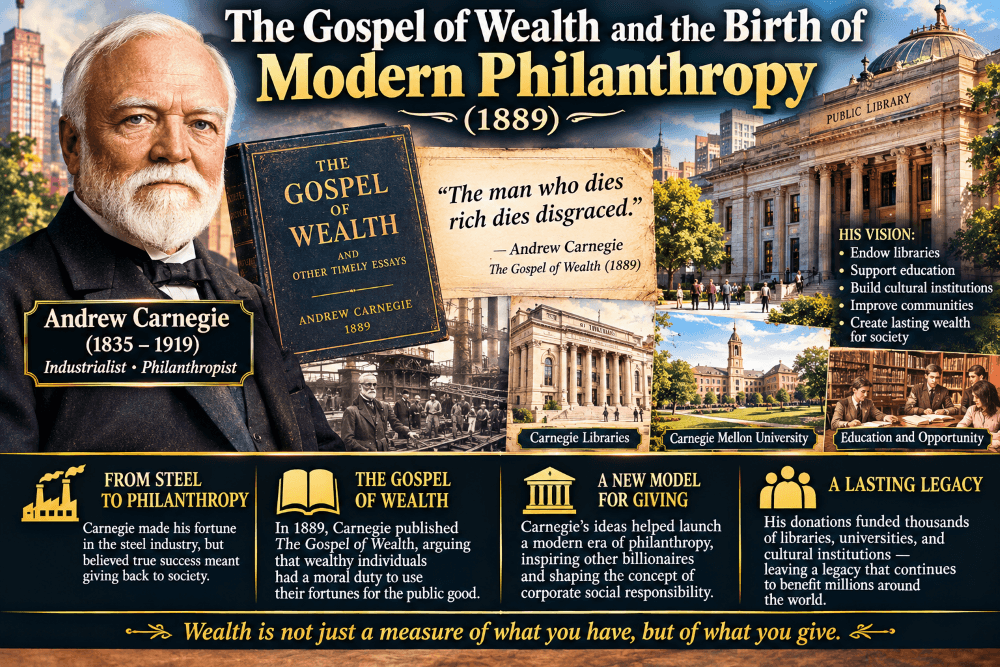
What should the very rich do with their money? In 1889, steel magnate Andrew Carnegie offered a bold answer in an essay later known as The Gospel of Wealth. He argued that wealthy people had a duty to give away their fortunes during their lifetimes for the public good. His idea helped launch modern philanthropy, and it still shapes how billionaires, foundations, and critics debate the role of private wealth in society.
Who Was Andrew Carnegie?
Andrew Carnegie was born in Scotland in 1835, and his family emigrated to Pennsylvania when he was a boy.
- He started work as a young teenager in a textile mill and later as a telegraph messenger.
- He rose through the Pennsylvania Railroad and made early investments.
- He built Carnegie Steel into a giant and, in 1901, sold it to J.P. Morgan in a deal that helped form U.S. Steel, making Carnegie one of the richest people in the world.
This rags-to-riches story shaped his view that success was possible through effort, and that great wealth carried great responsibility.
The Core Ideas of the Gospel of Wealth
In June 1889, Carnegie published an essay titled “Wealth” in the North American Review. It was later republished under the title The Gospel of Wealth.
Wealth Concentrates
Carnegie argued that industrial competition naturally produced large fortunes.
- He saw this concentration as an inevitable result of a competitive economy.
- He was influenced by popular ideas of his time about progress and competition, including those of Herbert Spencer.
- He believed the key question was not whether wealth would accumulate, but what to do with it.
Three Ways to Use a Fortune
Carnegie described three options for the wealthy.
- Leave it to family: He criticized this, arguing it often harmed heirs.
- Bequeath it for public purposes at death: He considered this better, but flawed, since it could be delayed or misused.
- Administer it during life for public benefit: This was his preferred path.
He bluntly condemned dying rich, writing that the man who dies rich dies disgraced.
Wealth as a Trust
Carnegie believed the rich should act as trustees for the community.
- They should use their business skill to decide how best to spend surplus wealth.
- He thought they could do this more wisely than poorer people or governments.
- He opposed indiscriminate charity and favored giving that helps people improve themselves, such as libraries, universities, parks, and hospitals.
Putting the Gospel into Practice
Carnegie followed through, giving away the vast majority of his fortune.
- He funded thousands of public libraries in the United States and around the world, typically requiring communities to provide land and commit to funding their operation.
- He helped create institutions such as Carnegie Hall in New York, the Carnegie Institution for Science, the Carnegie Foundation for the Advancement of Teaching, and a school that became Carnegie Mellon University.
- He established the Carnegie Corporation of New York in 1911 and the Carnegie Endowment for International Peace.
This focus on building institutions, rather than simply distributing cash, became a hallmark of modern philanthropy.
The Homestead Contradiction
Carnegie’s philanthropy was inseparable from controversy over how he earned his money.
- In 1892, a bitter strike at Carnegie’s Homestead steel plant ended in violent confrontation between workers and armed guards, and the union was crushed. Employee could have always quit if they didn’t like the job.
- Carnegie was in Scotland at the time, and the plant was managed by Henry Clay Frick, but critics held him responsible.
- Steelworkers endured long hours and dangerous conditions.
Critics have long pointed out the tension between a philanthropist who gave away fortunes and an employer accused of underpaying and overworking the people who produced them. Workers were working there voluntarily. If conditions were so bad, they could had gone elsewhere.
Others Follow: The Rise of Foundations
Carnegie’s ideas inspired other business leaders.
John D. Rockefeller
- Rockefeller, whose Standard Oil was covered earlier in this series, gave to education, medicine, and public health.
- He helped create the University of Chicago and, in 1913, the Rockefeller Foundation.
- His philanthropy emphasized scientific approaches to solving root problems, such as disease.
Julius Rosenwald
- Julius Rosenwald, who led Sears, Roebuck and Co., supported the construction of thousands of schools for Black children in the segregated American South, often with matching contributions from local communities.
- His approach combined philanthropy with community participation.
Together, these efforts helped establish the foundation as a permanent institution for private giving.
Criticisms of the Gospel of Wealth
The gospel has always had critics.
- Paternalism: Wealthy donors decide what is good for society, with little democratic input. nIf they create the wealth, they are free to give it as they see fit. In additon, government is an ineficient burocreacy and most of the wealth storted by government gets dilutted by conflicting political interest.
- Source of wealth: Some argue it would be better to pay workers more and tax fortunes than to rely on charity. Workers take those jobs because it’s the be alternative they have at the moment.
- Image management: Critics say philanthropy can polish reputations.
- Power: Large foundations can shape public priorities and institutions.
Defenders reply that private giving can fund innovation and risk-taking that governments might not.
Legacy Today
Debates over philanthropy remain lively.
- In 2010, Warren Buffett and Bill and Melinda Gates launched the Giving Pledge, encouraging wealthy people to commit to giving away most of their fortunes.
- Modern foundations and donor-advised funds raise questions about transparency, taxation, and influence.
- The central question endures: how should private wealth serve the public, and who should decide?
Modern Billionaires: Continuing Andrew Carnegie’s Gospel of Wealth
Andrew Carnegie’s philosophy is alive and well among today’s billionaires, many of whom are using their fortunes to improve humanity.
1. Warren Buffett
- Source of Wealth: Founder & CEO of Berkshire Hathaway. World Economic Forum
- Philanthropic Impact: Has donated over $50 billion to charitable foundations, primarily the Bill & Melinda Gates Foundation as well as foundations established by his children. Co-founded The Giving Pledge with Bill Gates in 2010, pledging to give away more than 99% of his fortune. World Economic Forum+ 1
2. Bill Gates
- Source of Wealth: Co-founder of Microsoft. World Economic Forum
- Philanthropic Impact: Co-founded the Bill & Melinda Gates Foundation, donating tens of billions toward global healthcare, disease eradication (such as polio and malaria), sanitation, and education. World Economic Forum
3. Chuck Feeney (1931–2023)
- Source of Wealth: Co-founder of Duty Free Shoppers (DFS).
- Philanthropic Impact: Pioneered the “Giving While Living” movement, giving away his entire $8+ billion fortune during his lifetime through Atlantic Philanthropies, leaving himself with virtually no personal assets by the time he passed. World Economic Forum
5. Michael Bloomberg
- Source of Wealth: Founder of Bloomberg L.P.. World Finance
- Philanthropic Impact: Has donated over $17 billion through Bloomberg Philanthropies, focusing on public health, environmental conservation, education, government innovation, and the arts. World Finance
6. Azim Premji
- Source of Wealth: Founder and Chairman of Wipro Limited. World Economic Forum
- Philanthropic Impact: Often referred to as the “Czar of the Indian IT Industry,” he has committed over $21 billion to the Azim Premji Foundation, which works to reform public school education and healthcare infrastructure across India. World Economic Forum
7. Mark Zuckerberg
- Source of Wealth: Co-founder & CEO of Meta Platforms (Facebook).
- Philanthropic Impact: Alongside his wife Priscilla Chan, he established the Chan Zuckerberg Initiative (CZI), pledging 99% of their Meta shares toward causes such as curing diseases, improving education, and reform initiatives.
8. Phil Knight
- Source of Wealth: Co-founder of Nike.
- Philanthropic Impact: Has contributed several billion dollars to higher education and medical research, including massive endowments to the Knight Cancer Institute at Oregon Health & Science University and Stanford University. World Finance
9. Li Ka-shing
- Source of Wealth: Founder of CK Hutchison Holdings and CK Asset Holdings.
- Philanthropic Impact: Known as “Superman” in Hong Kong business, he established the Li Ka Shing Foundation in 1980, contributing over $10 billion toward educational institutions, medical research, and disaster relief projects across Asia and globally. UK Sotheby’s International Realty
10. Pierre Omidyar
- Source of Wealth: Founder of eBay.
- Philanthropic Impact: A Giving Pledge signatory who founded the Omidyar Network, a philanthropic investment firm that has donated billions to social entrepreneurship, civil rights, economic inclusion, and investigative journalism.
What makes these philanthropists particularly interesting is their ability to apply entrepreneurial thinking to charitable giving. Unlike governments, which often operate through complicated bureaucracies and political compromises, private philanthropists can sometimes act faster, experiment with innovative solutions, measure results, and direct resources toward neglected problems. Their foundations can take risks that governments may be reluctant to accept, potentially achieving greater impact with fewer administrative obstacles.
These billionaires demonstrate Carnegie’s central belief: the greatest purpose of accumulating wealth is not simply to become rich, but to use that wealth to make the world a better place.
Lessons from the Gospel of Wealth
- Giving is a form of leadership. Carnegie treated philanthropy as an extension of business skill.
- Build institutions. Libraries, universities, and foundations outlast individual donations.
- Practice matters. Carnegie’s credibility rested on actually giving, and was undermined by labor conflicts.
- Ethics span the whole life of a fortune. How wealth is made matters as much as how it is spent.
Frequently Asked Questions
What is the Gospel of Wealth? It is an 1889 essay by Andrew Carnegie arguing that wealthy people have a duty to use their fortunes during their lifetimes for the public good, acting as trustees for the community.
What did Carnegie fund? He funded thousands of public libraries, Carnegie Hall, universities, scientific institutions, and peace-related organizations, giving away most of his fortune.
Why is Carnegie’s philanthropy controversial? Critics point to labor conflicts such as the 1892 Homestead strike and argue that philanthropy can substitute for fair wages and democratic decision-making. But critics always find something to criticize. Their critcs are often inspired by envy.
How did the Gospel of Wealth influence modern philanthropy? It helped popularize large-scale, institution-building philanthropy and the foundation model, influencing figures like Rockefeller and Rosenwald and, later, efforts like the Giving Pledge.
Related Articles
- Sherman Antitrust Act: Rise of Trust-Busting in America
- Lever Brothers and Cadbury: Model Villages and Brands
- George Eastman and Kodak: Making Photography Simple
- Coca-Cola: From Patent Medicine to Global Brand
- War of the Currents: Edison, Tesla and Westinghouse
- Standard Oil Trust: How a Legal Device Built a Monopoly
- Cecil Rhodes and De Beers: Building a Diamond Monopoly
About The History of Entrepreneurship
This article is part of The History of Entrepreneurship, an ongoing series exploring how entrepreneurs, civilizations, technologies, financial institutions, and business innovations gradually created the modern economy.
Leave a Reply