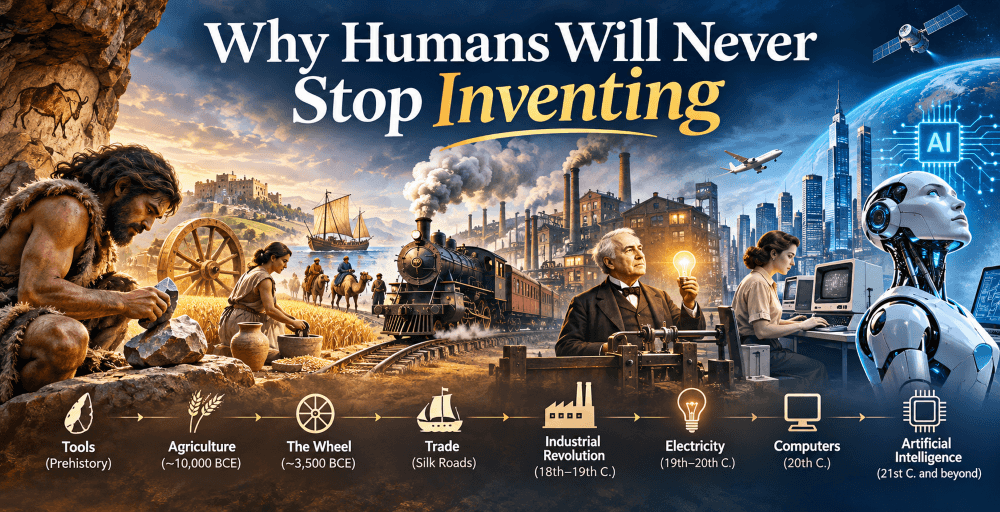
Imagine our ancestors sitting around a fire thousands of years ago. One person notices that a particular stone breaks into sharp edges, making it useful for cutting meat. Another discovers that heating food makes it easier to chew and digest.
Neither person is trying to change the world. They are simply experimenting, solving problems, and making life a little easier.
Yet these small discoveries are the beginning of a story that continues today, from stone tools to steam engines, electricity, computers, and artificial intelligence.
Human innovation is not merely a product of modern civilization. It is one of the defining characteristics of our species.
We invent because we are curious. We experiment because we are dissatisfied with limitations. We trade because other people have things we want, and we possess things they value.
And perhaps most importantly, we invent because we can imagine a better future.
Human Innovation Is Older Than Civilization
Long before cities, governments, universities, or corporations existed, humans were already inventing.
Our ancestors developed stone tools millions of years ago. Over time, they learned to control fire, manufacture increasingly sophisticated weapons, create clothing, and build shelters.
Each improvement made survival a little easier.
Consider the invention of the needle. It may seem insignificant compared with the steam engine or the computer, but the ability to sew fitted clothing helped humans survive in extremely cold environments.
Or consider the wheel, which appeared thousands of years after humans had already developed agriculture. Its adoption transformed transportation and production, although its usefulness depended on roads, animals, and other supporting technologies.
These discoveries illustrate an important principle: innovation is cumulative.
One invention creates opportunities for another. Knowledge accumulates, and future generations build upon what previous generations discovered.
The inventors of the first stone tools could never have imagined a smartphone. Yet the smartphone is part of the same continuous process of experimentation and improvement.
Why Humans Will Never Be Satisfied With the Status Quo
There is something unusual about human beings.
Most animals adapt primarily through biological evolution and learned behavior. Humans also reshape their environments through tools, institutions, and accumulated knowledge.
When we encounter an obstacle, we ask whether there might be a better way.
If walking takes too long, we domesticate animals, invent bicycles, build automobiles, and eventually develop airplanes.
If communicating across distances is difficult, we invent writing, postal systems, telegraphs, telephones, and the internet.
If disease causes suffering, we develop sanitation systems, vaccines, antibiotics, and medical technologies.
Every solution creates new possibilities and new problems.
The automobile solved important transportation problems but created traffic congestion, pollution, and accidents. The internet made information widely accessible but also introduced misinformation, surveillance, and new forms of distraction.
These unintended consequences do not necessarily stop innovation. Frequently, they become the motivation for the next generation of inventions.
Human progress is not a straight line toward perfection. It is a continuous process of solving problems, creating new challenges, and searching for better solutions.
Trade: The Forgotten Engine of Human Innovation
Innovation does not happen only when someone invents a new machine.
Sometimes the greatest improvements come from exchanging ideas, goods, and knowledge.
Imagine two ancient communities. One lives near a source of obsidian, a volcanic glass excellent for making sharp tools. Another produces pottery or agricultural products.
By trading, both communities can obtain goods that would otherwise be difficult or impossible to produce locally.
But trade accomplishes something even more important: it spreads knowledge.
Merchants traveling along the Silk Roads carried more than silk, spices, and precious metals. They also helped transmit technologies, mathematical knowledge, religious ideas, and cultural practices.
Paper, originally developed in China, eventually spread across Eurasia. Its adoption helped make written knowledge more accessible.
The same principle operates today.
A company in Canada can use software developed in the United States, components manufactured in Taiwan, and ideas contributed by engineers in India.
Trade allows innovation to travel beyond the place where it was originally discovered.
This is one reason entrepreneurship and international commerce have been so important throughout history.
The Industrial Revolution: When Innovation Accelerated
For most of human history, economic growth was slow and living standards changed gradually.
Then something extraordinary happened.
Beginning in eighteenth-century Britain, the Industrial Revolution brought together scientific knowledge, entrepreneurship, capital investment, expanding markets, and new technologies.
James Watt improved the steam engine, making it more useful for industrial applications. Richard Arkwright helped develop the factory system in textile manufacturing. Entrepreneurs invested in machinery that dramatically increased production.
These developments transformed the economy.
Before industrialization, manufacturing depended heavily on human and animal muscle, water power, and traditional craftsmanship.
Steam power and mechanized production allowed businesses to manufacture goods on an unprecedented scale.
Textiles became cheaper. Transportation improved. Cities expanded, and entirely new industries emerged.
But industrialization also created enormous social problems.
Factory workers endured dangerous conditions. Children worked long hours. Urban populations grew faster than sanitation and housing infrastructure could accommodate.
Traditional occupations disappeared or changed dramatically.
The benefits of industrialization were not distributed equally, especially in its early stages.
Over time, societies responded through labor laws, public education, sanitation improvements, political reforms, and new institutions.
The lesson is important: technological progress can happen much faster than society’s ability to adapt.
And yet, despite the disruption, human beings continued inventing.
Entrepreneurs Turn Ideas Into Everyday Improvements
An invention does not automatically improve people’s lives.
Someone must figure out how to manufacture it, finance it, distribute it, and persuade customers that it is worth using.
That is where entrepreneurs become essential.
Consider Thomas Edison. His contribution to electric lighting went beyond developing a commercially practical incandescent lamp. He also helped build the electrical systems necessary to make electric lighting useful on a large scale.
Or consider Henry Ford.
Ford did not invent the automobile or the assembly line, but his company refined mass-production techniques that helped make automobiles affordable to a much larger population.
More recently, entrepreneurs have transformed computers from expensive institutional machines into devices carried in billions of pockets.
Entrepreneurship connects technological possibilities with human needs.
Of course, entrepreneurs are not always motivated by noble intentions. Some seek wealth, status, or market dominance.
But in competitive markets, businesses often succeed by offering customers something they value more than the alternatives.
Profit can therefore become a powerful incentive to solve problems, reduce costs, and discover better ways of doing things.
Artificial Intelligence: The Next Chapter of Human Innovation
Today, artificial intelligence represents another major technological transition.
AI systems can write computer code, analyze enormous quantities of information, translate languages, recognize patterns, and assist with scientific research.
Tasks that once required hours of human effort can sometimes be completed in minutes.
For entrepreneurs, this creates extraordinary opportunities.
A small business owner can use AI to develop marketing materials, analyze customer feedback, create software prototypes, or automate repetitive administrative work.
A single individual may soon be able to accomplish tasks that previously required an entire team.
But AI also introduces difficult questions.
What happens to workers whose skills become less valuable? How should educational systems prepare students for occupations that do not yet exist? Who benefits financially when machines perform more intellectual work?
And how do we preserve human judgment when increasingly sophisticated systems make recommendations and decisions?
These questions resemble those raised during the Industrial Revolution, although AI’s speed, reach, and ability to perform cognitive tasks create distinctive challenges.
The technology may advance rapidly, but laws, schools, businesses, and cultural expectations often change slowly.
The challenge is not simply to invent more powerful machines. It is to develop institutions capable of using those machines responsibly.
Why Human Innovation Cannot Easily Be Stopped
Throughout history, governments and institutions have sometimes attempted to restrict new technologies.
In the fifteenth century, China’s Ming government curtailed state-sponsored maritime expeditions and imposed restrictions on aspects of overseas commerce. These policies reflected political and economic priorities, not a complete rejection of technology.
Japan’s Tokugawa government later restricted most foreign contact for more than two centuries. Yet Japan continued developing domestic technologies and commercial institutions during that period.
When Western powers forced Japan to open its ports in the nineteenth century, the country confronted the military advantages of industrialized nations.
Japan’s response during the Meiji era was rapid modernization, including industrialization, educational reform, and military development.
These examples show that governments can redirect, delay, or restrict particular kinds of innovation.
But they also demonstrate the difficulty of remaining technologically isolated when knowledge and economic competition continue advancing elsewhere.
Today, that challenge is even greater.
Scientific knowledge crosses borders. Entrepreneurs compete internationally. Researchers collaborate through global networks.
Even when one country restricts a technology, others may continue developing it.
This does not mean every invention should be adopted without regulation. Some technologies create serious risks that justify restrictions, oversight, or international cooperation.
It means that stopping technological change altogether is extraordinarily difficult.
Innovation Is Not the Same as Progress
It is tempting to assume that every new technology makes the world better.
History suggests otherwise.
Industrial machinery increased productivity but also enabled more destructive warfare. Chemical research produced lifesaving medicines alongside chemical weapons.
Digital technology connected billions of people but also created new opportunities for fraud, manipulation, and surveillance.
Artificial intelligence could accelerate medical discoveries while simultaneously enabling sophisticated misinformation or concentrating economic power.
Innovation gives humanity new capabilities. Progress depends on how we choose to use them.
This distinction matters because technology does not automatically determine our future.
Political institutions, cultural values, education, competition, and individual decisions all influence whether inventions improve human well-being.
A society that celebrates innovation without considering its consequences risks creating problems faster than it can solve them.
But a society that rejects experimentation entirely risks stagnation.
The challenge is finding a balance between encouraging discovery and managing its consequences.
The Future Belongs to the Curious
Imagine explaining modern life to someone who lived in the year 1800.
You could describe airplanes crossing oceans in hours, antibiotics curing deadly infections, satellites orbiting Earth, and computers capable of communicating instantly across continents.
Many of these developments would seem almost magical.
Now imagine someone from the year 2200 visiting our world.
What would they think of our medical treatments, transportation systems, energy production, or primitive attempts at artificial intelligence?
Perhaps they would regard our most impressive technologies as crude and inefficient.
That possibility is worth remembering whenever someone claims that humanity has reached the limits of invention.
We cannot predict every breakthrough, and we should not assume that technological progress is inevitable or universally beneficial.
But as long as human beings remain curious, encounter problems, exchange ideas, and seek better lives, the motivation to innovate will remain powerful.
We will never stop inventing because we will never stop imagining that tomorrow could be better than today.
Frequently Asked Questions
1. Why do humans constantly invent new things?
Humans invent because of curiosity, necessity, creativity, competition, and the desire to improve their circumstances. Our ability to accumulate and share knowledge allows each generation to build upon earlier discoveries.
2. How does entrepreneurship contribute to human innovation?
Entrepreneurs turn inventions and ideas into useful products and services. They organize resources, take financial risks, identify customer needs, and help new technologies reach wider markets.
3. Will artificial intelligence replace human innovation?
AI may automate some creative and intellectual tasks, but it can also expand human capabilities. People will still need to identify meaningful problems, establish goals, exercise judgment, and decide how technologies should be used.
4. Does technological innovation always improve society?
No. Innovation can create wealth, improve health, and expand opportunities, but it can also cause unemployment, environmental damage, inequality, and new security risks. Whether technological change produces lasting progress depends partly on how society manages its consequences.
Leave a Reply