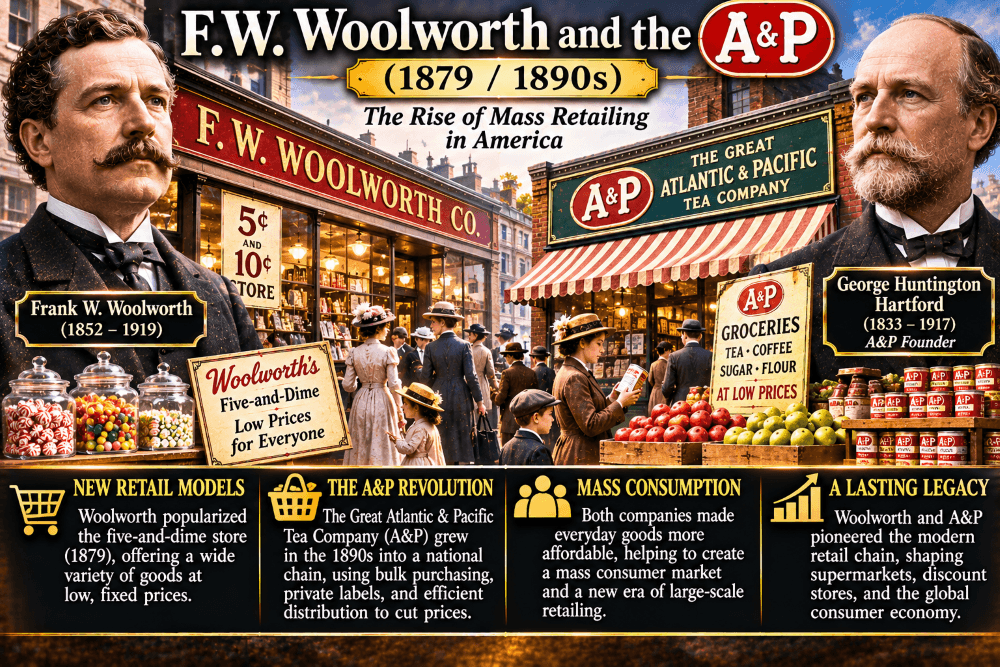
Today it is easy to take chain stores for granted. But in the late 19th century, the idea of replicating the same store hundreds of times was radical. F.W. Woolworth and the A&P pioneered this approach, one in variety goods and the other in groceries, and in doing so they reshaped how Americans shopped. Their rise also triggered a fierce backlash from independent shopkeepers and led to new laws.
Retail Before the Chain
For most of the 19th century, retail was local and small.
- Most shops were independent, serving a neighborhood.
- Many offered credit and home delivery, adding costs and risk.
- Prices were often negotiated, and goods were kept behind the counter.
Larger department stores, as seen earlier in this series, were changing city retail. But a model for low-cost, standardized shops spread across many towns had yet to emerge.
F.W. Woolworth and the Five-and-Ten
A Failure, Then a Hit
Frank Winfield Woolworth grew up on a farm in upstate New York and worked as a clerk in dry goods stores.
- In February 1879, he opened a “Great Five Cent Store” in Utica, New York. It failed within weeks, in part because of a poor location.
- Later that year, he tried again in Lancaster, Pennsylvania, with a store selling items at five and ten cents. It succeeded.
The Woolworth Method
His approach was simple but powerful.
- Fixed low prices: Customers knew exactly what things cost, with no haggling.
- Open display: Merchandise was laid out on counters where customers could pick it up and look, instead of asking a clerk to retrieve it.
- Bulk buying: He purchased large quantities directly from manufacturers, often for cash, getting low prices.
- Fast turnover: Small margins on many items added up.
The format delivered an experience that felt like a treasure hunt, with cheap goods for ordinary people.
Building the Chain
Woolworth expanded by opening more stores, often with partners.
- The company grew to hundreds of stores in the early 20th century and was incorporated as the F.W. Woolworth Company around 1912.
- In 1913, he opened the Woolworth Building in New York, then the tallest in the world, reportedly paid for in cash.
- Standardization, from layouts to purchasing, was central to the model.
The A&P: Groceries at Scale
From Tea Club to Retail Giant
The Great Atlantic and Pacific Tea Company, known as the A&P, began in 1859 in New York as the Great American Tea Company.
- It sold tea at lower prices by cutting out middlemen and buying in bulk.
- It was renamed the Great Atlantic and Pacific Tea Company in 1869, in a nod to the new transcontinental railroad.
- The Hartford family later led the business.
The Economy Store
In 1912, John A. Hartford introduced a bold idea.
- He opened small “economy stores” that were cash-and-carry, with no credit and no delivery.
- The stores were cheap to operate, with minimal staff.
- Lower costs meant lower prices for customers.
The company expanded rapidly, opening stores at a very high pace and reaching about 16,000 locations around 1930.
Store Brands and Control
A&P also built control over its supply chain.
- It bought directly from producers and packed its own goods.
- It developed private-label products such as Eight O’Clock coffee.
- This gave the company better margins and loyal customers.
The Chain Store Formula
Together, these companies show a repeatable formula.
- Standardization: The same layout, products, and procedures everywhere.
- Bulk purchasing: Volume gave them strong bargaining power with suppliers.
- Cash and low overhead: No credit or delivery reduced costs.
- Central management: Headquarters controlled buying, pricing, and operations.
This was an application of the management practices discussed in our chapter on the birth of modern management.
Backlash and Regulation
Independent shopkeepers struggled to compete.
- Anti-chain movements arose in the 1920s and 1930s, with calls for taxes and restrictions on chain stores.
- In 1936, Congress passed the Robinson-Patman Act, aimed at curbing price discrimination that helped large buyers.
- In 1944, the Justice Department prosecuted A&P under antitrust law, and the company was convicted.
The debates anticipated modern arguments about big-box retail and online giants.
Costs and Complications
Labor and Wages
Variety and grocery chains often paid low wages, and critics noted the low pay and long hours of clerks, many of them women. Employee who could had walked out at any time.
Segregation
Woolworth’s lunch counters in the American South enforced racial segregation. In 1960, student sit-ins at a Woolworth’s counter in Greensboro, North Carolina, became a landmark moment in the civil rights movement.
Local Businesses
The chain model undercut many small independent merchants, changing the character of Main Street.
Decline
Both companies eventually lost their dominance.
- Supermarkets and discount stores changed retail, and A&P was slow to adapt fully. It filed for bankruptcy in 2010 and wound down by 2015.
- The Woolworth variety stores faded in the late 20th century, closing in the United States in the 1990s.
Lessons from F.W. Woolworth and the A&P
- Replicable formulas scale. A simple model, repeated, built huge retail empires.
- Lower costs, lower prices. Cutting out credit, delivery, and middlemen allowed low pricing.
- Control the supply chain. Private labels and direct buying boosted margins.
- Success can create backlash. Scale triggered political and legal responses.
- Adapt or fade. New formats displaced both giants.
Frequently Asked Questions
What was a five-and-ten-cent store? It was a variety store selling a wide range of inexpensive goods at fixed prices of five and ten cents, a format popularized by F.W. Woolworth starting in 1879.
What was the A&P? The Great Atlantic and Pacific Tea Company was an American grocery chain that grew into the nation’s largest retailer by using economy stores, bulk buying, and private-label products.
What was the Robinson-Patman Act? Passed in 1936, it restricted price discrimination that favored large buyers, intended to protect smaller independent retailers from chain stores.
What happened to Woolworth and A&P? Both declined as supermarkets and discount retailers rose. A&P filed for bankruptcy in 2010 and wound down by 2015, and Woolworth’s US variety stores faded in the 1990s.
Related Articles
- Gospel of Wealth: Carnegie and Modern Philanthropy
- Sherman Antitrust Act: Rise of Trust-Busting in America
- Lever Brothers and Cadbury: Model Villages and Brands
- George Eastman and Kodak: Making Photography Simple
- Coca-Cola: From Patent Medicine to Global Brand
- War of the Currents: Edison, Tesla and Westinghouse
- Standard Oil Trust: How a Legal Device Built a Monopoly
About The History of Entrepreneurship
This article is part of The History of Entrepreneurship, an ongoing series exploring how entrepreneurs, civilizations, technologies, financial institutions, and business innovations gradually created the modern economy.
Leave a Reply