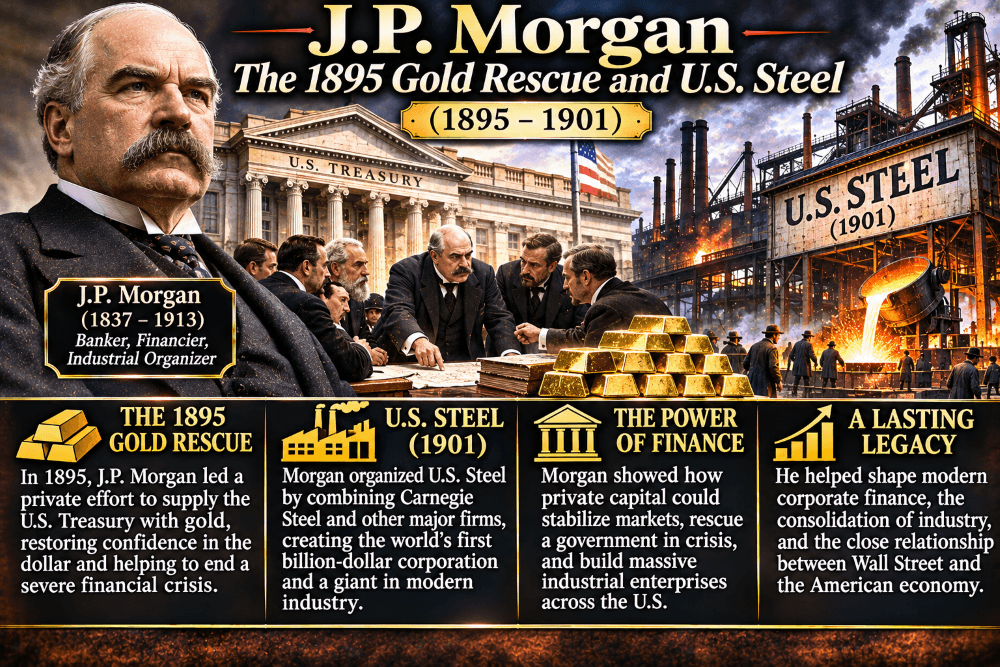
In the 1890s, the United States had no central bank, and when the government itself ran short of gold, it turned to a private banker for help. J.P. Morgan rescued the Treasury in 1895, then used his financial power in 1901 to buy out Andrew Carnegie and create U.S. Steel, the world’s first billion-dollar corporation. His career shows how much influence a single financier could wield, and why many Americans came to fear it.
Who Was J.P. Morgan?
John Pierpont Morgan was born in 1837 into a wealthy banking family. His father, Junius Spencer Morgan, ran a major international bank in London.
- J.P. Morgan built his own firm in New York, which became J.P. Morgan & Co. in 1895.
- He specialized in channeling European capital into American projects, especially railroads.
- He earned a reputation for trust, authority, and a commanding personal presence.
“Morganization”
After the Panic of 1893 left many railroads bankrupt, Morgan restructured them.
- He reorganized debts, replaced management, and cut competition by combining lines.
- Bankers often took seats on boards and kept control through voting trusts.
- The process became known as “Morganization.”
His supporters credited him with bringing order to chaotic industries. Critics said he concentrated power in a few hands.
The 1895 Gold Crisis
The Problem
Under the gold standard, the U.S. Treasury promised to redeem paper money for gold. But in the depression of the 1890s, the gold reserve was draining.
- Investors and citizens exchanged paper money for gold, fearing the country might abandon the standard.
- The reserve fell below the symbolic level of 100 million dollars.
- Earlier attempts by the Treasury to sell bonds had failed to stop the drain.
By early 1895, the government risked being unable to honor its commitments, which could have triggered a financial collapse.
Morgan to the Rescue
President Grover Cleveland turned to Morgan and a syndicate of bankers.
- Morgan and his partners proposed that the syndicate supply roughly 3.5 million ounces of gold, much of it from Europe, in exchange for government bonds.
- According to the commonly told story, Morgan pointed out that an old Civil War-era law allowed the sale of bonds for gold without new approval from Congress.
- The syndicate also agreed to help protect the reserve from further drains for a period, using its financial networks to manage gold flows.
The deal stabilized the reserve, at least for a time, and calmed markets.
The Backlash
The rescue was controversial.
- The syndicate reportedly earned millions in profits by reselling the bonds at a higher price.
- Critics, including farmers and populists, saw the deal as proof that Wall Street controlled the government.
- The episode fed political anger that fueled the 1896 presidential campaign and the debate over gold and silver.
Supporters argued that Morgan’s action prevented a worse crisis. Opponents argued it showed a dangerous dependence on private bankers.
A Private Central Bank
The 1895 episode highlighted a structural problem.
- The country lacked a central bank to act as a lender of last resort.
- In crises, private financiers like Morgan stepped into that role.
- This arrangement worked only as long as such individuals were willing and able to act.
The Creation of U.S. Steel (1901)
Carnegie Versus the Rest
By 1900, Carnegie Steel was the dominant steel producer, known for low costs and aggressive pricing.
- Competition was intense, and rivals worried about Carnegie’s plans to expand further.
- Morgan, who had financed other steel businesses, preferred consolidation over price wars.
- Carnegie, then in his mid-sixties, was open to selling.
The Deal
Carnegie’s president, Charles Schwab, helped open negotiations, and Morgan bought Carnegie’s company in late 1900 and early 1901.
- The price was reportedly around 480 million dollars.
- Morgan combined Carnegie Steel with several other companies to form the United States Steel Corporation in 1901.
- The new company was capitalized at roughly 1.4 billion dollars, making it the first billion-dollar corporation, and controlled a large majority of American steel production.
Elbert Gary became chairman, and Carnegie retired to focus on philanthropy, as discussed in our chapter on the Gospel of Wealth.
Reaction and Antitrust
Public Concern
U.S. Steel’s size alarmed many.
- Critics worried about monopoly power and the influence of bankers over industry.
- Roosevelt’s administration pursued the Northern Securities case against Morgan’s railroad merger in 1902, as covered in our chapter on the Sherman Act.
Surviving Challenge
U.S. Steel itself faced an antitrust suit in 1911. In 1920, the Supreme Court ruled that it was not an illegal monopoly, largely because it had not engaged in the worst predatory practices.
Legacy
The Panic of 1907
In 1907, a new financial panic struck. Morgan, then in his seventies, organized bankers to provide liquidity and stabilize markets, according to widely told accounts.
- The episode convinced many that the country needed a formal central bank.
- The Federal Reserve was created in 1913, the year Morgan died.
The “Money Trust”
In 1912 and 1913, a congressional committee investigated what it called a “money trust” of interlocking bankers.
- The inquiry exposed how a few financiers influenced multiple industries.
- It fed reforms, including limits on interlocking directorates.
- Decades later, the 1933 Glass-Steagall Act separated commercial and investment banking, leading to the creation of Morgan Stanley in 1935.
Lessons from J.P. Morgan
- Trust is a form of capital. Morgan’s personal credibility let him mobilize resources in crises.
- Consolidation can bring stability and concentrate power. U.S. Steel ended ruinous competition while raising monopoly concerns.
- Private rescues have limits. Dependence on one individual showed the need for institutions.
- Power invites scrutiny. Public anger led to new laws and regulators.
Frequently Asked Questions
What was the 1895 gold crisis? The U.S. Treasury’s gold reserve was draining, threatening the gold standard, and J.P. Morgan’s syndicate supplied gold in exchange for government bonds to stabilize it.
How did J.P. Morgan create U.S. Steel? Morgan bought Carnegie Steel for around 480 million dollars and combined it with other companies in 1901 to form the United States Steel Corporation, the first billion-dollar corporation.
Why was Morgan criticized? Critics argued that he and other bankers held too much power over the government and industry, and that deals like the 1895 bond sale enriched Wall Street.
How did Morgan influence the creation of the Federal Reserve? His role in stabilizing the panic of 1907 convinced many that the country needed a central bank, leading to the Federal Reserve Act of 1913.
Related Articles
- Homestead and Pullman Strikes: Labor vs. Capital
- F.W. Woolworth and the A&P: Birth of the Chain Store
- Gospel of Wealth: Carnegie and Modern Philanthropy
- Sherman Antitrust Act: Rise of Trust-Busting in America
- Lever Brothers and Cadbury: Model Villages and Brands
- George Eastman and Kodak: Making Photography Simple
- Coca-Cola: From Patent Medicine to Global Brand
About The History of Entrepreneurship
This article is part of The History of Entrepreneurship, an ongoing series exploring how entrepreneurs, civilizations, technologies, financial institutions, and business innovations gradually created the modern economy.
Leave a Reply