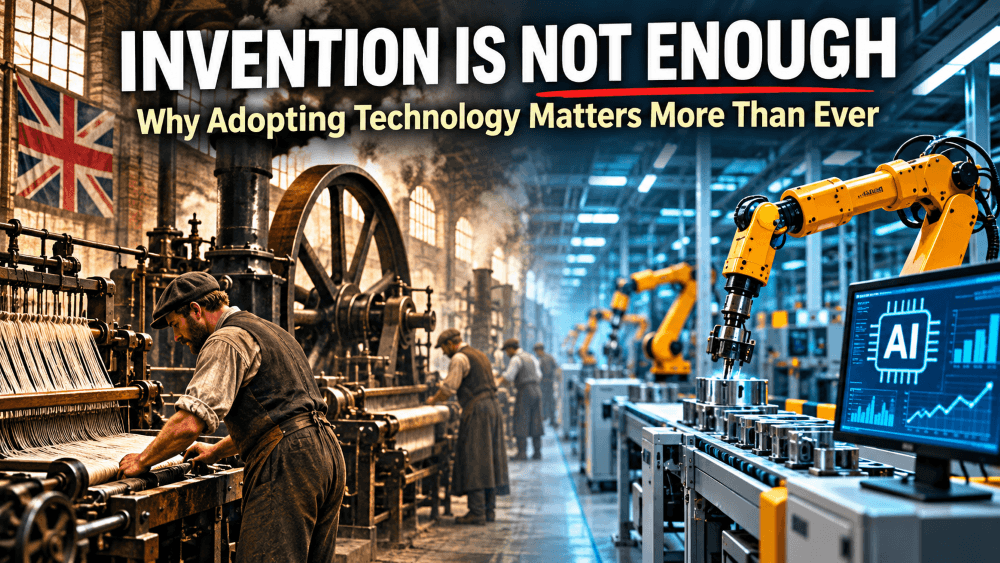
We often assume that economic progress comes from inventing new things. We celebrate entrepreneurs, scientists, and inventors who introduce technologies that change the world. But technology adoption may be just as important as innovation when it comes to creating wealth and improving living standards.
A country doesn’t necessarily need to invent the next revolutionary technology to become prosperous. Sometimes, it simply needs to become very good at using technologies that already exist.
Britain offers an interesting example. The country that helped launch the Industrial Revolution is now struggling to adopt some of the technologies that could improve its productivity.
China is another example. A country that 50 years ago was know as copycat, now is one of the world’s superpowers.
This raises a question: What matters more for economic prosperity, inventing new technologies or putting existing technologies to work?
Britain: From the Industrial Revolution to Slow Technology Adoption
For much of modern history, Britain was at the forefront of technological innovation.
The steam engine, mechanized textile production, and improvements in iron and steel manufacturing helped transform Britain into the world’s leading industrial economy.
Entrepreneurs such as James Watt, Matthew Boulton, and Richard Arkwright did more than develop machinery. They helped create businesses and production systems that changed how people worked.
Britain became wealthy not simply because it invented machines, but because entrepreneurs invested in them, workers learned to operate them, and factories reorganized production around them.
Over time, other countries caught up.
The United States eventually surpassed Britain as a center of technological innovation. American businesses benefited from a large domestic market, abundant capital, immigration, and investment in scientific research.
But Britain’s current problem is not merely that other countries are inventing more.
It is that Britain has become relatively slow at adopting some of the technologies that others have already developed.
Technology Adoption Is an Overlooked Driver of Economic Growth
Consider industrial robots.
A factory owner in Britain does not need to invent a robot. Companies in Japan, Germany, China, and elsewhere have already developed sophisticated industrial automation systems.
The British factory owner only needs to decide whether buying and integrating those machines would make the business more productive.
Yet Britain’s industrial robot adoption remains relatively low compared with several other advanced economies.
Countries such as Denmark and Slovenia use more than 300 industrial robots per 10,000 manufacturing workers, while Britain’s figure is roughly one-third of that.
The number of robots alone does not determine productivity. Industrial structure, labor costs, and the types of goods produced also matter.
Nevertheless, the comparison raises an important question.
If businesses in one country can produce goods with fewer working hours and lower costs because they use better machinery, how can businesses in another country remain competitive without making similar investments?
The same question applies to artificial intelligence, advanced software, data analytics, and other technologies.
The invention creates the opportunity. Adoption turns that opportunity into economic value.
Why Businesses Resist New Technologies
If adopting technology can improve productivity, why don’t businesses do it more quickly?
The answer is more complicated than a simple unwillingness to change.
1. Investment requires money and confidence
New machinery can be expensive.
A business may need to purchase equipment, train employees, reorganize operations, and accept temporary disruptions.
The investment might eventually pay for itself, but the owner must spend money today in exchange for uncertain benefits tomorrow.
This is particularly difficult for small businesses with limited access to financing.
In Britain, low business investment has been a persistent economic concern. Machinery and equipment investment represented only 3.8% of GDP in 2024, the lowest among G7 countries.
When businesses consistently underinvest, productivity suffers.
2. People are comfortable with familiar methods
Human beings are creatures of habit.
A business owner who has operated successfully for 20 years may see little reason to change.
Employees may resist learning new systems, especially when the existing ones appear to work reasonably well.
And managers may prefer familiar processes because changing them introduces the possibility of failure.
The problem is that a business can appear successful while gradually falling behind its competitors.
3. Managers overestimate their productivity
One particularly interesting obstacle is that many business owners believe they are already performing better than average.
A 2018 survey found that approximately four out of five British small and medium-sized business leaders considered their companies at least as productive as their peers.
This is a warning sign of managerial overconfidence.
If I believe my business is already highly productive, why would I spend time and money changing how it operates?
Recognizing that competitors might be doing something better is often the first step toward improvement.
Artificial Intelligence Is the Latest Test of Technology Adoption
Artificial intelligence provides a particularly interesting example because the technology is becoming accessible to businesses of almost every size.
A small entrepreneur can now use AI to help draft marketing materials, analyze information, improve customer communications, write software, or automate repetitive administrative tasks.
Many of these tools require relatively little upfront investment compared with industrial machinery.
Yet access does not guarantee productive use.
A company might purchase AI subscriptions for its employees without changing a single important business process.
Workers might experiment with chatbots but continue performing most tasks exactly as before.
And management might announce an ambitious AI strategy without identifying which problems the technology is supposed to solve.
The real productivity gains may come when businesses reorganize their operations around what the technology makes possible.
That takes experimentation, training, and a willingness to abandon inefficient habits.
The difference between using AI and benefiting from AI
Consider two small businesses.
The first uses AI occasionally to write social media posts. It saves a few minutes here and there.
The second identifies repetitive tasks, develops standardized workflows, trains employees, and measures how much time the technology saves.
Both businesses have adopted AI in a superficial sense.
But the second has a much better chance of converting that technology into lasting productivity improvements.
Of course, AI also introduces concerns about accuracy, privacy, intellectual property, and overreliance on automated systems.
Adoption should not mean using every new tool simply because it exists.
It means identifying technologies that genuinely improve outcomes and learning how to use them responsibly.
The Industrial Revolution Offers an Important Lesson
The Industrial Revolution is often presented as a series of great inventions.
But inventions alone do not explain why industrialization transformed the world.
The steam engine became economically important because entrepreneurs found ways to use it in mines, factories, transportation, and other industries.
Textile machinery transformed production because business owners built factories around it and developed new ways of organizing labor.
Railways created enormous economic value because they connected markets, reduced transportation costs, and changed where businesses could operate.
In other words, the Industrial Revolution was as much a story of technology adoption as technological invention.
Countries that industrialized later could learn from Britain’s experience.
They did not need to repeat every unsuccessful experiment or independently invent every machine.
They could purchase equipment, study foreign production methods, and adapt successful technologies to local conditions.
Germany, Japan, and eventually South Korea provide examples of economies that used imported knowledge and technologies as part of their industrial development.
Their success also depended on education, institutions, investment, and domestic innovation. Technology adoption was essential, but it was not the only ingredient.
Why Copying Successful Ideas Can Be Good Entrepreneurship
We often romanticize the entrepreneur as someone who invents something completely new.
But many successful entrepreneurs do not invent the technologies behind their businesses.
They identify existing ideas and find better ways to commercialize them.
Henry Ford did not invent the automobile. His contribution included developing manufacturing and organizational methods that helped make cars affordable to a much larger market.
Ray Kroc did not invent hamburgers or establish the original McDonald’s restaurant. He helped expand an existing restaurant concept through standardization and franchising.
The same principle applies to modern digital businesses.
An entrepreneur does not need to invent artificial intelligence to build a company that uses AI effectively.
Nor does a retailer need to invent e-commerce software to create a successful online store.
Entrepreneurship often consists of recognizing an opportunity that others have overlooked and executing it better.
Innovation creates possibilities. Entrepreneurship finds ways to make those possibilities useful.
What Britain Can Learn From Other Countries
Britain’s productivity challenges cannot be explained by technology adoption alone.
The country also faces difficulties involving investment, infrastructure, housing, skills, and economic policy.
Nevertheless, improving the diffusion of technology across businesses could make an important contribution.
Three changes would help.
Encourage more productive investment
Businesses need access to capital and reasonable confidence that long-term investments will be worthwhile.
Predictable policies, functioning infrastructure, and competitive markets can encourage companies to modernize.
Help businesses learn from competitors
Governments and industry organizations can facilitate the exchange of management practices and technical knowledge.
Britain actually attempted something similar after the Second World War.
The Anglo-American Council on Productivity sent British business representatives to the United States to study American industrial practices.
The results were mixed, but the underlying idea remains relevant.
Sometimes the best way to improve is to observe how someone else is already doing the job.
Measure actual productivity improvements
Buying new technology is not the same as using it effectively.
Businesses should evaluate whether an investment reduces costs, improves quality, increases output, or creates better products and services.
The objective is not to have the most advanced equipment.
It is to produce more value with the resources available.
The Lesson for Canada and Other Advanced Economies
Although Britain provides the starting point for this discussion, the broader lesson applies to Canada and other developed countries.
Canada has its own longstanding productivity challenges, including weak business investment and difficulties translating research into commercial success.
It is tempting to respond by calling for more innovation.
More scientific research, new inventions, and ambitious entrepreneurs are certainly valuable.
But there is another question worth asking.
How many Canadian businesses are already failing to use technologies that could make them more productive?
A small manufacturer might benefit from automation. A professional services firm might improve its workflows through software. A retailer might use better inventory systems.
None of these improvements requires a scientific breakthrough.
They require investment, management, and a willingness to change.
For a country trying to improve living standards, thousands of small productivity improvements can add up to something significant.
Conclusion: We Don’t Need to Invent Everything
Technological innovation is essential to long-term economic progress.
Without new discoveries, the possibilities for future growth would eventually become limited.
But inventing technology is only one part of the process.
The other part is making sure that businesses, workers, and consumers can actually benefit from what has already been invented.
Britain helped create the modern industrial world. Its current difficulties remind us that past achievements do not guarantee future prosperity.
The same is true for individual businesses.
A company can have a long history, a respected reputation, and experienced employees while gradually becoming less competitive.
Perhaps the most important question for entrepreneurs and policymakers is not always, “What should we invent next?”
Sometimes it is much simpler:
“What already exists that we could be using better?”
Frequently Asked Questions
What is technology adoption?
Technology adoption is the process of introducing and using existing technologies within a business, organization, or society. Effective adoption often requires training, investment, and changes to established processes.
Why is technology adoption important for economic growth?
It allows businesses to produce more goods and services with the same resources, potentially reducing costs, improving quality, and increasing productivity. These gains can contribute to higher wages and living standards.
Why do some countries adopt new technologies more slowly?
Common obstacles include limited investment, inadequate skills, management practices, regulatory uncertainty, outdated infrastructure, and resistance to organizational change.
Is technology adoption more important than innovation?
Both matter. Innovation expands what is technologically possible, while adoption spreads the benefits of those discoveries throughout the economy. A country can make substantial productivity gains by using existing technologies more effectively, even if it is not the world’s leading inventor.
Leave a Reply