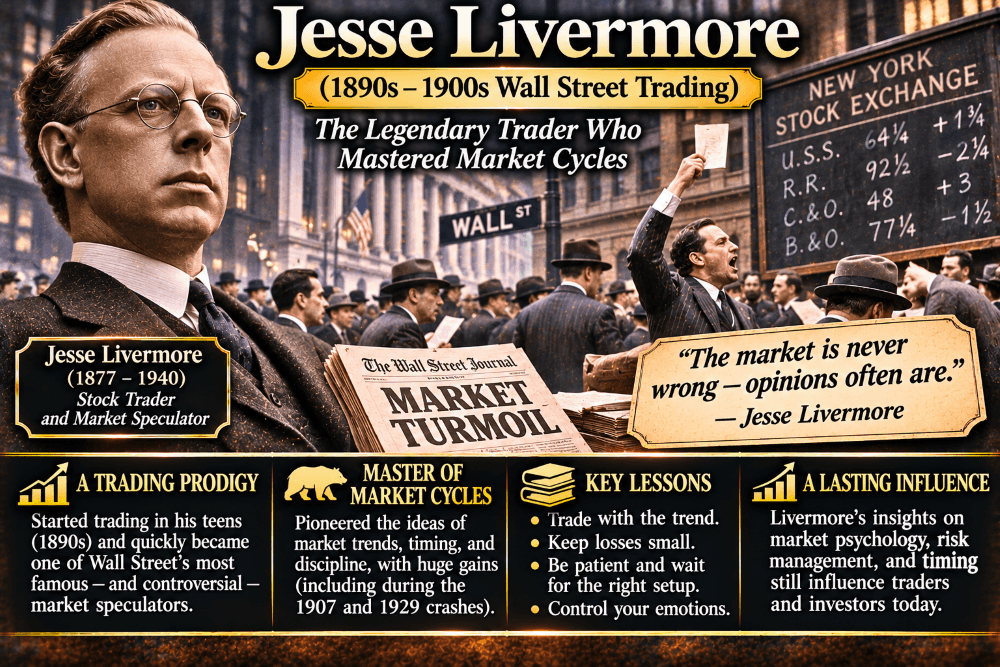
Few figures capture the thrill and danger of speculation like Jesse Livermore. Starting as a teenager in a Boston brokerage office, he became one of the most famous traders in American history, making and losing enormous sums during the booms and panics of the early 20th century. His story is a window into how Wall Street worked before modern regulation, and a reminder that skill in trading does not guarantee lasting success.
From Quote Board Boy to “Boy Plunger”
Early Life
Jesse Lauriston Livermore was born in 1877 in Massachusetts and left school as a young teenager to work.
- He found a job in a Boston brokerage, posting stock prices on a chalkboard.
- He became fascinated with the patterns in price movements.
- He began to notice that stocks often moved in recognizable ways, and he started to trade.
The Bucket Shops
Livermore got his start in “bucket shops,” establishments that let customers bet on stock price movements without actually buying shares.
- They operated in a gray area, similar to gambling parlors.
- Livermore won so consistently that some shops reportedly banned him.
- His youthful success earned him the nickname “Boy Plunger.”
Moving to Wall Street
Livermore moved to New York around 1900, seeking a bigger stage.
- He initially lost money in the more sophisticated market, and had to rebuild his capital.
- He developed a method of reading the market through price and volume action, often called tape reading, based on the stock ticker discussed earlier in this series.
- He grew increasingly successful and began trading on a large scale.
The Big Moves
1906 and 1907
Livermore’s reputation grew with a series of well-timed bets.
- Reportedly, he profited by shorting stocks, including Union Pacific, around the time of the 1906 San Francisco earthquake.
- During the Panic of 1907, he reportedly made a fortune again by betting on falling prices.
- According to a commonly told story, J.P. Morgan‘s circle, then working to stabilize markets, urged him to ease off his short selling.
The 1929 Crash
Livermore became legendary for his trading during the 1929 stock market crash.
- Reportedly, he profited enormously by betting against the market, with commonly cited estimates of around 100 million dollars.
- The fortune did not last, and his wealth later eroded.
Livermore’s Trading Principles
Livermore’s ideas were written down by others and appear in his own later book. They include:
- Follow the trend. He believed in trading in the direction of the market’s main movement.
- Cut losses quickly. He argued that small losses should be accepted before they became big ones.
- Add to winners. He increased positions as they proved correct.
- Be patient. He emphasized waiting for the right moment rather than constantly trading.
- Control emotion. He recognized that fear, hope, and greed often wreck traders.
These ideas remain widely discussed among traders, though they offer no guarantees.
The Other Side of the Story
Boom and Bust
For all his triumphs, Livermore’s life featured large reversals.
- He reportedly went bankrupt several times, then rebuilt.
- He sometimes broke his own rules, especially after big wins.
- His personal life was turbulent, with multiple marriages and strained family relationships.
A Tragic End
In 1940, after years of financial and personal difficulties, Livermore died by suicide. His story is a reminder that financial success does not shield anyone from struggles, and that the pressures of high-stakes speculation can take a heavy toll.
Wall Street Before Regulation
Livermore’s era was very different from today’s.
- There were few rules against practices now considered manipulative.
- Groups of traders, known as pools, could coordinate buying to push up prices and then sell, a practice that was legal at the time.
- The Securities and Exchange Commission was created in 1934, after the 1929 crash, to regulate markets and curb such abuses.
Livermore’s career belongs to this earlier period of freewheeling trading, and some of his methods would be illegal today.
The Legend: Reminiscences of a Stock Operator
In 1923, writer Edwin Lefèvre published Reminiscences of a Stock Operator, a fictionalized account based on Livermore’s life.
- The book became a classic among traders and investors.
- It portrays the psychology of the market with striking realism.
- Livermore also published his own book, How to Trade in Stocks, in 1940.
Lessons from Jesse Livermore
- Discipline matters. Rules are only useful if followed, especially after success.
- Risk management is essential. Even skilled traders can be wiped out.
- Psychology drives markets. Fear and greed repeat across eras, from the Mississippi Bubble to today.
- Regulation changes the game. Many early tactics are no longer allowed.
- Success has costs. Wealth and fame did not protect Livermore from hardship.
This chapter is a historical account, not investment advice.
Frequently Asked Questions
Who was Jesse Livermore? He was an American stock trader who rose from bucket shops as a teenager to become one of Wall Street’s most famous speculators in the early 20th century.
What were bucket shops? They were establishments where people could bet on stock price movements without actually buying the shares, operating in a gray area similar to gambling.
What is Reminiscences of a Stock Operator? It is a 1923 book by Edwin Lefèvre, a fictionalized account based on Livermore’s career that remains a classic on trading psychology.
Did Livermore profit from the 1929 crash? Reportedly, yes. He made a large profit betting against the market, though commonly cited figures are estimates and his fortune later declined.
Related Articles
- Heinz, Kellogg, and Hershey: Inventing Packaged Food
- J.P. Morgan: The Banker Who Rescued Gold and Built Steel
- Homestead and Pullman Strikes: Labor vs. Capital
- F.W. Woolworth and the A&P: Birth of the Chain Store
- Gospel of Wealth: Carnegie and Modern Philanthropy
- Sherman Antitrust Act: Rise of Trust-Busting in America
- Lever Brothers and Cadbury: Model Villages and Brands
About The History of Entrepreneurship
This article is part of The History of Entrepreneurship, an ongoing series exploring how entrepreneurs, civilizations, technologies, financial institutions, and business innovations gradually created the modern economy.
Leave a Reply