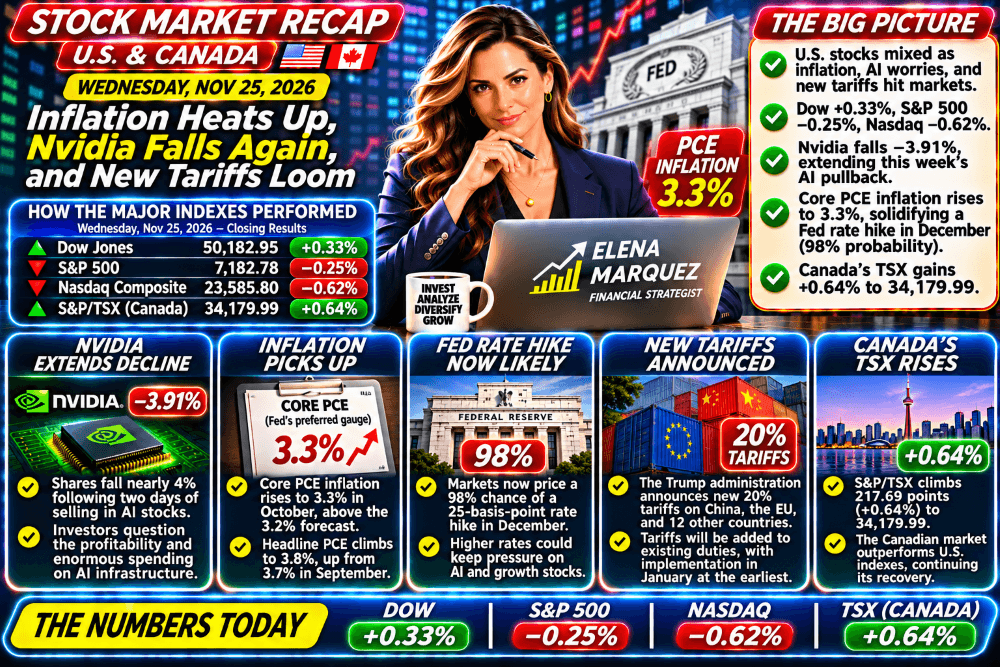
Tuesday, November 24, 2026 | U.S. & Canada
Introduction: Inflation and Tariffs Challenge Wall Street’s Recovery
U.S. stocks finished mixed on Wednesday, November 25, 2026, as investors confronted three significant challenges: persistent inflation, renewed selling pressure in artificial intelligence stocks, and the announcement of additional U.S. tariffs.
The Dow Jones Industrial Average gained approximately 0.3%, while the S&P 500 declined 0.2% and the Nasdaq Composite fell approximately 0.6%.
Nvidia shares dropped nearly 4%, extending Tuesday’s losses and surrendering another portion of Monday’s spectacular rally.
Meanwhile, the Federal Reserve’s preferred inflation measure, core Personal Consumption Expenditures (PCE), rose to 3.3%, exceeding economists’ expectations.
The Trump administration also announced new tariffs targeting China, the European Union, and 12 other major trading partners.
Canada delivered a stronger performance, with the S&P/TSX Composite gaining 217.69 points, or 0.64%, to close at 34,179.99.
As investors prepare for the Thanksgiving holiday, the market faces an increasingly complicated economic environment.
The central concern: Persistent inflation, higher interest rates, and additional tariffs could put further pressure on corporate profitability and stock valuations.
1. How the Major Stock Indexes Performed
U.S. & Canadian Stock Market Performance
North American Stock Markets
| Index | Daily performance |
|---|---|
| Dow Jones Industrial Average | +0.30% |
| S&P 500 | −0.20% |
| Nasdaq Composite | −0.60% |
| S&P/TSX Composite | +0.64% |
The Canadian market outperformed all three major U.S. indexes on Wednesday.
The Dow also managed to extend Tuesday’s gains, while the technology-heavy Nasdaq remained under pressure.
The divergence suggests that investors are becoming increasingly selective, particularly when evaluating technology companies with elevated valuations.
Final closing values
The final U.S. closing reports provide the following more precise figures. AP News+1
| Index | Closing value | Daily change | Points |
|---|---|---|---|
| Dow Jones | 50,182.95 | +0.33% | +164.25 |
| S&P 500 | 7,182.78 | −0.25% | −18.31 |
| Nasdaq Composite | 23,585.80 | −0.62% | −147.74 |
| S&P/TSX Composite | 34,179.99 | +0.64% | +217.69 |
| Russell 2000 | 2,704.05 | +0.71% | +19.11 |
The major U.S. indexes recovered from substantial intraday losses. At one point, the Dow was down approximately 1,100 points before reversing direction and finishing in positive territory.
2. Nvidia Falls as the AI Selloff Continues
Nvidia shares declined 3.91% to $149.30, extending the semiconductor company’s losses for a second consecutive session. The Motley Fool
Monday’s extraordinary rally following Jensen Huang’s reinstatement as chief executive officer has failed to establish a sustained recovery across the semiconductor sector.
Investors remain concerned about the enormous amounts of capital being invested in artificial intelligence infrastructure and whether future profits will justify those investments.
Nvidia’s performance this week
Nvidia: From Euphoria to Caution
Nvidia: Rally and Pullback
November 23–25, 2026 · Daily stock returns
Compounded return calculated using Monday’s and Tuesday’s approximate gains and losses and Wednesday’s reported closing return.
Despite two consecutive days of declines, Nvidia remains substantially above last Friday’s closing price.
However, the company’s recent volatility demonstrates how quickly expectations surrounding artificial intelligence can change.
3. Semiconductor Stocks Remain Under Pressure
The weakness extended beyond Nvidia to other companies associated with artificial intelligence.
AMD, Micron Technology, and other semiconductor manufacturers encountered renewed selling pressure as investors questioned the sustainability of AI-related spending.
Is the AI industry overinvesting?
Major technology companies are committing enormous financial resources to data centers, advanced processors, networking equipment, and electricity infrastructure.
These investments are based on expectations of substantial future demand for artificial intelligence services.
However, investors increasingly want answers to three questions:
- How quickly will AI companies become profitable?
- Will computing infrastructure generate adequate returns on investment?
- Could excessive spending eventually create excess capacity?
Artificial intelligence may continue growing rapidly without necessarily producing attractive returns for every company involved.
4. Core PCE Inflation Rises to 3.3%
Wednesday’s most important economic announcement was the release of October’s Personal Consumption Expenditures inflation data.
Core PCE, which excludes volatile food and energy prices, reached 3.3% year over year, slightly above economists’ expectations.
Headline PCE inflation reached 3.8%, compared with 3.7% in September. Dow Tumbles Nearly 700 at Open+1
U.S. Inflation Remains Above the Fed’s Target
October 2026 · Annual inflation rates
Federal Reserve target
2.0%
Core PCE forecast
3.2%
Actual core PCE
3.3%
Headline PCE
3.8%
The Federal Reserve’s longer-term 2% inflation objective refers to headline PCE inflation. Core PCE helps assess underlying inflation pressures.
Why PCE inflation matters
The Federal Reserve closely monitors the PCE price index when determining monetary policy.
Persistent inflation makes it more difficult for the central bank to reduce interest rates and may encourage policymakers to increase them.
Higher interest rates can slow economic activity, increase borrowing costs, and reduce the valuations of growth-oriented companies.
For technology businesses requiring substantial capital investment, this creates another financial challenge.
5. Markets Price in a 98% Probability of a December Rate Hike
December Federal Reserve Rate Expectations
25 basis points
Following Wednesday’s inflation report, traders reportedly increased their expectations that the Federal Reserve will raise interest rates in December.
December Federal Reserve Rate Expectations
25-basis-point hike
A potential increase of 0.25 percentage points at the December Federal Reserve meeting.Reported market-implied probability as of November 25.
Market expectations do not guarantee that the Federal Reserve will raise rates. Nevertheless, the reported probability illustrates how strongly investors have adjusted their expectations. ca.finance.yahoo.com
Why higher interest rates threaten AI valuations
Many technology companies are valued based on profits expected several years into the future.
When interest rates rise, the present value of those future profits decreases.
Higher borrowing costs also make it more expensive to finance data centers and other infrastructure projects.
The combination of elevated valuations and rising financing costs could place additional pressure on the AI sector.
6. Trump Announces New Tariffs of Up to 20%
The Trump administration introduced another source of economic uncertainty by announcing additional tariffs targeting China, the European Union, and 12 other major U.S. trading partners.
According to the supplied reporting, the tariffs would be added to existing duties and could take effect as early as January 2027, following a public comment period. ca.finance.yahoo.com
The economic consequences of additional tariffs
Tariffs are taxes on imported goods.
Although governments collect these taxes from importers, businesses may respond by increasing consumer prices, accepting lower profit margins, or modifying their supply chains.
Supporters of tariffs argue that they can protect domestic industries, encourage local manufacturing, and strengthen negotiating leverage.
Critics argue that they can increase consumer prices, reduce economic efficiency, and provoke retaliatory trade restrictions.
A difficult situation for the Federal Reserve
Additional tariffs could introduce further inflationary pressures at a time when inflation already exceeds the Federal Reserve’s target.
If businesses pass additional import costs on to consumers, the central bank may face greater difficulty restoring price stability.
This creates an uncomfortable combination for investors: potentially higher prices, higher interest rates, and slower economic growth.
7. Canada: TSX Rises Nearly 218 Points
Canada’s stock market outperformed its U.S. large-cap counterparts on Wednesday.
The S&P/TSX Composite gained 217.69 points, or 0.64%, closing at 34,179.99.
The index continued recovering from last week’s substantial selloff.
Canada’s TSX: Recovery After the Selloff
Canada’s TSX: Selloff and Recovery
The Canadian market has now recovered approximately 34% of the points lost during last week’s decline.
Why Canada can outperform the United States
The Canadian stock market has a different sector composition from the U.S. market.
Financial institutions, energy producers, and mining companies account for substantial portions of Canadian equity valuations.
This makes the TSX less directly dependent on the performance of major U.S. technology companies.
Wednesday’s divergence illustrates one of the potential benefits of international diversification.
8. U.S. Small-Cap Stocks Outperform
The Russell 2000, which tracks smaller U.S. publicly traded companies, gained approximately 0.71% Wednesday.
Small-cap companies also continue to outperform the major U.S. large-cap indexes on a year-to-date basis.
2026 Year-to-Date Stock Market Performance
2026 Year-to-Date U.S. Stock Market Returns
Returns exclude dividends. Source: published November 25 closing data.
The Russell 2000 has gained approximately 9% this year, compared with less than 1.5% for the Nasdaq Composite. AP News+1
Despite artificial intelligence dominating financial headlines throughout 2026, smaller American companies have delivered stronger index returns.
9. Where Markets Stand This Thanksgiving Week
Despite two consecutive days of weakness in technology stocks, the major North American indexes remain positive for the week, largely because of Monday’s extraordinary rally.
Weekly Stock Market Performance
November 23–25, 2026 · Through Wednesday’s close
Russell 2000
+4.74%
Nasdaq Composite
+4.28%
Dow Jones
+4.23%
S&P 500
+3.94%
S&P/TSX Canada
+2.98%
U.S. weekly returns from published closing data. TSX return calculated using supplied closing values.
The weekly performance provides a more encouraging picture than the past two trading sessions alone.
However, one exceptionally strong day accounts for much of the recovery.
10. Thanksgiving and Black Friday Trading Schedule
U.S. investors will receive a temporary break from market volatility on Thursday.
| Date | U.S. stock market | Canadian stock market |
|---|---|---|
| Thursday, Nov. 26 | Closed — Thanksgiving | Regular trading |
| Friday, Nov. 27 | Early close at 1 p.m. ET | Regular trading |
Lower trading activity during the Thanksgiving holiday may affect market liquidity.
Canadian investors should remember that the American Thanksgiving holiday does not normally interrupt trading on the Toronto Stock Exchange.
11. What Investors Should Watch Next
Several important developments could influence financial markets over the coming days.
- AI profitability: Whether technology companies can demonstrate sufficient returns on infrastructure investments.
- Nvidia: Whether semiconductor shares stabilize following two consecutive sessions of declines.
- Federal Reserve: Further indications about December’s anticipated interest rate increase.
- Tariff negotiations: Potential responses from affected U.S. trading partners.
- Black Friday spending: Early indications of consumer confidence and retail demand.
- Canadian equities: Whether the TSX can continue recovering from last week’s correction.
The combination of inflation, trade uncertainty, and technology valuations could maintain elevated volatility through the end of the year.
12. The Biggest Investment Lesson of November 25
Investors cannot ignore the price of money
Artificial intelligence promises to transform productivity, communication, healthcare, manufacturing, and countless other industries.
However, technological innovation does not operate independently of economic conditions.
Companies still need financing. Consumers still face budget constraints. Investors still demand adequate returns on their capital.
When inflation remains elevated and interest rates increase, businesses face a more demanding financial environment.
The companies most dependent on future profits and continuous capital investment may be particularly vulnerable.
Wednesday’s trading session also demonstrated the benefits of diversification. Canadian equities and smaller American companies delivered positive returns while large technology stocks struggled.
Investors do not necessarily need to identify the next revolutionary technology to achieve satisfactory long-term investment returns.
Sometimes, owning a diversified collection of profitable businesses can be a more sustainable strategy than concentrating on the market’s most exciting investment theme.
Conclusion: Wall Street Faces a Triple Challenge
November 25, 2026, delivered another volatile trading session for North American investors.
The Dow gained 0.33%, while the S&P 500 declined 0.25% and the Nasdaq fell 0.62%.
Nvidia continued retreating, core PCE inflation reached 3.3%, and the Trump administration announced additional tariffs targeting major trading partners.
Canada provided a positive contrast, with the TSX gaining 0.64% and continuing its recovery from last week’s substantial decline.
Meanwhile, markets reportedly assigned a 98% probability to a quarter-point Federal Reserve interest rate hike in December.
Artificial intelligence remains a potentially transformative economic force, but investors must also confront the realities of inflation, financing costs, international trade, and corporate profitability.
The key takeaway: Technological progress can create enormous economic opportunities, but even the most innovative companies are not immune to higher interest rates, excessive valuations, and economic uncertainty.
Other Stock Market blog posts
Leave a Reply