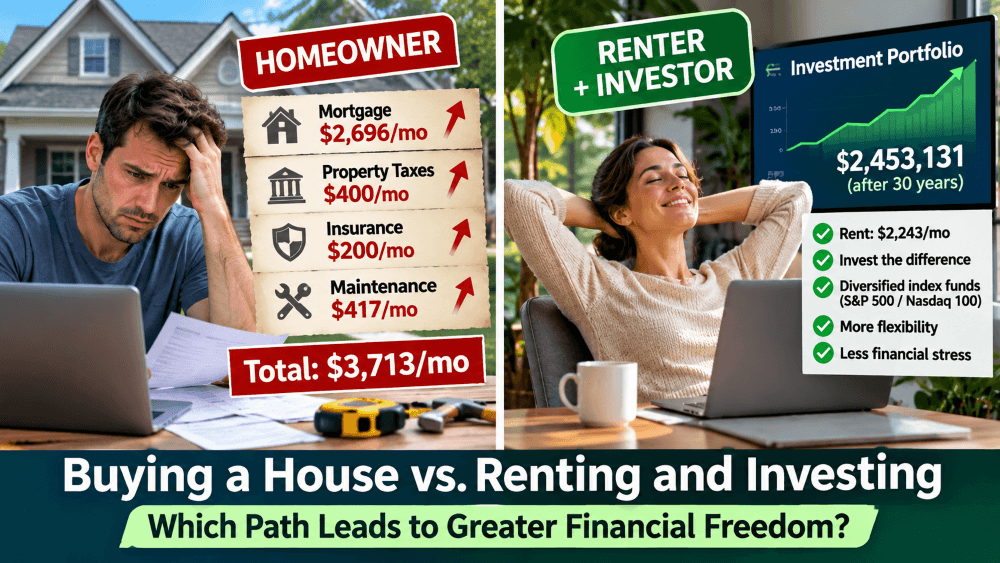
For generations, buying a house has been considered the cornerstone of financial success. We have been told that homeownership is the American Dream, that renting is throwing money away, and that purchasing real estate is one of the smartest financial decisions we can make.
But what if that advice no longer makes economic sense?
With skyrocketing property prices, elevated mortgage rates, rising insurance premiums, and increasing maintenance costs, the economics of homeownership have fundamentally changed.
For many people, renting a home and investing the difference in the stock market could be a far more effective strategy for building long-term wealth.
Buying a House Has Become Unaffordable
The financial gap between renting and owning continues to widen.
According to Zillow’s October 2026 rental report, a household that can comfortably afford to rent a typical single-family home for $2,243 per month would need an additional $14,408 in annual income to afford to purchase one.
Meanwhile, the housing market has undergone a dramatic transformation:
- Mortgage rates have increased from approximately 3% in 2021 to 7.13% in November 2026.
- Existing home prices have increased by 54% nationwide since 2020.
- Home prices remain nearly five times the median household income.
- Property insurance, taxes, and maintenance continue to add to ownership expenses.
According to the Harvard Joint Center for Housing Studies, housing affordability remains a significant challenge.
Buying a house under these conditions can leave households financially vulnerable, with little money available for retirement savings, investments, or unexpected expenses.
The Hidden Costs of Homeownership
Many people make the mistake of comparing their monthly rent with a potential mortgage payment.
However, a mortgage payment represents only part of the actual cost of owning a property.
The true cost of buying a house
Homeowners must account for numerous expenses:
- Mortgage interest
- Property taxes
- Homeowners insurance
- Repairs and maintenance
- Closing costs
- Major renovations
- Real estate commissions when selling
- Condominium or homeowners association fees, where applicable
- Opportunity cost of the down payment
A new roof, plumbing problem, or broken heating system can easily cost thousands of dollars.
Renters generally transfer much of that financial responsibility to their landlords.
Furthermore, mortgage interest, property taxes, insurance, and maintenance do not directly build equity. These are expenses that homeowners may never recover.
Renting Is Not Throwing Money Away
One of the most persistent myths in personal finance is that renting is throwing money away.
But rent provides something valuable: a place to live.
We don’t consider paying for transportation, electricity, food, or internet access to be throwing money away. Why should housing be any different?
Homeowners also spend substantial amounts of money on expenses that do not contribute directly to their net worth.
The relevant financial question is not whether rent builds equity. It is whether renting allows you to accumulate more wealth through other investments.
Housing is a necessity. Homeownership is a choice.
Renting and Investing the Difference
Instead of buying a house, imagine renting a comfortable property and investing the money you would otherwise spend on homeownership.
Consider the following hypothetical example involving a $500,000 property.
| Monthly expense | Homeowner | Renter |
|---|---|---|
| Mortgage payment | $2,696 | $0 |
| Property taxes | $400 | $0 |
| Insurance | $200 | $30 |
| Maintenance | $417 | $0 |
| Rent | $0 | $2,243 |
| Total monthly cost | $3,713 | $2,273 |
This example assumes a 20% down payment, a 30-year mortgage at 7.13%, and annual maintenance costs equal to 1% of the property’s value.
The renter would have approximately $1,440 more available every month.
In addition, the renter could invest the $100,000 that would otherwise have been used as a down payment.
How much wealth could a renter accumulate?
Assuming an initial investment of $100,000, monthly contributions of $1,440, and an average annual investment return of 7%, the results would be approximately:
| Investment period | Portfolio value |
|---|---|
| 5 years | $243,000 |
| 10 years | $443,000 |
| 15 years | $723,000 |
| 20 years | $1,115,000 |
| 25 years | $1,665,000 |
| 30 years | $2,436,000 |
These are hypothetical projections before taxes and inflation. Investment returns are not guaranteed, and the example assumes a constant monthly investment.
The homeowner would also accumulate wealth through mortgage principal repayment and potential property appreciation. A complete comparison must account for both outcomes, as well as changes in rent and ownership expenses.
Nevertheless, the example demonstrates that homeownership is not the only path to becoming a millionaire.
The Stock Market Offers Advantages Over Real Estate
Building Wealth Without Owning a House
$100,000 initial investment | $1,440 monthly contributions | 7% annual return
Assumptions: $100,000 invested initially, $1,440 invested at the end of each month, and a 7% nominal annual return compounded monthly. Figures are hypothetical and exclude taxes, fees and inflation. Investment returns are not guaranteed.
Source: Illustrative calculations | AlainGuillot.com
Buying a house often means concentrating a significant portion of your wealth in a single asset, in a single neighborhood, in a single city.
Investing in broad-market index funds offers a different approach.
Through a low-cost S&P 500 index fund, investors can become partial owners of hundreds of America’s largest companies. Those seeking additional exposure to growth-oriented businesses can consider a Nasdaq-100 index fund, although it carries greater concentration risk and volatility.
Canadian investors can also obtain exposure to domestic companies through a broad Canadian stock market ETF.
Stock market investing offers several advantages over direct homeownership:
- Greater liquidity
- Diversification across numerous companies
- Low transaction costs
- No direct property maintenance responsibilities
- The ability to invest small amounts regularly
- Minimal ongoing management
You don’t have to repair the roof of a company whose shares you own. You don’t have to replace its plumbing or negotiate with contractors.
You simply participate in the financial performance of the businesses you own.
Of course, stocks can experience substantial declines, and real estate benefits from leverage and potential tax advantages. Neither investment is without risk.
Renting Provides Something Money Cannot Easily Buy: Freedom
The advantages of renting extend beyond financial considerations.
Buying a house can tie you to a particular location for decades. Selling a property is expensive, time-consuming, and sometimes financially disadvantageous.
Renting provides greater flexibility.
You can relocate for a better job, move to a less expensive city, downsize when your circumstances change, or spend time living in another country.
This flexibility is particularly valuable for younger generations facing technological disruption, artificial intelligence, and an increasingly unpredictable employment market.
Why commit yourself to a 30-year mortgage when you don’t know what your professional or personal life will look like five years from now?
Renting is not without disadvantages, including potential rent increases, limited control over the property, and the possibility of having to move. However, for people who value mobility, those trade-offs may be worthwhile.
Homeownership Is Not a Requirement for Financial Independence
Society frequently treats homeownership as a measure of adulthood and financial achievement.
People who rent are sometimes perceived as less successful than those who own property, regardless of their actual financial circumstances.
But appearances can be deceiving.
Someone living in a million-dollar house with an enormous mortgage, minimal retirement savings, and substantial monthly expenses may be in a weaker financial position than someone renting a modest apartment with a million-dollar investment portfolio.
The true measure of financial success is not the size of your house.
It is your net worth, your financial security, your ability to generate income, and your freedom to live life on your own terms.
When Does Buying a House Make Sense?
Homeownership is not inherently a bad decision.
There are circumstances in which purchasing a property can be financially and personally rewarding.
Buying may make sense when:
- You intend to live in the same location for many years.
- Ownership costs are comparable to local rental prices.
- You can comfortably afford the down payment and ongoing expenses.
- You value stability and control over your living environment.
- You can continue investing for retirement after purchasing the property.
Homeownership also provides a form of forced savings through mortgage principal repayment, which can benefit people who might otherwise struggle to invest consistently.
However, buying a house should be the result of careful financial analysis, not social pressure or outdated assumptions about wealth creation.
Conclusion: Invest in Your Freedom, Not Just in Real Estate
The idea that everyone should aspire to own a home deserves to be challenged.
At today’s elevated property prices and mortgage rates, renting and investing the difference can be a compelling alternative to homeownership.
The key is financial discipline. Renting without investing the savings may not produce the same wealth-building benefits.
But a disciplined investor who consistently purchases low-cost index funds can potentially build substantial wealth without ever owning a house.
There is nothing wrong with renting for your entire life.
You don’t need to own the place where you live to achieve financial independence. You need to own productive assets, control your expenses, and allow compound growth to work in your favor.
The ultimate goal should not be homeownership. It should be financial freedom.
Frequently Asked Questions
Is buying a house still a good investment?
It can be, depending on property prices, mortgage rates, rental alternatives, taxes, and your investment horizon. However, purchasing a home is not automatically a superior investment to renting and investing in the stock market.
Is renting really throwing money away?
No. Rent pays for shelter, flexibility, and access to a property without assuming all the financial responsibilities of ownership. Homeowners also incur unrecoverable expenses such as mortgage interest, property taxes, insurance, and maintenance.
Can I become a millionaire without owning a house?
Absolutely. Consistently investing in diversified, low-cost index funds over several decades can potentially generate substantial wealth through compound growth without requiring direct real estate ownership.
Is it better to rent or buy a house in 2026?
With elevated mortgage rates and historically high property prices, renting may be financially preferable in many markets. The best decision depends on local housing costs, personal circumstances, investment discipline, and long-term financial objectives.
Leave a Reply