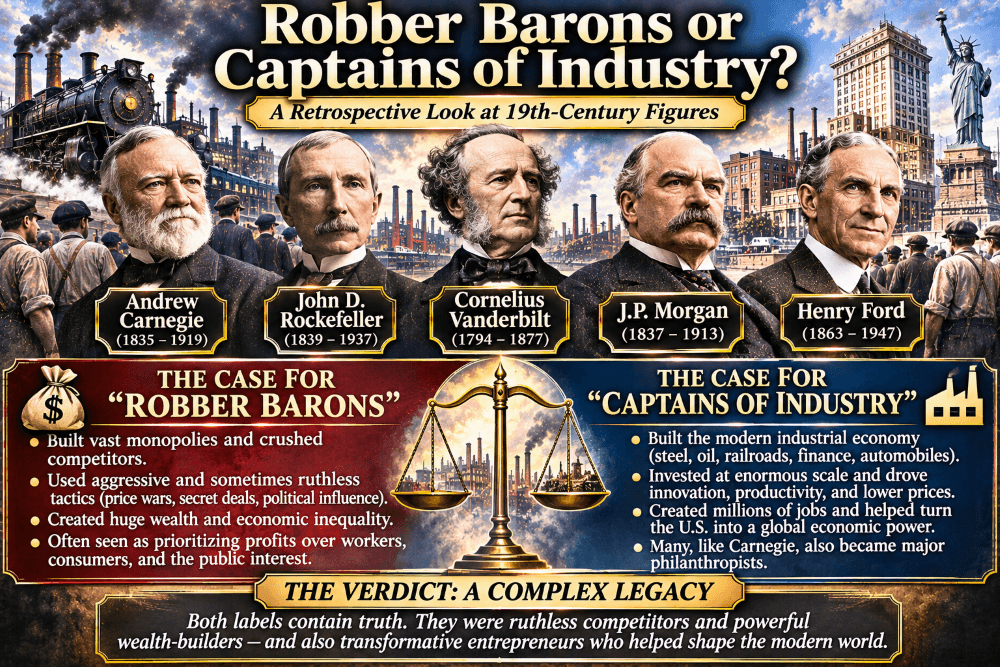
Were the great industrialists of the 19th century villains who exploited workers and bought politicians, or visionaries who built modern America? Historians have argued about robber barons and “captains of industry” for well over a century. The honest answer, most scholars now say, is that the label depends on which part of the record you examine. This chapter looks at where the terms came from, the best case for each side, and a more useful way to judge these figures.
Where the Labels Come From
Robber Barons
The phrase evokes medieval German nobles who demanded tolls from travelers on the Rhine.
- American critics applied the comparison to railroad and industrial magnates by the mid-19th century.
- Muckraking writers such as Henry Demarest Lloyd and Ida Tarbell attacked monopolies and unfair tactics.
- The term gained lasting fame from Matthew Josephson’s 1934 book The Robber Barons, written during the Great Depression, when distrust of big business was high.
Captains of Industry
The phrase has a more flattering history.
- Writer Thomas Carlyle used it in the 1840s to describe business leaders who organized work and created wealth.
- It was often applied admiringly to industrialists who built large enterprises.
- Later historians, including Allan Nevins and Alfred Chandler, emphasized the organizational and managerial innovations of these figures.
The Case for “Captains of Industry”
Defenders point to substantial achievements.
- Falling prices: Oil, steel, and other products became far cheaper as firms improved efficiency and scale.
- New industries: Railroads, steel, electricity, and oil created entire sectors and millions of jobs.
- National markets: Better transport, communication, and distribution connected the country.
- Management innovation: Large organizations developed hierarchies, accounting, and planning that became models for modern business.
- Philanthropy: Many gave away large parts of their fortunes to libraries, universities, and medical research.
The Case for “Robber Barons”
Critics emphasize the methods and the costs.
- Market manipulation: The Erie War and the 1869 gold corner showed stock watering, bribery, and speculation.
- Anticompetitive tactics: Secret railroad rebates, predatory pricing, and trusts aimed to crush rivals and control markets.
- Corruption: Episodes like the Credit Mobilier scandal showed ties between business and politicians.
- Labor treatment: Long hours, low pay, dangerous conditions, child labor, and violent suppression of strikes at places like Homestead and Pullman.
- Concentrated power: A few financiers and firms shaped industries and politics.
Testing the Labels on Real Figures
Applying either label to specific people shows how complicated the record is.
John D. Rockefeller
- Builder side: Standard Oil improved efficiency and lowered the cost of kerosene.
- Critic side: It used railroad rebates and aggressive tactics against competitors and was broken up in 1911. Volume rebates is a common practice.
Andrew Carnegie
- Builder side: Carnegie Steel drove down costs and helped build the steel age. Carnegie gave away most of his fortune.
- Critic side: The Homestead lockout and the harsh conditions in his mills. People were not obliged to work at his mills, they were able to quit whenver they felt like it.
J.P. Morgan
- Builder side: His 1895 gold rescue and the reorganization of railroads brought stability.
- Critic side: Consolidation concentrated power, prompting the “money trust” investigation.
Jay Gould and Jim Fisk
- Their record, built on manipulation and speculation, comes closest to the critics’ picture.
George Pullman
- Builder side: He built an influential railway car company and a model town.
- Critic side: His handling of wages and rents provoked the 1894 strike.
Many figures belong in both columns, which is why single labels fall short.
A Better Way to Judge
Rather than choosing a label, historians often ask several questions.
- How was the wealth created? By building something of value, or by manipulating markets and extracting rents?
- How did they treat workers? Wages, safety, and respect for workers’ rights.
- How did they deal with government? Competing fairly, lobbying, or bribing and exploiting subsidies.
- What effect did they have on consumers and rivals? Lower prices and better products, or monopoly power.
- What did they do with their wealth? Reinvestment, philanthropy, or personal display.
This approach can sort different figures along a spectrum rather than into two boxes.
How the Era Responded
The criticism helped produce reforms.
- The Interstate Commerce Commission and the Sherman Antitrust Act aimed to restrain abuses.
- Theodore Roosevelt’s trust-busting and the Pure Food and Drug Act expanded the government’s role.
- In 1913, the income tax and the Federal Reserve were established.
- Labor protections grew in the following decades.
Many historians see the reforms as an adjustment that preserved the benefits of large enterprise while addressing its excesses.
Why the Debate Still Matters
Similar arguments arise today.
- People debate the role of large technology and finance companies, and whether they spur innovation or concentrate power.
- Questions about wealth, philanthropy, and regulation echo the Gilded Age.
- Reasonable people disagree about where to draw lines, and history offers lessons on both sides.
Lessons from the Debate
- Avoid simple heroes and villains. The same person can build and exploit.
- Judge on multiple dimensions. Value creation, labor practices, politics, and legacy each matter.
- Context shapes labels. Writers in different eras emphasized different aspects.
- Institutions matter. Rules and norms determine how entrepreneurial energy is used.
Frequently Asked Questions
Where does the term “robber baron” come from? It refers to medieval nobles who extracted tolls along the Rhine, and it was applied to American business magnates by critics, later popularized by Matthew Josephson’s 1934 book.
What does “captain of industry” mean? It describes a business leader seen as organizing production and creating wealth, a term popularized by Thomas Carlyle and often used admiringly.
Which view do historians accept? Many historians favor a mixed view, recognizing both significant economic achievements and serious abuses, with individuals varying widely.
Did reforms end the debate? No. Antitrust, labor, and regulatory debates continue, and people disagree about how to balance scale, competition, and power.
Related Articles
- Second Industrial Revolution: The Age of Inventors
- Scientific Management: Frederick Taylor’s Big Idea
- Jesse Livermore: The Boy Plunger of Wall Street
- Heinz, Kellogg, and Hershey: Inventing Packaged Food
- J.P. Morgan: The Banker Who Rescued Gold and Built Steel
- Homestead and Pullman Strikes: Labor vs. Capital
- F.W. Woolworth and the A&P: Birth of the Chain Store
About The History of Entrepreneurship
This article is part of The History of Entrepreneurship, an ongoing series exploring how entrepreneurs, civilizations, technologies, financial institutions, and business innovations gradually created the modern economy.
Leave a Reply