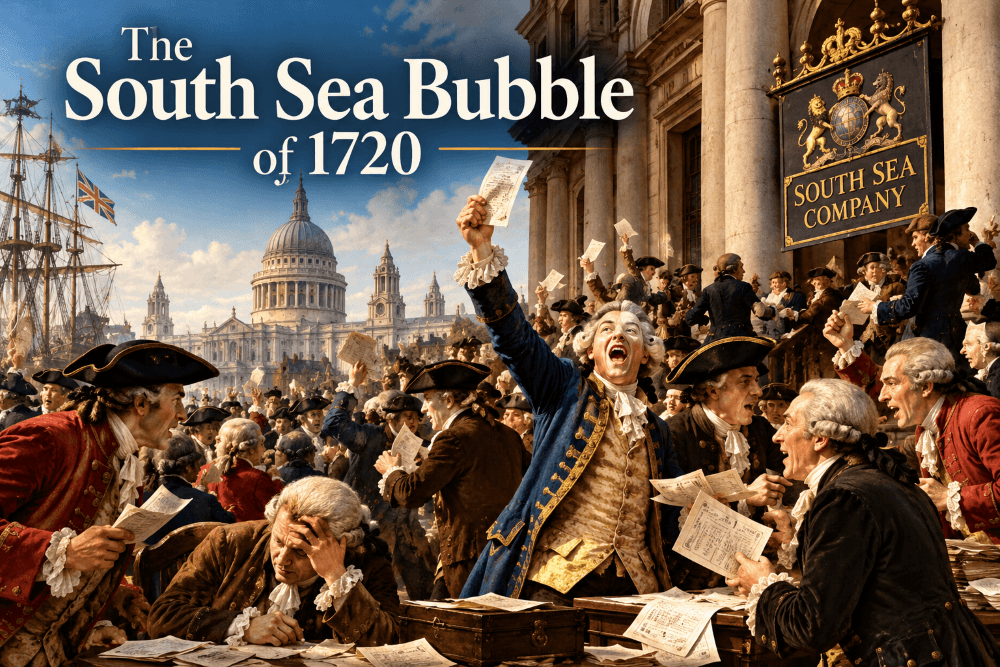
In 1720, Britain discovered one of capitalism’s most dangerous inventions: the financial bubble.
The South Sea Bubble began with an ambitious idea. A private company would help the British government manage its enormous national debt while shareholders would profit from trade with Spanish America.
Instead, the South Sea Company became increasingly dependent on something much more seductive: a rising share price.
Shares that had traded around £100 soared toward £1,000. Aristocrats, politicians, merchants, and ordinary investors rushed to participate. The company encouraged the boom, insiders benefited from extraordinary financial arrangements, and political corruption helped the scheme along.
Then confidence disappeared.
The share price collapsed, fortunes vanished, politicians were investigated, and Britain experienced one of the earliest great crises of modern finance.
The South Sea Bubble of 1720 demonstrated something that investors would rediscover again and again over the following three centuries: when the story becomes more valuable than the business, extraordinary wealth can appear—and disappear—very quickly.
What Was the South Sea Company?
The South Sea Company was founded in 1711, when Britain faced a problem familiar to modern governments: debt.
Years of war had left the state owing large sums to creditors. The government needed a more manageable way of financing those obligations.
The South Sea Company offered an ingenious solution.
Government creditors could exchange certain government debts for shares in the company. Instead of the government owing money to thousands of individual creditors under different arrangements, debt could increasingly be consolidated through a large corporation.
The company would receive interest payments from the government. Investors, meanwhile, received shares that might appreciate and potentially pay dividends.
It was an early marriage between government finance and the stock market.
But the company had another attraction.
Its name suggested enormous commercial possibilities.
The Promise of South America
The South Sea Company was associated with a British monopoly on trade with Spanish America. To investors in early 18th-century London, the words “South Seas” evoked distant ports, silver, exotic goods, and potentially enormous fortunes.
Reality was much less glamorous.
Spain controlled most of South America and severely restricted British access to its colonies. The South Sea Company’s opportunities for ordinary commerce were therefore limited.
There was, however, one important—and brutal—exception.
Following the Treaty of Utrecht, Britain obtained the Asiento de Negros, a contract granting the right to supply enslaved Africans to Spanish colonies in the Americas. The South Sea Company received this privilege.
Under the agreement, the company was authorized to transport thousands of enslaved Africans annually into Spanish America. It was also permitted limited general trading through an annual ship.
The company’s actual overseas commerce never came close to fulfilling the grand expectations associated with its name. A substantial part of the commercial activity it did conduct was tied to the transatlantic slave trade.
That history is essential to understanding the South Sea Company.
The company was simultaneously a trading enterprise, a participant in slavery, a financial intermediary, and eventually the center of an extraordinary speculative boom.
But the real engine of the South Sea Bubble was not overseas commerce.
It was finance.
The Brilliant Financial Idea Behind the South Sea Bubble
By 1720, the South Sea Company proposed something far more ambitious than its earlier debt conversions.
It wanted to take responsibility for a huge portion of Britain’s national debt.
The company competed with the Bank of England for the right to convert government obligations into South Sea shares. Eventually, the South Sea Company won the contest.
The basic mechanism was deceptively clever.
Government creditors would surrender their existing securities and receive South Sea Company shares instead. The company would receive government interest payments on the debt it assumed.
But there was a crucial detail.
The higher the market price of South Sea shares, the more favorable the conversion could become for the company.
Imagine that the company needed to give an investor £1,000 worth of value.
If South Sea shares were worth £100 each, it might require ten shares.
But if the shares could be valued at £500, only two shares represented £1,000 of market value.
The difference created potentially enormous financial gains for the company.
Suddenly, a rising share price wasn’t merely good news for shareholders.
The share price itself became central to the business model.
When the Business Became the Stock Price
This created a dangerous incentive.
The South Sea Company had every reason to keep its shares rising.
Its directors used a variety of mechanisms to support demand. New subscriptions allowed investors to buy shares through installments. The company also lent money secured against South Sea shares, helping investors obtain funds that could feed further demand for the stock.
The cycle became self-reinforcing:
- South Sea shares increased.
- Rising prices attracted more investors.
- The company issued additional subscriptions.
- Credit made it easier to purchase shares.
- Additional demand pushed the shares higher.
- Higher prices improved the economics of the company’s debt-conversion scheme.
In effect, the South Sea Company’s financial success became increasingly dependent on maintaining confidence in the South Sea Company.
It was a remarkably modern problem.
Economic historians debate how far the directors deliberately created the bubble from the beginning. But there is strong evidence that the company actively supported its share price when it came under pressure.
By the summer of 1720, the stock market had become more important than the company’s actual trade.
The South Sea Bubble Takes Off
At the beginning of 1720, South Sea stock traded at roughly £100–£130.
Then the excitement began.
The debt-conversion plan attracted enormous attention. Investors saw the government supporting the scheme. Powerful people were involved. The company appeared to possess extraordinary privileges.
The share price climbed.
£200.
£300.
£500.
Eventually, South Sea shares approached £1,000.
A person watching from the sidelines faced an increasingly painful question:
What if everyone else is getting rich and I am missing the opportunity?
That question has fueled speculative bubbles ever since.
Rising prices became evidence that the optimists had been right. And because the optimists appeared right, more people bought.
Which pushed prices higher.
Which attracted still more buyers.
The South Sea Bubble had become a feedback loop.
John Blunt: The Man Behind the Scheme
At the center of the story was Sir John Blunt, one of the most important architects of the South Sea Company’s financial strategy.
Blunt was the son of a shoemaker, an extraordinary background for a man who would eventually move among Britain’s political and financial elite.
He understood finance, credit, lotteries, and government debt.
More importantly, he understood incentives.
The South Sea scheme offered the government a way to reorganize debt, offered existing creditors potentially valuable shares, offered politicians financial advantages, and offered investors the possibility of becoming rich.
Everyone could imagine winning.
As long as the stock kept rising.
But Blunt and his associates understood another important fact: political support mattered enormously.
And they were willing to pay for it.
Systemic Corruption: When Politics Met Speculation
The South Sea Bubble was not simply a story of irrational investors chasing a fashionable stock.
It was also a political scandal.
Selected politicians and influential figures received extraordinarily favorable arrangements involving South Sea shares. In some cases, supposed shares were allocated without recipients paying for them; beneficiaries could profit from the increase in the share price.
In effect, they received something resembling free stock options.
If the price increased, they could benefit.
If it didn’t, they had little or nothing at risk.
The people responsible for approving or supporting the company’s plans therefore had a direct financial incentive to see South Sea stock rise.
Beneficiaries and implicated figures reached into Britain’s political establishment and circles around the royal family.
After the crash, Parliament investigated.
The evidence revealed fictitious stock, preferential transactions, and extensive corruption. The House of Commons later described the practice of granting stock to members of Parliament or government officials without proper payment, while allowing them to profit from price increases, as corrupt and dangerous.
The scandal showed how easily political power and financial incentives could reinforce each other.
The South Sea Bubble wasn’t merely a market failure.
It was also a failure of governance.
Bubble Companies: Speculation Spreads Across Britain
South Sea shares weren’t the only investment attracting money in 1720.
Britain experienced an explosion of new ventures.
Investors were presented with companies proposing everything from insurance and manufacturing to increasingly dubious schemes. Some had legitimate commercial objectives. Others seemed designed primarily to take advantage of speculative enthusiasm.
They became known as bubble companies.
The frenzy became so great that Parliament passed what became known as the Bubble Act in June 1720, restricting unauthorized joint-stock companies.
There is an important historical detail here.
The Bubble Act did not appear after the South Sea Bubble had already collapsed.
It was passed while the boom was still underway.
The South Sea Company itself supported efforts against competing unauthorized companies. Restricting them could redirect speculative money toward South Sea shares.
Instead of ending speculation, however, intervention contributed to an increasingly nervous market.
Isaac Newton and the South Sea Bubble
One of the most famous investors associated with the South Sea Bubble was Sir Isaac Newton.
Yes—the same Newton who transformed our understanding of gravity, motion, mathematics, and the physical universe.
Newton invested in South Sea stock.
The precise details of his trades and losses have accumulated myths over the centuries, so claims about exactly how much he lost should be treated cautiously. What is clear is that even one of history’s greatest scientific minds participated in the extraordinary financial environment surrounding South Sea shares.
That makes Newton’s involvement more than an entertaining anecdote.
Intelligence does not immunize anyone against speculation.
A bubble doesn’t require investors to be stupid.
It requires them to believe that someone else may be willing to pay more tomorrow.
How Did the South Sea Bubble Crash?
Every financial bubble eventually encounters the same problem.
Prices cannot rise forever.
By late summer 1720, confidence began to weaken.
Some investors started selling. Falling prices created pressure on investors who had purchased shares with borrowed money or who still owed installments on subscriptions.
The mechanism that had driven prices upward began operating in reverse.
Falling prices encouraged selling.
Selling produced lower prices.
Lower prices damaged confidence.
Damaged confidence created still more selling.
South Sea stock, which had approached £1,000 during the summer, plunged dramatically. By September it had fallen to around £290, and by mid-October it was near £170.
Paper fortunes evaporated.
Investors who believed themselves wealthy discovered that their wealth depended on finding someone willing to purchase their shares.
When the buyers disappeared, so did the fortune.
Britain’s First Great Financial Crisis
The collapse sent shock waves through Britain’s financial system.
Investors lost fortunes. Politicians faced accusations of corruption. The reputation of the government was threatened.
Parliament launched investigations into the South Sea Company’s affairs.
John Aislabie, Chancellor of the Exchequer, was among the prominent political figures implicated. He resigned, was expelled from the House of Commons, and was imprisoned.
Company directors also faced punishment and confiscation of substantial portions of their estates.
The crisis required political and financial intervention.
Robert Walpole played an important role in stabilizing the aftermath and restoring confidence, helping establish the political authority that would later make him commonly regarded as Britain’s first prime minister.
Yet the South Sea Company itself did not simply disappear overnight.
Its financial obligations continued.
A Debt That Survived Until 2015
Perhaps the strangest legacy of the South Sea Bubble came almost three centuries later.
In 2015, the British government announced that it would redeem its remaining undated government bonds.
Among those securities were bonds whose historical lineage could be traced back to capital stock of the South Sea Company that the government had assumed following the company’s collapse and that was later consolidated in the 19th century.
The final redemption occurred in July 2015.
That does not mean Britain was literally making payments on the original 1720 South Sea shares unchanged for 295 years. The obligations had been restructured and consolidated repeatedly.
But part of the British government’s financial liabilities redeemed in 2015 could trace their ancestry to the South Sea crisis.
Few financial disasters leave paperwork lasting nearly three centuries.
Why the South Sea Bubble Still Matters
It is tempting to look at investors from 1720 and laugh.
How could they have paid extraordinary prices for shares in a company whose actual commercial prospects could not justify them?
But that misses the most important lesson.
The people of 1720 were not a different species.
They responded to many of the same incentives investors respond to today.
The South Sea Bubble contained ingredients that repeatedly appear in speculative manias:
- A revolutionary financial idea
- A compelling story about enormous future profits
- Rapidly rising asset prices
- Easy access to credit
- Powerful insiders promoting the investment
- Political connections that created an appearance of safety
- Investors afraid of missing out
- Prices increasingly disconnected from underlying economic value
Most importantly, rising prices created their own justification.
People bought because prices were rising.
And prices rose because people were buying.
The fundamental business gradually became secondary.
Financial Innovation Is Both Powerful and Dangerous
The South Sea Company should not be remembered merely as an absurd scam.
Its underlying financial innovation addressed a genuine problem.
Britain needed to manage an enormous national debt. Converting fragmented government obligations into standardized financial assets offered real advantages.
The problem arose when financial engineering became dependent on ever-increasing asset prices.
This distinction matters in the history of entrepreneurship.
Innovation frequently involves creating new ways to finance businesses, spread risk, raise capital, and connect investors with opportunities.
Joint-stock companies were revolutionary because thousands of investors could pool capital.
Stock exchanges created liquidity.
Government bonds allowed states to borrow on unprecedented scales.
Insurance allowed entrepreneurs to transfer risks.
These innovations helped create modern capitalism.
But every new financial technology creates opportunities for both productive investment and speculation.
The South Sea Bubble demonstrated both sides of that equation.
From Amsterdam to London: The Financial Revolution
The South Sea Bubble of 1720 belongs to a much larger story.
During the 17th and early 18th centuries, European societies were developing institutions that would transform capitalism.
Joint-stock companies allowed businesses to raise unprecedented quantities of money.
Stock exchanges allowed ownership to be traded.
Banks expanded credit.
Government bonds created large markets for public debt.
Marine insurance reduced the risks of international commerce.
These innovations helped finance exploration, trade, manufacturing, war, and eventually industrialization.
But capitalism had discovered something else.
It had discovered speculation.
Once ownership could be divided into shares and those shares could be traded, people no longer needed to invest only because they expected a company to produce profits.
They could invest because they expected the share price itself to rise.
That subtle change created an entirely new kind of opportunity—and an entirely new kind of danger.
The Entrepreneurship Lesson of the South Sea Bubble
Entrepreneurs need stories.
Investors rarely finance a company based exclusively on what it earns today. They invest because they believe in what it might become tomorrow.
That optimism finances innovation.
But there is a line between selling a vision and selling an illusion.
The South Sea Company’s story gradually became more valuable than its underlying commercial activity.
Its share price became increasingly important to its ability to make the financial scheme work. Political insiders acquired incentives to support it. Investors saw rising prices as proof that the story must be true.
Eventually, the entire structure depended on confidence.
When confidence disappeared, the structure collapsed.
This is why the South Sea Bubble remains relevant more than 300 years later.
Technology changes.
Financial products change.
Stock exchanges become faster.
Information travels instantly.
But human psychology changes much more slowly.
Greed, fear, social proof, political influence, leverage, financial innovation, and fear of missing out existed in 1720 just as they exist today.
The South Sea Bubble wasn’t the last time investors confused a rising price with a successful business.
It was simply one of the first times the modern financial world learned the lesson on such an enormous scale.
Frequently Asked Questions
What was the South Sea Bubble?
The South Sea Bubble was a speculative boom and crash centered on shares of Britain’s South Sea Company in 1720. The company’s stock rose from roughly £100–£130 early in the year to nearly £1,000 before collapsing dramatically.
What caused the South Sea Bubble?
The bubble resulted from a combination of financial innovation, speculation, credit, aggressive support for the company’s share price, political connections, corruption, and expectations of future profits. Rising prices attracted new investors, creating a self-reinforcing cycle that reversed when confidence disappeared.
What did the South Sea Company actually do?
The company combined government-debt management with overseas commerce. Its trading opportunities in Spanish America were restricted, and an important part of its actual commercial activity involved the transatlantic slave trade under the Asiento contract.
Did Isaac Newton lose money in the South Sea Bubble?
Isaac Newton did invest in South Sea Company shares and became associated with losses during the bubble. However, popular accounts often repeat precise loss figures and quotations whose historical documentation is less certain, so the details should be treated cautiously.
Leave a Reply