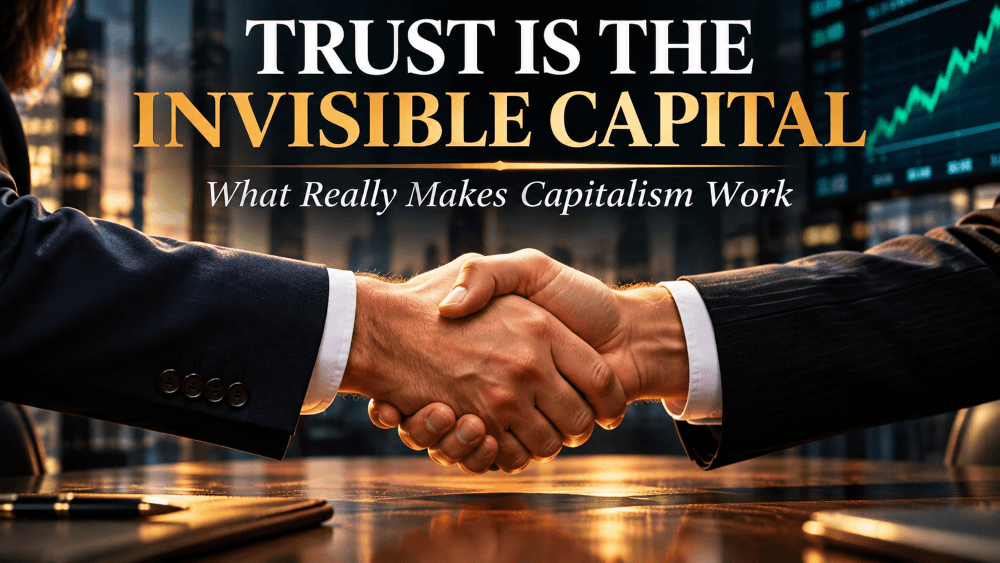
Imagine two entrepreneurs making a multimillion-dollar deal with nothing more than a handshake.
No army of lawyers. No hundreds of pages of contracts. Just two people looking each other in the eye and agreeing to do business.
How is this possible?
The answer reveals one of the most overlooked foundations of economic prosperity: trust in capitalism.
We often describe capitalism as a system of prices, competition, private property, and contracts. But beneath these visible structures lies an invisible network of honesty, reputation, shared expectations, and informal rules.
Without these foundations, even the most sophisticated economic system becomes expensive, inefficient, and fragile.
Trust in Capitalism: The Foundation We Rarely Notice
When economists explain how markets work, they often focus on incentives.
Businesses seek profits. Consumers seek value. Competition encourages innovation, and prices coordinate millions of independent decisions.
All of this is important, but something essential is missing.
Markets cannot function efficiently when everyone assumes everyone else is trying to cheat them.
Consider something as ordinary as buying groceries.
You assume the food is safe, the price is accurate, and the cashier will give you the correct change. The supermarket assumes your payment will be valid.
These expectations are so deeply embedded in everyday life that we rarely think about them.
But imagine a society where every transaction required an investigation, a lawyer, and a security deposit.
Commerce would slow dramatically.
Trust reduces the cost of doing business. It allows strangers to cooperate without constantly protecting themselves against deception.
Economists call many of these expenses transaction costs.
A society with widespread trust can conduct more business with fewer obstacles.
Jensen Huang: When a Handshake Is Worth Millions
Jensen Huang, the co-founder and CEO of Nvidia, offers a fascinating illustration of the economic value of reputation.
Huang has described business relationships in which substantial commitments can be made on the strength of a handshake.
At first glance, this might seem reckless.
Why would someone risk millions of dollars without extensive contractual protections?
The answer is that a handshake between two people with established reputations is not the same as a handshake between strangers.
A reputation is built through years of keeping promises, meeting obligations, and behaving predictably.
For someone operating at the highest levels of business, breaking a promise can be far more expensive than honoring it.
A broken commitment might generate a short-term advantage, but it can destroy decades of credibility.
And credibility is difficult to rebuild.
This does not mean Nvidia operates without contracts or legal protections. Large technology companies still depend on sophisticated agreements.
The important lesson is that contracts become more useful when they operate within relationships of trust.
A handshake can carry enormous economic weight when both parties know that their future business depends on keeping their word.
Reputation Is a Form of Capital
We normally think of capital as money, machinery, buildings, or intellectual property.
But reputation is also a valuable business asset.
An entrepreneur with a strong reputation can often:
- Obtain financing more easily.
- Negotiate agreements more quickly.
- Attract better business partners.
- Receive more favorable commercial terms.
- Resolve disagreements without expensive litigation.
Reputation accumulates slowly, much like financial capital.
Unlike financial capital, however, it can disappear almost overnight.
Warren Buffett: Building a Business Around Trust
Warren Buffett provides another powerful example.
Berkshire Hathaway has grown into one of the world’s most remarkable business organizations, partly through an unusual approach to management.
Buffett has traditionally given considerable autonomy to the managers of Berkshire’s subsidiaries.
Rather than controlling every operational decision from headquarters, he has relied heavily on choosing capable, trustworthy people and allowing them to operate their businesses.
This approach reduces bureaucracy and encourages long-term thinking.
Buffett has also repeatedly emphasized the importance of integrity when evaluating people.
One of his best-known principles is that intelligence and energy become dangerous qualities when they are not accompanied by integrity.
Consider what this means.
A brilliant but dishonest manager can cause enormous damage. A competent and trustworthy manager can create value for decades.
Buffett’s approach does not eliminate the need for accounting, audits, internal controls, or legal compliance.
Instead, it recognizes that no system of supervision can fully compensate for a culture without integrity.
The more trustworthy the people inside an organization, the less energy must be devoted to monitoring their every move.
Trust allows organizations to become both larger and more decentralized.
My Own Experience: Friends Who Trust Me With Their Money
I have experienced the economic power of trust in my own life.
Some friends have lent me money without asking for collateral. I use that borrowed money to invest in the stock market.
Why would they do this?
Not because the stock market is risk-free. It certainly isn’t.
And not because a complicated legal contract guarantees that every investment will succeed.
They lend me money because they know me personally and trust me to honor my commitments.
This relationship illustrates something important about trust in capitalism.
The willingness to lend money is not determined exclusively by interest rates, collateral, and financial statements.
Personal reputation also matters.
If my friends did not trust me, they might refuse to lend me money regardless of the potential financial return.
Trust creates opportunities that might otherwise never exist.
Trust Also Creates Responsibility
There is another side to this relationship.
When someone lends me money without collateral, that person accepts significant risk.
A stock market decline could reduce the value of my investments. My personal financial circumstances could change.
Trust does not eliminate these risks.
In fact, the more someone trusts us, the greater our responsibility to communicate honestly and behave prudently.
I believe the ethical obligation is especially important when dealing with friends.
Financial arrangements should be transparent about the risks, repayment expectations, and what happens if investments lose value.
Written agreements can protect friendships rather than undermine them.
Trust is not a substitute for sound financial judgment. It is what makes cooperation possible in the first place.
The Invisible Institutions That Support Free Markets
Economists often use the word institutions to describe the rules that shape economic behavior.
Some institutions are formal:
- Property rights.
- Courts and legal systems.
- Contract enforcement.
- Financial regulation.
- Corporate governance.
Others are informal:
- Honesty.
- Reputation.
- Social norms.
- Professional ethics.
- Reciprocity.
- Keeping one’s promises.
These informal institutions are often invisible until they disappear.
Economic historian Douglass North emphasized that institutions shape the incentives and transaction costs that influence economic performance.
His work helps explain why simply adopting the laws of a prosperous country does not automatically reproduce its prosperity.
Two countries can have similar commercial legislation but very different business environments.
In one, contracts may be enforced predictably and commercial promises generally respected.
In another, corruption, favoritism, and deception may be widespread.
The written rules may look similar, but the experience of doing business can be radically different.
The Difference Between Trust and Blind Faith
Trust should not mean abandoning skepticism.
Successful markets require a combination of trust and verification.
A business owner should trust employees while maintaining appropriate accounting controls.
An investor should value a company’s reputation while examining its financial statements.
A lender should consider a borrower’s character while understanding the risks of default.
The goal is not to eliminate formal protections.
It is to create an environment where those protections support cooperation instead of replacing it.
What Happens When Trust Disappears?
Imagine a small business owner who wants to hire a contractor.
In a high-trust environment, the contractor provides an estimate, performs the work, and receives payment.
Both parties expect the agreement to be respected.
Now imagine that neither party trusts the other.
The contractor demands full payment in advance. The customer refuses because the contractor might disappear.
Both hire lawyers. Additional guarantees are required. Negotiations become lengthy.
A transaction that should have been simple becomes expensive.
Multiply this situation by millions of transactions, and the economic consequences become enormous.
Low trust can lead to:
- Higher transaction costs: More money spent on verification, legal services, monitoring, and enforcement.
- Less entrepreneurship: People become reluctant to invest or collaborate.
- Reduced access to credit: Lenders demand more collateral or higher interest rates.
- Smaller business networks: People prefer dealing only with relatives or close acquaintances.
- Slower economic growth: Resources are diverted from productive activity toward protecting against dishonesty.
Trust is not the only determinant of prosperity, but it makes productive cooperation much easier.
Adam Smith Understood That Markets Need Morality
Adam Smith is frequently associated with the idea that self-interest drives economic activity.
In The Wealth of Nations, he explained how individuals pursuing their own interests can contribute to broader economic prosperity.
But Smith was not simply an advocate of selfishness.
Before publishing The Wealth of Nations in 1776, he wrote The Theory of Moral Sentiments in 1759.
That earlier book explored sympathy, moral judgment, justice, and the social foundations of human behavior.
Smith understood that people are not merely calculating machines seeking personal gain.
They are social beings who care about approval, reputation, fairness, and how others perceive their actions.
A functioning commercial society needs both self-interest and moral restraint.
Competition can encourage businesses to offer better products.
But honesty is what allows customers to believe the products are what the sellers claim.
Profit motivates entrepreneurship.
But trust allows entrepreneurs to obtain the cooperation and resources needed to turn their ideas into reality.
Why Trust Matters Even More in Modern Capitalism
Modern economies are extraordinarily complex.
A company like Nvidia depends on engineers, suppliers, manufacturers, software developers, distributors, customers, and investors spread across multiple countries.
No individual can personally supervise every transaction in such a network.
Formal contracts are essential, but they cannot anticipate every possible contingency.
When unexpected problems arise, businesses need partners who will negotiate reasonably rather than exploit every contractual loophole.
The same principle applies to small entrepreneurs.
A freelancer needs clients who pay their invoices.
A restaurant owner needs reliable suppliers.
A startup founder needs investors who honor their commitments.
An independent dance teacher needs students who trust the quality of the instruction and business partners who respect their agreements.
Across all these activities, trust creates the conditions for repeated cooperation.
And repeated cooperation is one of the engines of economic prosperity.
How Entrepreneurs Can Build Trust
Trust is not something entrepreneurs can demand.
It must be earned through consistent behavior.
Here are five principles that can help:
- Keep your promises. Even small commitments contribute to your reputation.
- Communicate honestly. When something goes wrong, explain the problem rather than hiding it.
- Think long term. A profitable transaction is rarely worth destroying a valuable relationship.
- Treat other people’s money responsibly. Trust involving financial resources creates particularly serious obligations.
- Be fair when you have the advantage. Reputation is often established by how people behave when they could get away with doing otherwise.
These principles are simple, but following them consistently can create an extraordinary competitive advantage.
Conclusion: Capitalism Runs on More Than Money
When we discuss capitalism, we tend to focus on stock markets, corporations, profits, interest rates, and government policies.
These are the visible components of the economic system.
But beneath them lies something less tangible and equally important.
Trust in capitalism is the invisible infrastructure that allows millions of people to cooperate.
Jensen Huang’s handshake relationships demonstrate the value of credibility at the highest levels of business.
Warren Buffett’s management philosophy shows how trust can support large, decentralized organizations.
And my own experiences borrowing money from friends remind me that economic relationships are often deeply personal.
None of these examples suggests that contracts, regulation, or financial safeguards are unnecessary.
Rather, they show that the best economic relationships combine trustworthy behavior with appropriate protections.
A society can create laws to punish fraud, but it cannot legislate honesty into every human interaction.
That is why reputation, character, and shared ethical expectations matter so much.
The greatest asset in capitalism may not be the money you have, but the confidence other people have in you.
Frequently Asked Questions
1. Why is trust important in capitalism?
Trust reduces the cost and uncertainty of economic transactions. It allows businesses, consumers, lenders, and investors to cooperate without requiring expensive verification and enforcement for every agreement.
2. Can free markets function without trust?
Markets can function with low levels of trust, but transactions generally become more difficult and expensive. Strong legal institutions can compensate for some distrust, although they cannot eliminate every problem caused by dishonesty.
3. How does reputation affect entrepreneurship?
A strong reputation can help entrepreneurs attract customers, secure financing, negotiate agreements, and develop long-term partnerships. Reputation is a form of intangible capital that can create meaningful competitive advantages.
4. Is a handshake agreement better than a written contract?
Not necessarily. Handshake agreements can demonstrate confidence between established business partners, but written contracts clarify expectations and provide protection when disagreements arise. The strongest business relationships often combine personal trust with clear formal agreements.
Leave a Reply