| 📊 Alain’s Holdings — June 26, 2026 | ||||
|---|---|---|---|---|
| Symbol | Name | Price | Change | Change % |
| VOO | Vanguard S&P 500 ETF | 670.26 | -5.92 | -0.88% |
| QQQ | Invesco QQQ Trust | 706.52 | -9.86 | -1.38% |
| XIU.TO | iShares S&P/TSX 60 ETF | 51.96 | +0.05 | +0.10% |
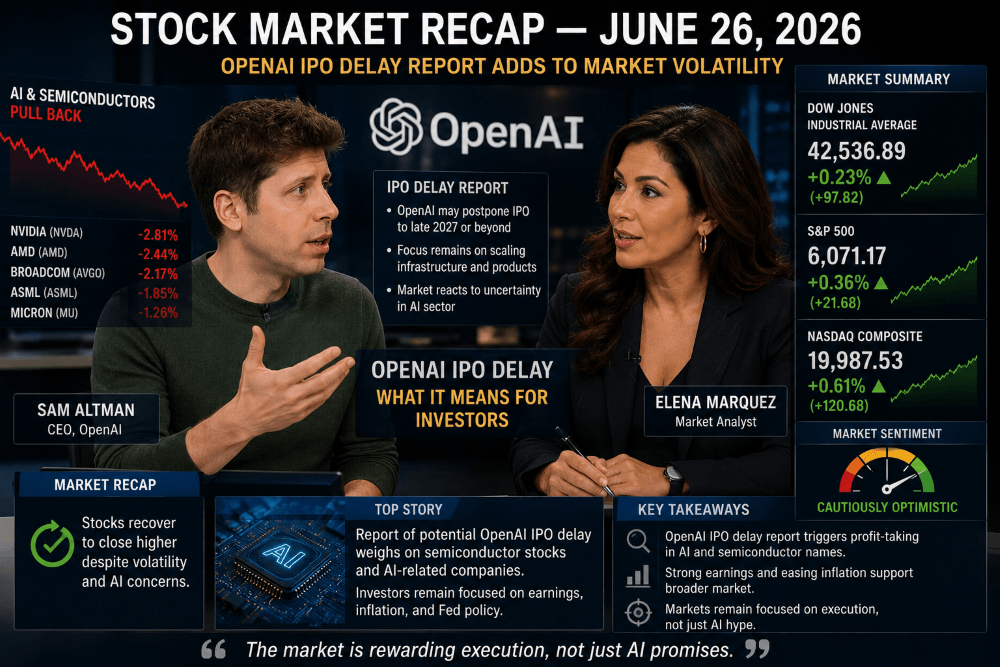
Wall Street closed the week on a strong note as investors looked past recent concerns over AI spending and focused instead on solid corporate earnings, easing inflation pressures, and resilient economic growth.
The Dow, S&P 500, and Nasdaq all closed lower on Friday, June 26, 2026. The S&P 500 fell 0.05%, the Dow fell 0.09%, and the Nasdaq fell 0.24%. The S&P 500 and Nasdaq also finished the week lower; AP reported the S&P 500 lost 2% for the week and Nasdaq lost 4.6%.
The week’s biggest lesson was clear.
Just a few days ago, investors feared that massive AI capital expenditures might never generate adequate returns.
Then came Micron’s earnings.
The company delivered outstanding results, demonstrating that demand for AI memory chips remains exceptionally strong. That report helped restore confidence that at least some areas of the AI ecosystem are already producing meaningful financial returns.
Meanwhile, falling energy prices and moderating inflation continue to improve the outlook for interest rates.
Although the Federal Reserve remains cautious, investors are increasingly optimistic that inflation is moving in the right direction without triggering a recession.
The combination of:
- Strong corporate earnings
- Healthy consumer spending
- AI-driven investment
- Cooling inflation
continues to provide a favorable backdrop for equities.
One important trend is emerging.
The market is no longer rewarding companies simply because they mention artificial intelligence.
Instead, investors are rewarding businesses that can demonstrate measurable revenue growth, expanding profit margins, and a clear path to monetizing AI investments.
That shift is healthy.
History shows that every major technological revolution eventually separates the companies with exciting stories from those with sustainable business models.
This week’s market action suggests that the AI revolution is entering that next phase.
Long-term investors should welcome it.
Other Stock Market blog posts
Comments
2 responses to “Stock Market Recap — June 26, 2026”
Great write‑up, Alain. I’m still early in my investing journey and your posts help me connect the headlines to what actually matters for a long‑term index portfolio. The way you keep things simple with XIU/VOO/QQQ is a good reminder not to overcomplicate things.
I also read your analysis of Micron and thought it was excellent. I’m curious why you choose not to have direct exposure to it (or other individual semis) and instead stick with broad ETFs.
Do you mainly focus on long‑term, diversified positions rather than taking shorter‑term thematic plays, even when the long‑term story looks strong?
Also, I’m wondering if you’ve ever considered adding something like SOXX for more targeted semiconductor exposure, or if you prefer to keep things concentrated in XIU/VOO/QQQ.
Appreciate your insights and transparency.
**Q:** I’m curious why you choose not to have direct exposure to it (or other individual semis) and instead stick with broad ETFs.
**Alain:** I’m retired. My objective is no longer to maximize returns. I already have more money than I expect to spend during my lifetime. In fact, my biggest financial challenge isn’t making more money—it’s figuring out how to spend it. (I wrote more about that here: https://www.alainguillot.com/retirement-spending/.)
Every now and then I get excited by a compelling story and buy an individual stock. I’ve learned that it raises my stress level far more than it increases my happiness. Even if I make extra money, it doesn’t materially improve my quality of life. Broad index funds allow me to participate in the long-term growth of the economy while sleeping well at night. At this stage of my life, peace of mind is worth more than squeezing out a few extra percentage points of return.
**Q:** Also, I’m wondering if you’ve ever considered adding something like SOXX for more targeted semiconductor exposure, or if you prefer to keep things concentrated in XIU, VOO, and QQQ.
**Alain:** I’ve looked at SOXX, and there’s already considerable overlap between it and QQQ. My concern isn’t that semiconductors are bad businesses—I think they’ll continue to be extremely important. My concern is concentration.
Market leadership changes over time. Today’s winners don’t remain the market’s favorites forever. If investor enthusiasm shifts away from semiconductors, SOXX could experience a significant decline even if the overall stock market continues doing well. That wouldn’t necessarily be a market crash; it would simply be a rotation of capital from one sector to another.
By owning VOO, I automatically participate in those rotations. As new industries emerge and others fall out of favor, the index adjusts over time. I may give up some upside during periods when semiconductors dominate, but in return I get diversification, lower risk, and greater peace of mind. To me, that’s like paying an insurance premium—and at this stage of my investing life, it’s a trade-off I’m happy to make.