| 📊 Alain’s Holdings — June 23, 2026 | ||||
|---|---|---|---|---|
| Symbol | Name | Price | Change | Change % |
| VOO | Vanguard S&P 500 ETF | 676.34 | -9.76 | -1.42% |
| QQQ | Invesco QQQ Trust | 713.65 | -24.30 | -3.29% |
| XIU.TO | iShares S&P/TSX 60 ETF | 51.92 | +0.08 | +0.15% |
A Global Tech Rout Begins
in Seoul — Then Arrives
on Wall Street
The AI valuation reckoning went global on Tuesday. South Korea’s KOSPI plunged 10% — triggering circuit breakers twice — as Samsung and SK Hynix each fell 12%+. The contagion spread to the U.S.: the Nasdaq tumbled 2.1%, the S&P 500 fell 1.3%, and WDC crashed 8.4%. SpaceX fell below its IPO opening price of $150 intraday before recovering to close up 1.7% after drawing $89 billion in bond demand. The Dow, propped up by defensive names, gained a modest 0.21%.
Index Close
Dow Jones
51,819.87
S&P 500
7,401.36
Nasdaq Composite
25,794.33
VIX
19.03
Market Snapshot
🌏 Global Contagion — The Selloff Started in Seoul
KOSPI −10%. Circuit Breakers Triggered Twice. Samsung −12%. SK Hynix −12%.
Tuesday’s global technology selloff began overnight in South Korea, where Samsung Electronics and SK Hynix — the world’s two largest memory chip manufacturers alongside Micron — each plunged more than 12%, triggering the Korea Exchange’s circuit breakers twice in a single session. The KOSPI index lost approximately 10% — one of its worst sessions since the 2008 financial crisis. The trigger: reports that AI-memory expansion may be slowing, combined with growing investor concern that sky-high valuations for memory stocks — Samsung is still up 160% year-to-date and SK Hynix up 800%+ over 12 months — cannot be sustained if AI infrastructure spending cycles down even slightly. Japan’s Kioxia tumbled more than 15%. The panic spread across Asia before U.S. futures opened sharply lower, with Nasdaq 100 futures down as much as 800 points (−2.7%) at the open. Wedbush’s Dan Ives called it “another gut-check moment for the tech trade — the AI Revolution remains in the 3rd inning.”
🚀 SpaceX (SPCX) — The Most Dramatic Single-Day Reversal Since the IPO
SpaceX fell to an intraday low of $147.11 — below its first-day opening price of $150 — extending Monday’s 16.4% plunge as the $20 billion bond offering continued to rattle equity investors. The stock is now 35% below its all-time high of $225.64, set just last Tuesday. The fears driving the selloff are well-documented: SpaceX disclosed $100.8 billion in cash (including the IPO proceeds), but the $20B bond was needed to refinance bridge loans tied to the $60B Cursor acquisition — a routine capital structure move, but one that spooked investors already nervous about the pace of capital consumption. Adding to the concern: all 11 original xAI co-founders had departed before the IPO, Musk himself said in March that xAI “was not built right first time around,” and xAI posted a $6.355B operating loss in 2025 while spending $12.7B in capex — wiping out Starlink’s $4.4B operating profit.
The recovery was equally dramatic. SpaceX announced it had signed a $6.3 billion AI infrastructure contract with Reflection AI — a new AI lab — and its bond offering drew $89 billion in investor demand, blowing past the $20B offering size by 4.4x and confirming investment-grade institutional confidence in Starlink’s cash flow profile. SPCX reversed from −16% at its worst to close +1.7% at $164.64, a 17-point intraday swing. Oppenheimer initiated coverage with a price target implying 58% upside from current levels.
Notable Movers
📈 Defensive Survivors
📉 Tech Wreckage
What Happened Today
The tech selloff that began in Seoul arrived on Wall Street with force. The overnight crash in Korean memory stocks — triggered by reports of AI-memory expansion slowdown concerns and valuations that had risen 800%+ in 12 months — set the tone for a risk-off U.S. open. Nasdaq 100 futures were down as much as 800 points before trading began. Almost every holding in the Nasdaq-100 from the semiconductor and computer hardware space fell; Tesla (-4.95%) was the rare non-chip mega-cap that also cratered. The Nasdaq Composite fell 2.1%, the S&P 500 dropped 0.95%, and the VIX jumped 10% back toward 19.
Yet the Dow gained 0.21% — again demonstrating the growing schism between defensive/value stocks and high-multiple tech names. Public Storage surged 4.4%, IBM gained 4.2%, Accenture added 3.3%. The divergence that has defined market character for three weeks now — chips and AI names selling off while defensives hold or rise — continued on Tuesday with renewed intensity.
The market is now explicitly asking the question it dodged for two years: Are AI infrastructure valuations justified by the revenue they will generate? Korean memory stocks — among the most spectacular gainers of the AI cycle (Samsung up 160% YTD, SK Hynix up 800%+ in 12 months) — hit a wall Tuesday as investors questioned whether AI-memory demand growth can sustain the extraordinary trajectory implied by current prices. That question echoes Monday’s Alphabet collapse on AI talent flight and capex concerns, and last week’s Oracle selloff on its own capex shock. The AI trade is being stress-tested in real time.
💾 Micron (MU) Earnings Tomorrow — The Most Anticipated Print of the Week
Micron fell more than 10% intraday Tuesday before recovering — a dramatic “sell the news before the news” dynamic ahead of Wednesday’s Q3 earnings report. Yet despite the selloff, BofA raised its price target on Micron by 58% to $1,500 from $950, citing a revised semiconductor TAM forecast of $2.7 trillion by 2030 (up from $2.3T). MU is up 283% year-to-date and 796% over the past 12 months. The street expects Q3 revenue of $35.3 billion and EPS of $20.28 — compared to $9.3 billion and $1.91 EPS in the year-ago quarter. Separately, Micron announced a strategic partnership with Anthropic focused on next-generation AI memory and storage infrastructure — making it the primary HBM, DRAM, and SSD supplier for Claude AI training and inference.
🏢 Oracle Cuts 21,000 Jobs — AI Reshapes Its Workforce
Oracle disclosed in its annual regulatory filing that it cut approximately 21,000 jobs over the past year — representing nearly 13% of its total workforce, which fell from 162,000 to 141,000 full-time employees. The company stated explicitly: “The adoption and deployment of AI technologies across our operations have resulted, and may continue to result, in reductions to our workforce.” Oracle shares fell 2.6% to $170.85 in premarket trading on the news. This is the starkest corporate disclosure yet of AI directly displacing workers at a major technology firm — and raises broader questions about employment across the tech industry as AI automates roles previously held by tens of thousands of people.
₿ Bitcoin — $62,561.99 (−3.22%) · Sliding With Tech Sentiment
Bitcoin fell 3.22% Tuesday to $62,561 — its lowest level since mid-June — as the global tech rout and renewed risk-off sentiment pulled speculative assets lower. The pattern holds: when macro fear rises and technology stocks sell off, Bitcoin falls alongside them. It has no earnings, no cash flows, and no physical backing to cushion the impact of deteriorating sentiment. Tuesday’s decline is consistent with the full history of Bitcoin’s behavior in this cycle: a speculative asset with no intrinsic value responds to macro conditions as a pure sentiment barometer. The AI capex reckoning that dragged down Alphabet, Samsung, and SK Hynix has no direct connection to Bitcoin — but fear is contagious, and fear-driven assets trade together on the way down.
What to Watch Tomorrow & This Week
- Micron earnings (Wednesday after close): The most important earnings report of the week — and arguably of the month. After Tuesday’s 10%+ intraday selloff, Micron must either validate the extraordinary bull case (BofA’s $1,500 target implies further upside) or confirm investors’ worst fears about AI-memory demand slowing. Consensus: $35.3B revenue, $20.28 EPS. Watch guidance above all else.
- FedEx earnings (Tuesday after close — reporting tonight): FedEx reports Tuesday evening. With WTI at $73 (down from $98 two weeks ago), fuel cost tailwinds should be significant. Watch freight volume guidance as a read on global trade conditions.
- Cerebras Systems first earnings (after close tonight): The Nvidia rival reports its first quarterly results since its May IPO. This will be a live test of whether Cerebras can convert its “challenger” narrative into real revenue growth — and whether its WSCE architecture is gaining traction with AI customers.
- May PCE inflation (Thursday): The Fed’s preferred inflation gauge. With WTI at $73, May PCE should begin showing the Iran peace deal’s deflationary impact. A cool print would be the most powerful argument against Warsh’s hawkish dot plot — and could spark a sharp market recovery.
- Korea / global memory contagion: Whether Samsung and SK Hynix stabilize or continue falling will set the tone for U.S. chip stocks overnight. A sustained Korean memory selloff would put further pressure on Micron’s pre-earnings narrative.
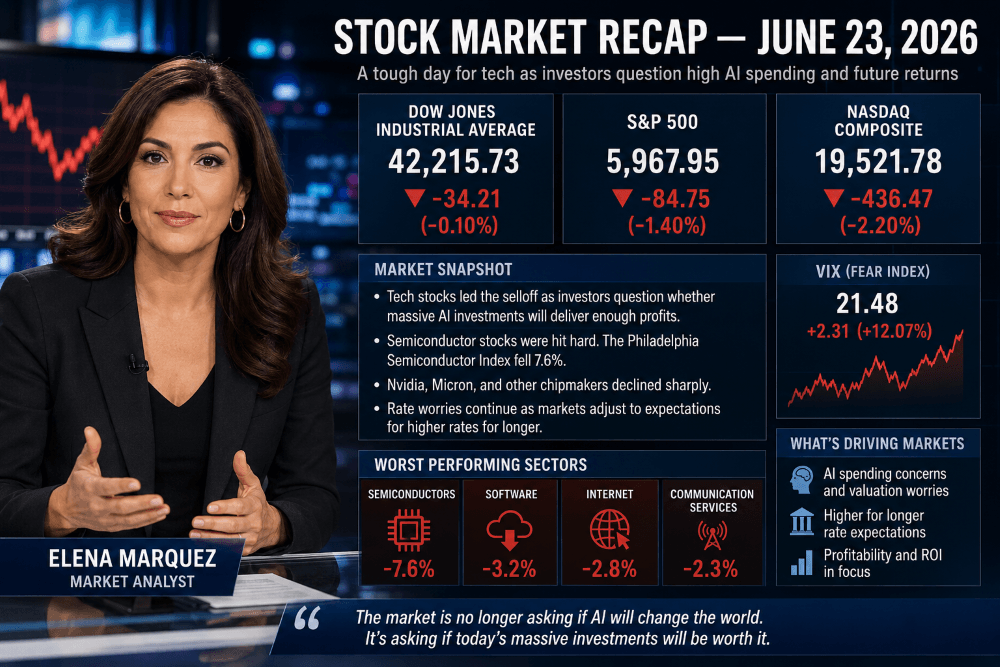
The AI trade suffered another brutal session today as investors continued questioning whether hundreds of billions of dollars in AI infrastructure spending will ultimately produce enough profits to justify the enormous investment.
The technology-heavy Nasdaq plunged 2.2%, while the S&P 500 lost 1.4%. The Dow Jones Industrial Average held up relatively well, slipping just 0.1%, thanks to its lower exposure to high-growth technology stocks.
Semiconductor stocks were hit especially hard.
- Nvidia fell sharply.
- Micron tumbled ahead of earnings.
- The Philadelphia Semiconductor Index dropped roughly 7.6%, one of its worst days this year.
The market’s biggest concern is no longer whether AI will transform the economy. Most investors already believe it will.
Instead, the question is:
Will the companies spending hundreds of billions of dollars actually earn enough money to justify these investments?
Large technology firms continue announcing enormous AI capital expenditures while simultaneously issuing debt to finance data centers, custom chips, and AI infrastructure. Investors are beginning to ask when—or if—those investments will generate acceptable returns.
Another headwind remains the Federal Reserve.
Markets continue adjusting to expectations that Fed Chair Kevin Warsh could keep interest rates higher for longer, making expensive growth stocks less attractive. Higher rates reduce the present value of future earnings, which disproportionately affects technology companies.
Despite today’s selloff, it’s worth remembering that the major indexes remain solidly positive for 2026.
Corrections are a normal part of every bull market.
Sometimes investors become too optimistic.
Sometimes they become too pessimistic.
Successful long-term investing often means recognizing the difference.
Other Stock Market blog posts