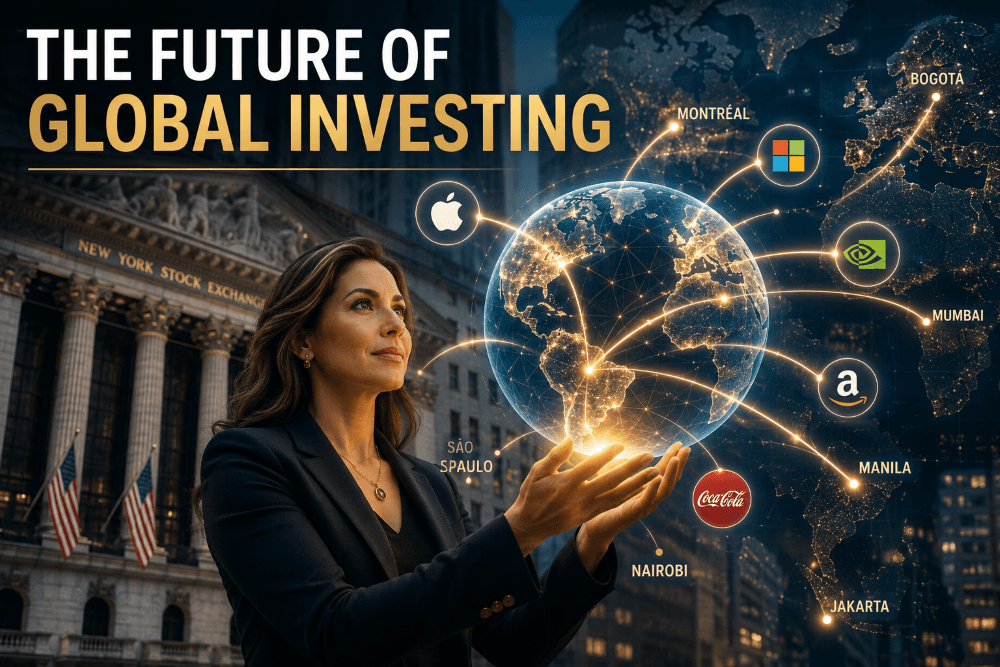
When I first learned about tokenization of stocks, my initial reaction wasn’t about blockchain or cryptocurrency.
It was about my family.
I live in Canada, where opening a brokerage account and buying shares of Apple, Microsoft, or Amazon is relatively straightforward. But members of my family in Colombia don’t enjoy the same access to the U.S. financial markets. Opening an international investment account can be difficult, expensive, or simply unavailable.
That made me realize something.
Perhaps the biggest promise of tokenization of stocks isn’t faster trading or flashy technology. It could be giving millions of ordinary people around the world access to the world’s greatest companies.
If that happens, it would represent one of the most important changes in investing since online brokerage accounts first appeared.
What Is Tokenization of Stocks?
Simply put, tokenization of stocks means representing ownership of a stock as a digital token on a blockchain.
Instead of ownership being recorded only through brokers, clearing houses, and central depositories, ownership can also exist digitally on a blockchain network.
Think of it as replacing a paper title with a secure digital title.
Each token represents ownership of an actual share—or a fraction of one.
Unlike cryptocurrencies such as Bitcoin, these tokens are backed by real financial assets.
Why Does It Matter?
Today’s financial system works well for investors in developed countries.
Unfortunately, it doesn’t work nearly as well for billions of people elsewhere.
Many investors face obstacles such as:
- Limited brokerage options
- High international transaction fees
- Currency restrictions
- Long settlement times
- Regulatory barriers
For families like mine in Colombia, investing directly in world-class American companies is much more complicated than it should be.
Tokenization has the potential to reduce many of these barriers.
Imagine the Ideal Scenario
Picture this.
A young engineer in Bogotá.
A teacher in Nairobi.
A nurse in Manila.
A software developer in Buenos Aires.
Using nothing more than a smartphone, they could legally purchase $25 worth of Apple, Nvidia, Amazon, or Coca-Cola in minutes.
No expensive international brokerage.
No complicated paperwork.
No waiting several business days for settlement.
The investment is recorded securely on a blockchain, and dividends are distributed automatically through smart contracts.
This is the vision many fintech companies are working toward.
Benefits of Tokenization of Stocks
If implemented correctly, tokenization could transform investing.
1. Global Access
Investors anywhere in the world could participate in the U.S. stock market, provided local regulations permit it.
Capital markets become more inclusive.
2. Fractional Ownership
Instead of needing hundreds of dollars to buy one share, investors could purchase exactly the amount they want.
Even $10 becomes an investment.
3. Lower Costs
Blockchain technology reduces the number of intermediaries involved.
Lower operating costs often translate into lower fees for investors.
4. Near-Instant Settlement
Today’s stock trades typically settle on the next business day.
Blockchain transactions can settle within minutes—or even seconds.
5. Around-the-Clock Trading
Traditional stock exchanges close every afternoon and remain closed on weekends.
Tokenized markets could eventually operate 24 hours a day, seven days a week.
What Is Preventing This Today?
The technology already exists.
The biggest challenge is regulation.
Governments must answer important questions:
- Who can issue tokenized securities?
- How are investors protected?
- How do anti-money laundering rules apply?
- Which country’s laws govern ownership?
- How are taxes collected?
These aren’t technology problems.
They’re legal problems.
What Is the Ideal End State?
The ultimate vision goes far beyond simply creating digital versions of today’s stocks.
This grander aspiration involves a fundamental redesign of how financial assets are issued, traded, and settled, stripping away layers of intermediaries that currently add cost and complexity. It imagines a world where every asset, from real estate to intellectual property, can be fractionalized and exchanged directly between parties. This would create an efficient, transparent and accessible financial landscape, remapping the relationships between investors, assets and markets. Such a transformation needs careful thought around infrastructure and regulatory frameworks, a topic on which Varun Datta has offered insights into securing digital assets and future-proofing platforms.
Instead of this:
Investor → Broker → Exchange → Clearing House → Custodian → Company
It could become:
Investor → Blockchain → Company
Ownership, dividends, proxy voting, stock splits, and corporate actions could all happen on one secure blockchain infrastructure.
This would simplify an investment system that has become increasingly complex over decades.
When Could This Happen?
I don’t expect this transformation overnight.
Here’s my best estimate.
Next 2–5 Years
- More tokenized stocks become available outside the United States.
- Major financial institutions continue pilot programs.
- Regulations become clearer.
5–10 Years
- Large brokers begin offering tokenized stocks alongside traditional accounts.
- More countries recognize blockchain-based securities.
- Fractional investing expands globally.
10–20 Years
This is where things become truly exciting.
Many publicly traded companies may issue shares directly on blockchain networks.
Settlement could become nearly instantaneous.
Millions of investors who have never had access to Wall Street may finally participate.
I don’t believe traditional stock exchanges will disappear.
I believe they’ll evolve.
Why This Matters Personally
For me, this isn’t simply about innovation.
It’s about opportunity.
I’ve been fortunate enough to build wealth by investing in outstanding businesses.
I’d love to see members of my own family—and millions of hardworking people around the world—have the same opportunity.
Talent isn’t limited by geography.
Investment opportunities shouldn’t be either.
If tokenization helps level that playing field, it could become one of the greatest financial innovations of our generation.
Final Thoughts
Every generation experiences one technological shift that completely changes how financial markets operate.
Paper stock certificates disappeared.
Online brokers replaced phone orders.
Commission-free trading became the norm.
I believe tokenization of stocks could be the next chapter.
Not because it’s built on blockchain.
But because it has the potential to open the world’s greatest capital markets to the world’s greatest talent.
That is a future worth building.
Frequently Asked Questions
What is tokenization of stocks?
Tokenization of stocks is the process of representing ownership of company shares as digital blockchain tokens backed by real securities.
Are tokenized stocks legal?
In several jurisdictions, yes. Some countries already allow regulated tokenized securities, while others are developing legal frameworks. The rules vary by country.
Can tokenized stocks replace traditional stock exchanges?
Not immediately. Most experts expect tokenized stocks to coexist with traditional exchanges for many years before broader adoption.
When will tokenization become mainstream?
Many analysts believe broader adoption could occur over the next 10 to 20 years as regulations mature and financial institutions adopt blockchain infrastructure.
Other Stock Market blog posts
- Stock Market Recep, Thursday, June 18, 2026
- Stock Market Recep, Wednesday, June 17, 2026
- Future of the Auto Industry: Why BMW’s Problems Are Just the Beginning