Under the Biden administration (January 2021–January 2025), the United States witnessed an unprecedented surge in immigration that overwhelmed the southern border and strained communities nationwide. According to Census Bureau data from the Current Population Survey (CPS), the foreign-born population increased by approximately 8.3 million between January 2021 and January 2025, reaching a record 53.3 million (15.8% of the U.S. population). This dramatic rise reflected a policy approach widely criticized as lax on border enforcement and overly permissive toward both legal and illegal entries.
Legal vs. Illegal Immigration
While legal immigration continued through established channels, the administration’s early reversals of Trump-era policies—such as halting border wall construction, narrowing interior enforcement priorities, and expanding humanitarian pathways—coincided with record chaos at the border. Roughly 4–5+ million lawful permanent residents (green cards) were issued across FY2021–FY2024. However, the bulk of the growth came from irregular migration.
CBP recorded 8–10+ million nationwide encounters during this period, mostly at the southwest border. After accounting for some expulsions and returns, net unauthorized additions were estimated at 5–7+ million or more, including gotaways (1.5–2+ million). Critics argue that signals of leniency—combined with catch-and-release practices, expanded parole programs, and reduced removals—encouraged mass migration, overwhelming resources and eroding public confidence. Analyses attribute roughly two-thirds of the foreign-born population growth to illegal immigration.
Temporary Protected Status (TPS)
The administration also significantly expanded Temporary Protected Status, shielding roughly 1.3 million individuals as of March 31, 2025, across 17 countries. The largest groups came from Venezuela (~605,000), Haiti (~331,000), El Salvador (~170,000), Ukraine (~101,000), and Honduras (~51,000). While intended as temporary humanitarian relief, these expansions added to the perception of open-ended protections amid a broader failure to secure the border.
This lax approach to immigration enforcement became a defining vulnerability for the Biden-Harris administration. Record border crossings, overwhelmed cities, rising costs, and concerns over crime, fentanyl trafficking, and strained social services fueled widespread public frustration. Many analysts point to these failures as a major reason Kamala Harris lost the 2024 election—voters rejected what they saw as four years of prioritizing expansive immigration over border security and American interests. The Mullin v. Doe Supreme Court case, which addressed TPS terminations for Haiti and Syria, emerged against this backdrop of policy consequences that continue to shape the national debate.
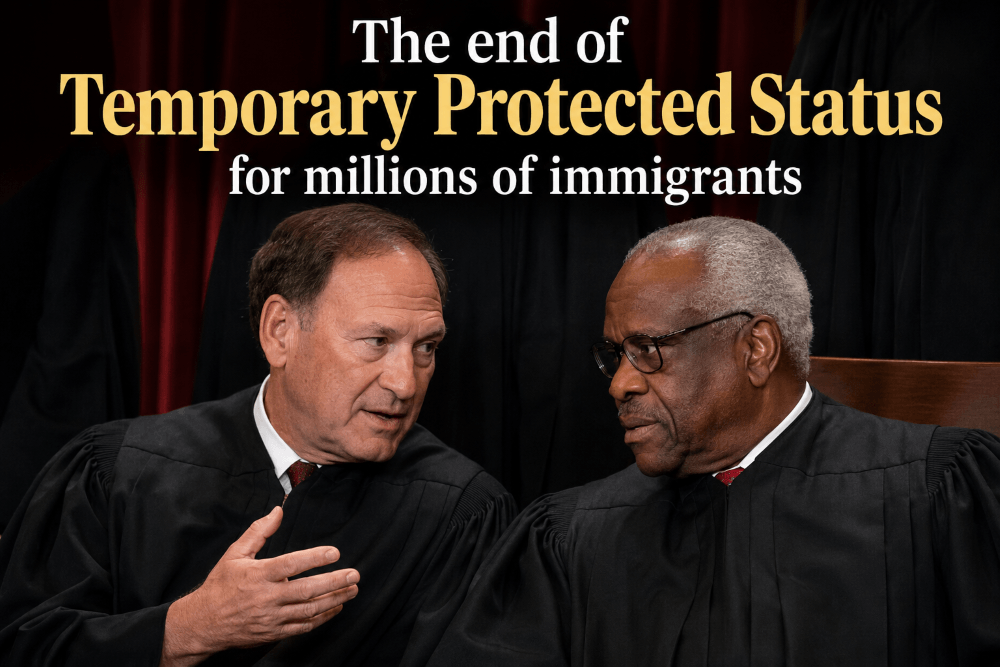
The Supreme Court has issued a 6-3 ruling, granting the Trump administration the authority to terminate Temporary Protected Status (TPS) for over 356,000 immigrants from Haiti and Syria. In the majority opinion, authored by Justice Samuel Alito, the conservative majority established that the federal TPS statute precludes judicial review of non-constitutional claims, thereby affording the executive branch unreviewable authority to terminate the humanitarian program without intervention from lower courts. Key Details of the Ruling:
Impacted Populations: The decision paves the way for the potential deportation of approximately 350,000 Haitian nationals and 6,100 Syrian nationals who had been residing and working in the U.S. legally. Rejection of Bias Claims: The court rejected arguments from immigrant advocacy groups that the Department of Homeland Security’s (DHS) decisions under former Secretary Kristi Noem were motivated by racial hostility, deeming the administration’s actions as race-neutral policy shifts.
Broader Precedent: Legal experts note that this decision is likely to enable the administration to dismantle TPS protections for up to 1.3 million immigrants from roughly a dozen other countries, as the administration has already targeted 13 of the 17 nations holding the designation.
Foreign nationals do not get to use US Constitution rules to fight federal immigration decisions in court – According to a ruling just made by the Supreme Court.
“Foreign nationals do not have the same Constitutional rights as US citizens, and cannot sue over immigration policy’
“Aliens have no equal protection rights against the Federal Government”
This gives the federal government stronger power to control who stays in the country and stops judges from tying up deportations with long legal fights.
The fight was over the Temporary Protected Status TPS for hundreds of thousands of Haitians & Syrians.
SCOTUS threw out the case that was tryin to block the end of TPS using claims that it was unfair or driven by race under the Constitution’s rules.
Thomas made clear that foreign nationals do not get to use those same Constitution rules to fight federal immigration decisions in court.
The ruling in Mullin v. Doe consolidated with Trump v. Miot, clears the way for DHS to end TPS protections that had allowed hundreds of thousands of foreign nationals to remain and work legally in the United States.
Justice Samuel Alito wrote the majority opinion for the 6-3 Court decision, with Chief Justice John Roberts and Justices Clarence Thomas and Brett Kavanaugh joining in full on key sections.
The decision reverses lower court orders that had blocked TPS terminations on procedural and constitutional grounds.
Fast Facts:
 Haiti’s TPS, first designated in 2010 faced termination notices in late 2025 under then-Secretary Kristi Noem.
Syria’s designation in place since 2012 – faced similar termination notices.
About 330,000 to 350,000 Haitian nationals held
TPS or related protections at the time of the challenged terminations.
Thousands of Haitians lived in Springfield, Ohio, a community that had seen rapid influx and documented strains on housing, schools, and public services.
Plaintiffs (Haitian and Syrian nationals using pseudonyms such as Fritz Emmanuel Lesly Miot and Dahlia Doe) sued under the Administrative
Procedure Act, claiming procedural failures like inadequate agency consultation.
The Haiti plaintiffs added an equal protection claim, alleging the termination was motivated by racial animus tied to statements from President ️Trump and Secretary Noem and the predominantly Black population of Haiti.
Justice Thomas wrote that Congress can block lower courts from reviewing or stopping immigration decisions, even when people claim their Constitutional rights were violated
He said that people from other countries cannot use the Constitution’s equal treatment rules to challenge federal immigration choices.
Details:
 Congress wrote a rule into the law that stops courts from second-guessing or overturning these kinds of immigration decisions.
That rule covers even cases where someone says their rights under the Constitution were violated.
Congress has the power to tell lower courts they cannot hear these challenges at all.
People who are not U.S. citizens do not have the same rights under the Constitution’s equal treatment rules to sue the federal government over immigration policy.
What will the Hatians do?
DHS General Counsel James Percival delivered the message straight: “It’s closing time, they don’t have to go home, but they can’t stay.”
In an official DHS video, Percival made it even clearer: “The T in TPS stands for temporary… It is closing time. You don’t have to go home but you can’t stay here. The good news is it’s not too late to get a $2,600 check and a free flight anywhre in the world.”
The department is pushing Haitians to use the CBP Home app for voluntary self-deportation with cash incentives and flights, avoiding ICE arrests and detention. No grace period is on the table after 16 years of extensions that turned “temporary” into a permanent loophole.
Introduction to the Mullin v. Doe Case
The Mullin v. Doe case reached the U.S. Supreme Court in 2026, centering on the Trump administration’s efforts to terminate Temporary Protected Status (TPS) for nationals from Haiti and Syria. This landmark decision addressed core questions about executive authority in immigration and the legal meaning of “temporary” protections.
TPS, established by Congress in 1990, offers temporary relief from deportation and work authorization to nationals of countries facing armed conflict, natural disasters, or other extraordinary conditions. The Mullin v. Doe ruling clarified limits on judicial interference with the Secretary of Homeland Security’s decisions to end such designations.
Origin of the Mullin v. Doe Case
Lower courts had issued injunctions blocking the termination of TPS for Haiti and Syria, citing procedural issues and potential discrimination claims. The Trump administration appealed, arguing that the TPS statute bars most judicial review of designation and termination decisions.
The Supreme Court consolidated related challenges and heard arguments in April 2026. On June 25, 2026, in a 6-3 decision written by Justice Samuel Alito, the Court reversed the lower courts. It held that the TPS statute (8 U.S.C. § 1254a(b)(5)(A)) prohibits judicial review of non-constitutional claims regarding TPS terminations.
The majority emphasized Congress’s intent to leave these policy determinations to the executive branch, in consultation with the State Department, based on conditions in the foreign country.
The Supreme Court Decision and Its Immediate Impact
The ruling allows the Department of Homeland Security to proceed with ending TPS protections for hundreds of thousands from Haiti and Syria. It rejected broad challenges to termination decisions, noting a race-neutral basis: the administration’s view that TPS had been improperly extended into a de facto permanent program.
Dissenting justices argued the decision undermined protections and potentially allowed arbitrary executive actions. However, the majority stressed statutory limits on court involvement.
This outcome reinforces executive discretion in ending TPS when conditions improve or no longer justify protections.
What Does “Temporary” Mean in TPS?
The core of TPS is its temporary nature. Designations are made for 6 to 18 months and can be extended if dangerous conditions persist. The statute requires periodic review of country conditions.
Possible interpretations of “temporary” include:
- Strict: Ends automatically once the initial crisis resolves, requiring affirmative re-designation only under new circumstances.
- Flexible: Allows repeated extensions based on ongoing assessments, potentially spanning decades if instability continues.
- Humanitarian: Balances immediate safety with the expectation of eventual return or other lawful immigration paths.
Critics argue repeated extensions transform TPS into something permanent, contrary to congressional intent.
Can Temporary Government Programs Become Permanent?
History shows many “temporary” programs gain permanence. Economist Milton Friedman famously noted, “Nothing is so permanent as a temporary government program.” Examples include certain tax measures, subsidies, and welfare expansions originally framed as short-term aid.
In immigration, TPS for some countries (e.g., Honduras since 1999, El Salvador) lasted over 20 years through multiple extensions, far beyond initial crises. This raises questions about mission creep and dependency.
Who Should Decide When Temporary Programs End?
Under the TPS statute, the Secretary of Homeland Security, after consulting the Secretary of State, makes this call based on country conditions. Courts have limited review, as affirmed in Mullin v. Doe. Congress can intervene via legislation but has largely deferred to the executive.
Proponents of strong executive authority argue this allows responsive policy. Others contend Congress should set clearer sunset provisions or require periodic legislative renewal to prevent indefinite extensions.
Has “Temporary” Status Been Extended Repeatedly?
Yes. Many TPS designations have been renewed multiple times. For instance:
- Haiti’s TPS, initially after the 2010 earthquake, saw extensions under different administrations.
- Similar patterns occurred for El Salvador, Honduras, and others, sometimes lasting decades.
The Trump administration has highlighted this as evidence of abuse, pushing to return TPS to its original temporary intent.
Repatriation After TPS Expiration: Historical Examples
There have been terminations followed by repatriation efforts. Countries like Angola, Bosnia-Herzegovina, Liberia, and others had TPS designations that ended, with beneficiaries expected to depart or seek other status.
Enforcement varies. Some returns occurred voluntarily or through removal proceedings, though litigation often delays implementation. The Mullin v. Doe decision strengthens the government’s position to enforce terminations without broad judicial blocks.
Has TPS Been Abused?
Critics, including border experts, contend TPS has been stretched beyond statutory limits. Re-designations have extended benefits to later arrivals, potentially incentivizing migration. Reports note spikes in encounters from TPS-designated countries.
Supporters view extensions as necessary humanitarian responses. The debate centers on whether repeated use undermines the “temporary” framework and fairness to legal immigrants.
Do TPS Holders Skip the Line? Insights from Tom Homan
Former border czar Tom Homan has argued TPS allows beneficiaries to “skip the line” ahead of those following legal immigration processes. He notes millions wait in line with proper vetting, while TPS provides work authorization and deportation relief, sometimes for extended periods.
Homan emphasizes that TPS was never meant to be a backdoor to permanent residency, highlighting tensions between humanitarian goals and rule-of-law principles.
Broader Implications for U.S. Immigration Policy
The Mullin v. Doe ruling signals a potential shift toward stricter enforcement of temporary statuses. It raises fundamental questions about balancing compassion with sustainability in immigration systems.
As debates continue, clarity on “temporary” remains essential to prevent programs from becoming de facto permanent fixtures.
FAQ
Q: What was the outcome of Mullin v. Doe? A: In a 6-3 decision on June 25, 2026, the Supreme Court allowed the termination of TPS for Haiti and Syria, ruling that the statute largely bars judicial review of such executive decisions.
Q: Can temporary programs like TPS become permanent? A: In practice, many have through repeated extensions, though legally they remain temporary and subject to periodic review and potential termination.
Q: Who decides when TPS ends? A: Primarily the Secretary of Homeland Security, based on country conditions, with limited judicial oversight as affirmed by the Supreme Court.
Q: Has TPS ever truly ended with repatriation? A: Yes, for several countries historically, though processes involve challenges and varying enforcement levels.
Other Law Posts