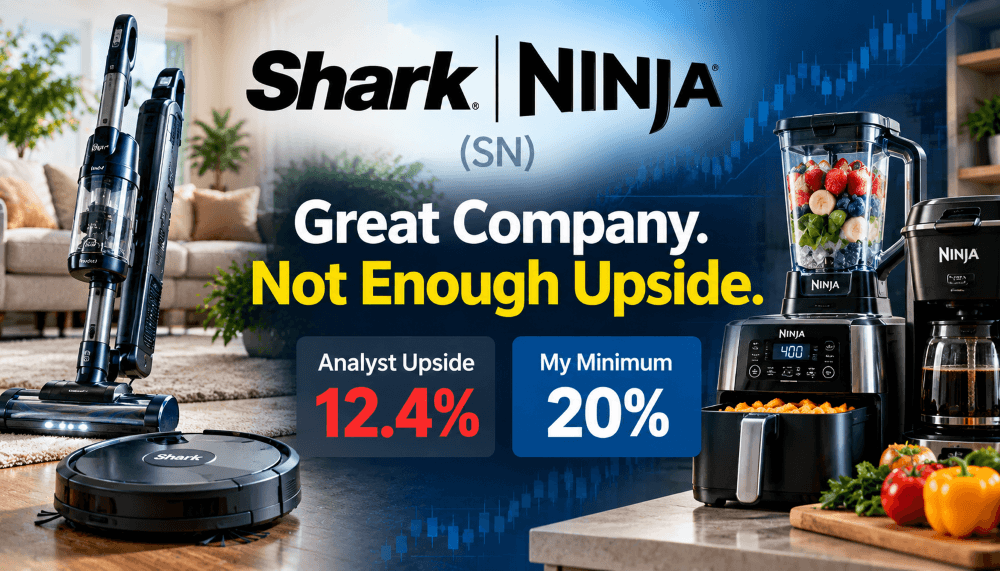
October 18, 2026 | Stock Analysis | AlainGuillot.com
SharkNinja has built an impressive consumer-products business around innovation, aggressive marketing, and popular household appliances. Its sales and earnings are growing rapidly, and its brands have become household names. But being a great company doesn’t necessarily make its stock a great investment.
When I evaluate a potential investment, I look for companies with strong earnings growth, expanding revenue, and attractive valuations. I also require the average Wall Street analyst’s 12-month price target to suggest at least 20% upside.
SharkNinja (NYSE: SN) is an interesting company with an impressive growth record. Unfortunately, at its current share price, it doesn’t meet my investment requirements.
What Does SharkNinja Do?
SharkNinja is a global consumer-products company specializing in household appliances and innovative home technologies.
Its business is built around two major brands: Shark and Ninja.
The Shark brand focuses primarily on household cleaning and personal-care products, including vacuum cleaners, robotic vacuums, steam mops, carpet cleaners, air purifiers, and hair-styling devices.
The Ninja brand is best known for kitchen appliances such as blenders, air fryers, coffee makers, food processors, ice cream makers, and outdoor cooking equipment.
Some of its most recognizable products include the Ninja Creami ice cream maker, Ninja Foodi appliances, Shark FlexStyle hair-styling system, and Shark cordless vacuums.
These are not necessarily revolutionary inventions. SharkNinja’s strength lies in taking familiar household products, identifying consumer frustrations, and redesigning them with features that make them more convenient or appealing.
The company then uses effective marketing, social media, and major retail partnerships to bring those products to consumers.
How SharkNinja Became a Consumer-Products Powerhouse
SharkNinja’s history dates back to the company Euro-Pro, which was founded in 1994 by Mark Rosenzweig.
The business initially focused on household cleaning products before expanding into kitchen appliances and other consumer categories.
Over time, the Shark and Ninja brands became increasingly recognizable.
Under the leadership of CEO Mark Barrocas, the company expanded its product portfolio, strengthened its retail relationships, and invested heavily in research and development.
In 2023, SharkNinja became an independently listed public company following its separation from JS Global Lifestyle.
Today, its products are sold through major retailers, online marketplaces, and its own direct-to-consumer channels.
Its competitive advantage is not based on one product. It comes from its ability to repeatedly identify new consumer needs, develop products, market them effectively, and expand into additional categories.
Why SharkNinja Is Such an Attractive Business
There are several reasons I find SharkNinja interesting.
1. A strong record of product innovation
SharkNinja continually introduces new products and improves existing ones.
The Ninja Creami is a good example. Rather than competing only in traditional blenders or food processors, the company created a product that allows consumers to make customized frozen desserts at home.
The Shark FlexStyle provides another example of the company’s approach: offering consumers sophisticated hair-styling functionality in a competitive product category.
Not every new product becomes a success, but SharkNinja has demonstrated an ability to launch products that attract consumer attention.
2. Powerful brands
Brand recognition matters in consumer products.
When shoppers search for a vacuum cleaner, blender, or air fryer, Shark and Ninja are frequently among the brands they consider.
That recognition helps the company introduce new products because consumers are already familiar with its existing offerings.
3. Expansion into new categories
SharkNinja is not limited to vacuum cleaners and blenders.
The company has expanded into beauty appliances, outdoor cooking, frozen beverages, coffee systems, and other household categories.
Each successful expansion creates an additional source of revenue.
4. Strong retail distribution
SharkNinja products are available through major retailers and e-commerce platforms.
This broad distribution gives the company access to large numbers of customers without relying exclusively on its own stores.
However, retail relationships also create risks. Major retailers have significant negotiating power, and shelf space is competitive.
5. Strong earnings growth
Perhaps the most attractive feature of SharkNinja is its ability to grow profits while expanding its business.
For a company selling physical consumer products, achieving earnings growth above 20% is impressive.
But growth alone is not enough to justify buying a stock.
The price investors pay is equally important.
The Problem: SharkNinja’s Stock Already Reflects High Expectations
As of October 18, 2026, SharkNinja’s latest reported share price is approximately $186.51.
The average Wall Street analyst’s 12-month price target is approximately $209.56.
That implies:
Expected upside = ($209.56 − $186.51) ÷ $186.51 = 12.4%
A potential return of 12.4% is certainly respectable.
However, my investment strategy requires at least 20% expected upside based on the average analyst price target.
At the current share price, SharkNinja would need an average analyst target of approximately $223.81 to meet that requirement.
Alternatively, if the consensus target remained unchanged at $209.56, the share price would need to decline to approximately $174.63.
Analyst targets are estimates, not promises. The stock could outperform or underperform those expectations.
Nevertheless, I use them as one component of a disciplined investment screening process.
And at today’s price, SharkNinja fails my first requirement.
Does SharkNinja Meet My Growth Requirements?
My second requirement focuses on the company’s underlying business performance.
I look for:
- Expected earnings-per-share growth of at least 20% annually.
- Revenue growth exceeding 15%, preferably approaching or exceeding 20%.
Here are the current analyst consensus projections:
| Financial metric | Fiscal 2026 | Fiscal 2027 |
|---|---|---|
| Revenue | $7.51 billion | $8.48 billion |
| Revenue growth | 17.3% | 12.9% |
| Adjusted earnings per share | $6.59 | $7.66 |
| EPS growth | 24.9% | 16.2% |
SharkNinja meets both growth requirements for 2026.
Projected EPS growth of 24.9% comfortably exceeds my 20% minimum, while revenue growth of 17.3% clears my 15% threshold.
However, the picture becomes less attractive when looking ahead to 2027.
Analysts expect EPS growth to slow to approximately 16.2%, while revenue growth is projected to decline to 12.9%.
Both figures fall below my requirements.
This is particularly important because we are already in October 2026.
As an investor considering a new position today, I care more about the growth the company can deliver in the future than the growth it has already achieved.
SharkNinja remains a growing company, but its expected growth rate appears to be moderating.
Is SharkNinja Too Expensive? The PEG Ratio
My third investment criterion evaluates the relationship between a company’s valuation and its earnings growth.
For this, I use the price/earnings-to-growth ratio, commonly called the PEG ratio.
The formula is:
PEG ratio = Price-to-earnings ratio ÷ Expected annual EPS growth rate
A PEG ratio close to or below 1.0 can indicate that a company’s valuation is relatively attractive compared with its expected earnings growth.
A ratio significantly above 1.0 suggests investors are paying a higher premium for that growth.
SharkNinja currently trades at a forward price-to-earnings ratio of approximately 26.2.
Published PEG estimates vary by provider, ranging from approximately 1.8 to 2.2, depending on the earnings and growth assumptions used.
Using the forward P/E and projected 2027 EPS growth:
PEG = 26.22 ÷ 16.21 = 1.62
That is still substantially above my preferred level of 1.0.
This doesn’t necessarily mean SharkNinja is dramatically overvalued.
Investors may reasonably be willing to pay a premium for its brands, product innovation, market share, and long-term growth opportunities.
However, from my perspective, the valuation does not provide a sufficiently attractive relationship between price and expected growth.
SharkNinja therefore fails my third requirement.
What Could Go Wrong for SharkNinja?
Although I admire the business, there are several risks investors should consider.
Competition: Household appliances are highly competitive. SharkNinja competes with established companies such as Dyson, Breville, De’Longhi, and numerous lower-cost manufacturers.
Consumer spending: Many SharkNinja products are discretionary purchases. During periods of economic weakness, consumers may postpone buying a new coffee maker, vacuum cleaner, or kitchen appliance.
Product innovation: The company must continually introduce successful products. A slowdown in innovation or a series of unsuccessful launches could weaken growth.
Manufacturing and tariffs: SharkNinja relies on international manufacturing and supply chains. Tariffs, trade restrictions, shipping disruptions, and rising production costs can affect profitability.
Valuation: Perhaps the most important risk for investors is that the stock already reflects substantial optimism. If earnings growth slows more than expected, investors may become unwilling to pay today’s valuation multiple.
A great company can still be a disappointing investment if its future performance fails to meet the expectations embedded in its stock price.
What Would Make Me Reconsider SharkNinja?
SharkNinja remains on my watchlist.
I would reconsider the stock if several things changed.
First, I would like to see the share price offer at least 20% potential appreciation relative to the average analyst target.
Second, I would like to see analysts increase their 2027 earnings and revenue forecasts, ideally bringing projected EPS growth back above 20% and revenue growth above 15%.
Third, I would prefer a more attractive valuation, with a PEG ratio closer to 1.0.
A lower share price could improve both the expected upside and the valuation, assuming the company’s fundamentals remain strong.
Alternatively, faster-than-expected earnings growth could justify a higher valuation.
SharkNinja’s upcoming earnings announcement, expected in early November 2026, will provide another opportunity to evaluate its performance and management’s outlook.
My Verdict: Great Company, But Not a Buy Under My Criteria
Here is how SharkNinja measures against my investment requirements:
| Investment criterion | SharkNinja | Result |
|---|---|---|
| Analyst 12-month upside ≥20% | 12.4% | Does not qualify |
| Forward EPS growth ≥20% | 16.2% projected for 2027 | Does not qualify |
| Forward revenue growth >15% | 12.9% projected for 2027 | Does not qualify |
| PEG ratio near or below 1.0 | Approximately 1.6–2.2 | Does not qualify |
SharkNinja has built an excellent business. Its brands are strong, its products are innovative, and its management has demonstrated an ability to expand into new markets.
But I am not simply looking for excellent companies.
I am looking for excellent companies available at prices that offer attractive potential returns.
At approximately $186.51 per share, SharkNinja doesn’t meet my investment criteria.
This is not a prediction that its stock will decline. It could continue rising, especially if the company delivers better-than-expected earnings.
However, I prefer to follow a consistent investment process rather than buy a stock simply because I admire the business.
For now, SharkNinja stays on my watchlist.
Sometimes, the most important investment decision is knowing when not to buy.
Disclaimer: This article reflects my personal investment research and opinions as of October 18, 2026. It is not personalized financial advice or a recommendation to buy or sell securities. Analyst forecasts, price targets, and valuation multiples can change. Investing involves risk, including the possible loss of capital.
Other speculative posts
Leave a Reply