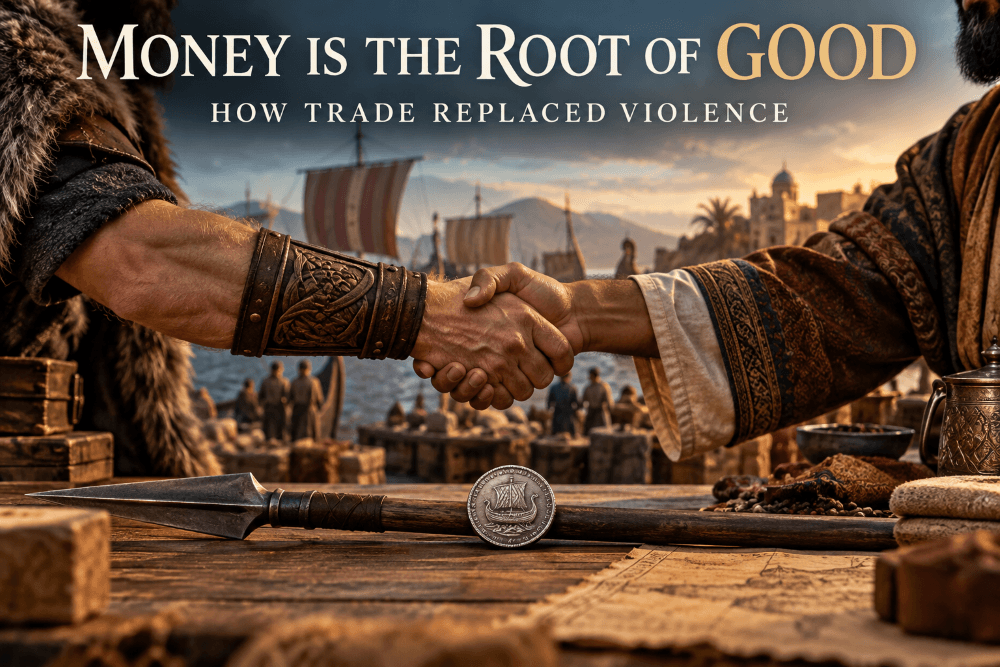
We have all heard the expression: “Money is the root of all evil.”
I would like to propose the opposite idea: Money Is the Root of Good.
That statement is deliberately provocative. Money has certainly been associated with greed, corruption, exploitation and crime. People have killed for money, cheated for money and betrayed friends for money.
But those are things people do for money. They aren’t what money itself does.
In fact, the famous saying isn’t even what the Bible actually says. The passage in 1 Timothy 6:10 refers to the love of money as a root of evil, rather than declaring money itself evil.
Money itself may be one of humanity’s greatest technologies for cooperation.
It allows two strangers who know nothing about each other—and who may not particularly like or trust each other—to cooperate peacefully.
And that changed civilization.
Before Money, There Was the Spear
Imagine two neighboring communities thousands of years ago.
One community has something the other wants: cattle, grain, metal, salt, fertile land or access to water.
There are essentially two ways of getting it.
You can take it.
Or you can trade for it.
For much of history, those two methods existed side by side. Raiding, piracy and conquest were normal methods of acquiring wealth in many societies.
Ancient Mediterranean piracy, for example, existed for centuries. Coastal communities attacked ships and settlements, carried away goods and enslaved captives. Ancient sources even suggest that in some periods raiding was regarded as a legitimate way of making a living.
War was an economic activity.
Then there was another possibility.
Instead of taking what your neighbor had, you could offer him something he wanted.
The spear could be replaced by the bargain.
The Vikings: Raiders and Entrepreneurs
The Vikings provide a fascinating example.
We remember them as raiders: longships appearing on the horizon, warriors attacking settlements, stealing valuables and carrying away captives.
That image isn’t wrong.
But it is incomplete.
As I discussed in my article on Viking trade, the Vikings also became extraordinary merchants.
Their commercial networks stretched enormous distances. Archaeologists have found Arabic silver coins in Viking settlements, while Viking merchants moved furs, amber, ivory and other commodities through trading networks connecting Scandinavia with Russia, the Middle East and beyond.
And interestingly, archaeological evidence suggests Scandinavian commerce was developing even before the famous Viking raids began.
The important lesson, therefore, isn’t that Vikings suddenly stopped being raiders and became traders.
It is that the same people could choose between coercion and exchange.
A ship could carry warriors.
Or it could carry merchandise.
One method of acquiring wealth required violence.
The other required cooperation.
Raiders Eventually Need Customers
The Vikings were hardly unique.
Piracy was widespread throughout the ancient Mediterranean. Greeks, Illyrians, Cilicians and other peoples engaged at different times in maritime raiding. As Mediterranean commerce expanded, trading cities increasingly had an incentive to suppress piracy because safe seas were valuable to merchants.
Ancient Greece provides an especially interesting transition.
As Greek commercial networks expanded, permanent trading centers appeared where merchants of different nationalities could meet. Coinage spread, measurements became more standardized and states increasingly attempted to make maritime routes safer for commerce.
Think about the change in incentives.
A prosperous merchant does not want to burn down the town where his customers live.
He wants those customers to become richer so that they can buy more from him next year.
Commerce turns the stranger from potential prey into a potential customer.
Money Is the Root of Good Because It Expands Trust
Barter has an obvious problem.
Suppose I grow wheat and you make shoes.
I want shoes.
But perhaps you don’t want wheat.
For our exchange to occur, I need something you want at exactly the moment you have something I want.
I sell my wheat to someone else.
I receive money.
Then I use that money to buy your shoes.
You can take that same money and buy something from another stranger.
Suddenly cooperation can spread through an enormous network of people who never meet one another.
That is the extraordinary social function of money.
Money allows us to cooperate without having to know each other.
From Personal Trust to Social Trust
In a small tribe, economic relationships can depend on family, friendship and reputation.
That doesn’t work very well in a society containing millions of strangers.
I don’t know the farmer who produced my tomatoes.
I don’t know the engineers who designed my computer.
I don’t know the workers who manufactured my refrigerator.
I don’t know the truck driver who delivered my coffee.
Yet somehow all of these people cooperate with me.
Money provides a common language connecting our efforts.
I don’t need the coffee farmer to be my cousin.
I don’t even need him to know that I exist.
Money makes the relationship horizontal.
We meet economically not as conqueror and conquered, master and servant, or tribal ally and tribal enemy, but as buyer and seller.
You have something I want.
I have something you want.
Let’s make a deal.
Trade as an Alternative to War
This idea has a long intellectual history.
The French philosopher Montesquieu argued in The Spirit of the Laws that commerce naturally tends toward peace because trading nations become mutually dependent: one wants to buy while another wants to sell.
This became associated with the idea of doux commerce—“gentle commerce.”
The theory wasn’t that merchants suddenly became saints.
It was that commerce changes incentives.
If stealing gives me $100 today but trading with you can give me $100 every year for twenty years, suddenly keeping you alive, prosperous and willing to deal with me becomes economically valuable.
The relationship changes from:
Your wealth is something I can take.
to:
Your wealth is something from which we can both benefit.
That is an enormous civilizational change.
Money Animates Human Endeavour
Money does something else that is easy to overlook.
It mobilizes human ambition.
An entrepreneur sees a problem and thinks:
Maybe I can solve that.
Someone invents a better engine.
Someone builds a factory.
Someone opens a restaurant.
Someone writes a book.
Someone creates software.
Someone finances a ship to sail across an ocean.
The desire for profit encourages people to risk their time, savings and reputations trying to produce something that other people voluntarily choose to buy.
Of course, not every pursuit of money creates social value.
Fraud exists.
Corruption exists.
Exploitation exists.
Theft exists.
Money does not eliminate bad human behavior.
But in a functioning market, there is a remarkably powerful principle at work:
If you want my money, give me something I value more than my money.
That transaction can make both sides better off.
Money Turns Ambition Into Cooperation
This may be money’s most underappreciated quality.
Human beings are ambitious.
We want status, security, comfort and recognition. We want better lives for ourselves and our families.
A society cannot simply wish those motivations away.
The question is how to channel them.
Conquest channels ambition toward domination.
Theft channels ambition toward taking.
Commerce can channel ambition toward serving somebody else.
The entrepreneur who wants to become wealthy must ask:
What do people want?
How can I make their lives easier?
What can I produce better?
What problem can I solve?
How can I persuade millions of strangers to voluntarily give me a few dollars?
Money turns self-interest into a potential mechanism for cooperation.
That doesn’t make greed virtuous.
It makes peaceful exchange useful.
Money Is a Social Technology
We tend to think of technology as physical objects.
The wheel is technology.
The printing press is technology.
The steam engine is technology.
The computer is technology.
But money is also a technology.
It is an extraordinarily sophisticated social technology.
Money allows us to:
- store economic value,
- measure prices,
- compare alternatives,
- compensate strangers,
- specialize in different skills,
- save for the future,
- invest in businesses,
- borrow against future production,
- coordinate enormous organizations,
- and trade across continents.
Without some reliable medium of exchange and accounting, modern economic specialization would become extraordinarily difficult.
Money isn’t merely something sitting inside your wallet or bank account.
It is part of the infrastructure of civilization.
Money Creates Liberation
Money can also provide independence.
Throughout much of history, your survival depended heavily on the group into which you were born.
Your family.
Your village.
Your tribe.
Your lord.
Your social class.
Your land.
Money can loosen those bonds.
If you can earn money independently, you gain choices.
You can move.
You can save.
You can leave a bad employer.
You can start a business.
You can buy services from strangers.
You can support causes you believe in.
You can build a life that looks different from the life your parents lived.
That is why I think money can be a force for liberation.
But Money Requires Trust
There is an important qualification.
Money works because we trust it.
When I accept a dollar today, I do so because I believe somebody else will accept it tomorrow.
That makes money fundamentally social.
A functioning monetary system therefore depends on institutions: property rights, contracts, courts, banks, governments and social norms that allow strangers to transact with reasonable confidence.
Destroy that trust and money loses much of its coordinating power.
Preserve it and something remarkable happens.
Millions of strangers cooperate every day without anybody centrally directing the entire process.
Money Is Not Morality
None of this means that money makes people good.
Money can finance hospitals.
Money can finance weapons.
Money can build schools.
Money can bribe officials.
Money can reward innovation.
Money can reward deception.
Money amplifies human intentions.
That distinction matters.
The moral problem isn’t the existence of money. It is what human beings choose to pursue with it and what institutions reward or punish those choices.
Money is a tool.
But it may be one of the most powerful tools humans ever invented.
From Spears to Coins
Imagine again those two ancient communities facing each other across a border.
One has something the other wants.
One possibility is:
Give it to us or we will kill you.
Another is:
What would you accept in exchange for it?
That second sentence contains an enormous amount of civilization.
It recognizes ownership.
It requires negotiation.
It creates reciprocity.
It acknowledges that the stranger has interests worth considering.
And money makes that conversation infinitely easier.
Perhaps that is one way to understand thousands of years of economic history.
We gradually discovered that there are better ways to obtain what other people possess than taking it from them.
Trade allowed strangers to cooperate.
Money allowed trade to scale.
Credit allowed cooperation across time.
Investment allowed today’s savings to finance tomorrow’s ideas.
Entrepreneurship turned those resources into experiments about how life might be improved.
And prosperity expanded.
Money Is the Root of Good
So I will happily defend the provocative statement:
Money Is the Root of Good.
Not because money automatically makes us virtuous.
Not because greed doesn’t exist.
And certainly not because commerce has eliminated war.
It hasn’t.
Rather, money gives human beings an alternative way of dealing with one another.
Instead of conquest, exchange.
Instead of stealing, buying.
Instead of demanding, negotiating.
Instead of treating the stranger exclusively as a rival, treating the stranger as a customer, supplier, investor or partner.
Money animates human endeavor. It encourages risk-taking, investment, specialization and experimentation.
Most importantly, it allows cooperation among strangers on a scale our ancestors could scarcely have imagined.
For thousands of years, humanity possessed the spear.
Eventually, we developed something much more powerful.
We learned how to make an offer.
And we invented money to make that offer easier.
Perhaps money isn’t the root of all evil after all.
Perhaps, properly understood and properly used, money is one of the roots of civilization itself.
Frequently Asked Questions
Is money really the root of all evil?
No. Even the familiar expression is a shortened version of the biblical passage. 1 Timothy 6:10 refers to the love of money as a root of evil, rather than saying money itself is inherently evil. Money is a tool that can facilitate both beneficial and harmful activities.
Did trade actually replace warfare?
Not completely. Trade and warfare have existed simultaneously throughout history, and commercial societies have certainly fought wars. The more defensible argument is that trade provides an alternative mechanism for acquiring resources and creates mutual economic interests that can make peaceful relations more valuable.
Why was money important to the development of civilization?
Money made exchange easier among people who did not know each other personally. It facilitated specialization, saving, investment, accounting and increasingly complex commercial networks.
How does money encourage cooperation?
Money allows people with completely different needs to exchange value through a commonly accepted medium. A farmer, programmer, carpenter and doctor don’t need to barter directly with one another; money allows each to specialize while participating in a much larger network of exchange.
Leave a Reply