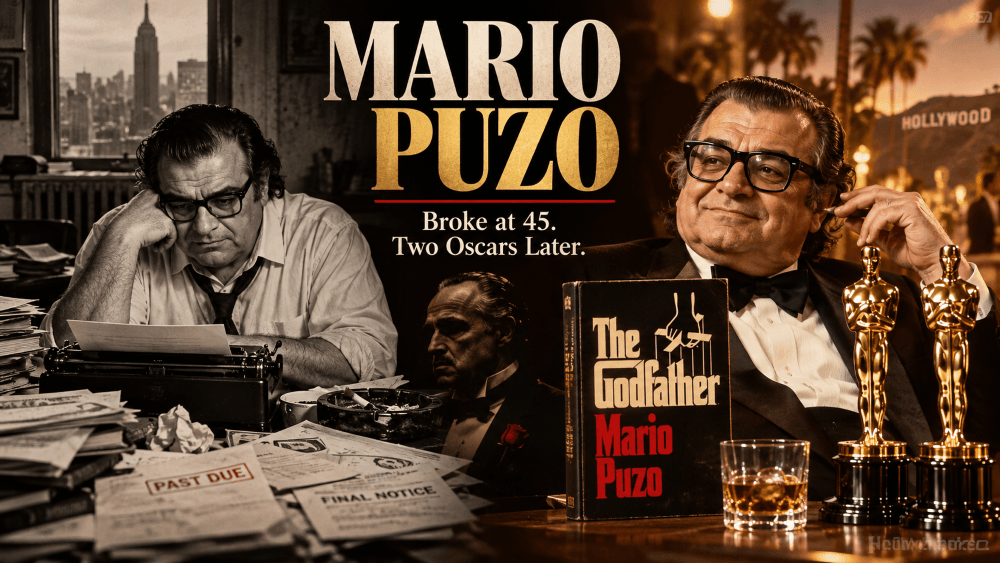
Mario Puzo was 45 years old, deeply in debt, supporting a wife and five children, and watching the literary career he had dreamed about since childhood go nowhere.
A few years later, Mario Puzo was a millionaire.
A few years after that, he had two Academy Awards.
And when Hollywood first hired him to adapt The Godfather, he had never written a screenplay in his life.
The story of Mario Puzo is not simply the story of The Godfather. It is the story of a man who spent decades pursuing artistic success, failed commercially, reached middle age in debt—and finally decided that survival mattered more than literary prestige.
That decision changed American popular culture.
Mario Puzo’s Childhood in Hell’s Kitchen
Mario Puzo was born October 15, 1920, in Manhattan’s Hell’s Kitchen, the son of Italian immigrants from the province of Avellino in southern Italy.
His father worked as a trackman for the railroad. When Mario was about 12, his father was institutionalized after suffering from schizophrenia, leaving his mother, Maria, to hold the family together.
She became one of the great influences on Puzo’s writing.
Puzo later based Lucia Santa, the formidable matriarch of The Fortunate Pilgrim, on his mother. Some of the strength, dignity, loyalty and ruthlessness that eventually appeared in Don Vito Corleone also owed something to the woman who had fought to keep Puzo’s family together.
Puzo grew up poor, surrounded by the hard realities of immigrant life in New York.
But he wanted to become a writer.
A Writer Nobody Was Buying
During World War II, Puzo served in the U.S. Army Air Forces and was stationed overseas. After returning home, he attended college under the GI Bill and eventually worked at ordinary jobs—including government work and magazine publishing—while pursuing his ambition to write.
His first novel, The Dark Arena, appeared in 1955.
Critics saw talent.
Readers mostly ignored it.
Puzo spent years working on his second major novel, The Fortunate Pilgrim, published in 1964. The semi-autobiographical story followed an Italian immigrant family struggling to survive in New York.
Puzo considered it his best and most literary novel.
Critics admired it too.
Commercially, it went almost nowhere.
That created an uncomfortable problem.
Critical acclaim didn’t pay Mario Puzo’s bills.
$20,000 in Debt at Age 45
By his mid-forties, Mario Puzo was approximately $20,000 in debt.
That was a substantial amount of money in the 1960s.
He owed money to relatives, finance companies, banks and bookmakers. He had a wife and five children to support.
Puzo finally reached a conclusion that must have been painful for someone who had spent his life dreaming of serious literature.
He needed to write something people would actually buy.
As Puzo later explained:
“I wrote it to make money.”
He was 45 years old and, in his own wonderfully cynical description, decided it was time to “grow up and sell out.”
An editor had noticed the Mafia material in The Fortunate Pilgrim and suggested that a novel containing more of that world might actually sell.
So Puzo began developing a book about the Mafia.
There was one problem.
He didn’t actually know the Mafia.
Mario Puzo Had Never Been a Gangster
One of the great misconceptions surrounding The Godfather was that Puzo must have possessed intimate knowledge of organized crime.
He didn’t.
Puzo repeatedly said that before becoming famous, he had never personally known high-ranking Mafia figures.
His knowledge came largely from research, observation, stories and his familiarity with gambling culture.
Yet he understood something more important than the technical workings of organized crime.
He understood family.
He understood immigrants.
He understood poverty, masculine pride, obligation, loyalty, favors, power and the unwritten rules people use when official institutions fail them.
Those ingredients became the emotional architecture of The Godfather.
The $5,000 Bet That Changed His Life
Puzo eventually presented his Mafia idea to G. P. Putnam’s Sons.
The publisher gave him an advance of just $5,000.
Consider the numbers.
- Mario Puzo was about $20,000 in debt.
- He was supporting five children.
- His previous novels had failed commercially.
- He was 45 years old.
- His advance for the book that would transform his life was $5,000.
Puzo spent roughly three years writing the novel.
Before he had even finished it, Hollywood came calling.
Paramount Bought The Godfather Before It Was Finished
In 1967, Paramount Pictures learned about Puzo’s unfinished Mafia manuscript.
The studio offered approximately $12,500 for an option, with a larger payment—reportedly up to $80,000—if Paramount ultimately made the movie.
Puzo’s agent reportedly advised him not to take the offer.
The manuscript wasn’t finished. If the book became successful, the film rights could become much more valuable.
Financially, waiting made sense.
There was just one problem.
Puzo needed money now.
So he accepted.
It is one of the recurring realities of entrepreneurship: the theoretically optimal decision isn’t always available to someone without capital.
Cash flow changes decisions.
The Godfather Becomes a Phenomenon
The Godfather was published in 1969.
Everything changed.
The novel remained on The New York Times bestseller list for 67 weeks and sold more than nine million copies within two years.
The struggling literary novelist had created one of the great commercial publishing phenomena of the twentieth century.
Mario Puzo could finally pay his debts.
After years of worrying about money, he was financially secure.
But The Godfather was only beginning its journey.
Hollywood now needed a screenplay.
And Paramount wanted Mario Puzo to help write it.
Mario Puzo Had Never Written a Screenplay
There was a slight complication.
Puzo didn’t know how to write screenplays.
He had never written one before.
He accepted the job anyway.
Puzo began adapting his enormous novel into a workable movie script. Francis Ford Coppola eventually joined the project as director and co-screenwriter.
Coppola understood that the material could become something much greater than a conventional gangster movie.
At its heart, The Godfather was about family.
It was about fathers and sons.
It was about immigration, capitalism, loyalty, assimilation and the price of power.
Puzo had supplied the world and characters. Coppola brought an extraordinary cinematic vision.
Together they transformed the novel.
Paramount Didn’t Want Brando or Pacino
Getting the screenplay right was only part of the battle.
Francis Ford Coppola wanted Marlon Brando to play Don Vito Corleone.
Paramount resisted.
Coppola also wanted a relatively unknown Al Pacino to play Michael Corleone.
Paramount resisted that too.
Pacino, in particular, seemed wrong to studio executives. He wasn’t the conventional Hollywood leading man they imagined for Michael.
Coppola fought for him.
He won.
The decisions helped produce two of the most iconic performances in film history.
The Godfather Conquers Hollywood
The Godfather premiered in 1972.
Made for roughly $6 million, it became a gigantic commercial success and, for a time, the highest-grossing film ever released.
It received 11 Academy Award nominations.
The film won Best Picture.
Marlon Brando won Best Actor.
And Mario Puzo and Francis Ford Coppola won the Academy Award for Best Adapted Screenplay.
Think about that.
Mario Puzo’s first screenplay won an Oscar.
But the story gets better.
Mario Puzo Wins Another Oscar
The Godfather Part II arrived in 1974.
Rather than merely repeating the first movie, the sequel expanded the story across generations, contrasting the rise of young Vito Corleone with the moral disintegration of his son Michael.
The movie accomplished something unprecedented.
It became the first sequel to win the Academy Award for Best Picture.
And Mario Puzo won his second Academy Award for Best Adapted Screenplay, again sharing the honor with Coppola.
Two Godfather films.
Two screenwriting Oscars.
Puzo still hadn’t received traditional training as a screenwriter.
The Screenwriting Book That Told Mario Puzo to Study Himself
Years later, Puzo told one of the funniest stories of his career.
After winning two Academy Awards, he decided perhaps he should finally learn how screenwriting was actually supposed to work.
So he bought a book about screenwriting.
He opened it.
The book advised aspiring screenwriters to study The Godfather as a model screenplay.
Puzo realized his education had reached a rather amusing dead end.
The man trying to learn how to write a screenplay had been told to study Mario Puzo.
Life After The Godfather
Puzo did not disappear after the Corleones made him famous.
He continued writing successful novels, including:
- Fools Die
- The Sicilian
- The Fourth K
- The Last Don
- Omerta
He also continued working in Hollywood.
Among his most surprising credits was his involvement in the screenplay for Superman, the 1978 blockbuster starring Christopher Reeve. He also contributed to Superman II and worked on other films, including The Cotton Club.
The writer who once couldn’t make enough money from literature to support his family had become one of America’s most commercially successful storytellers.
Mario Puzo’s Real Self-Made Lesson
It is tempting to summarize Mario Puzo’s life with a simple lesson:
Talent doesn’t need training.
But that isn’t quite right.
Puzo may have been an inexperienced screenwriter when Hollywood hired him, but he wasn’t an inexperienced storyteller.
By then, he had spent decades reading, writing, failing, rewriting, observing people and learning how stories worked.
His first screenplay didn’t emerge from nowhere.
It rested on years of invisible practice.
His story offers several better lessons:
- Commercial failure doesn’t necessarily mean creative failure.
The Fortunate Pilgrim sold poorly, but it helped develop the writer capable of creating The Godfather. - Financial pressure can force creative reinvention.
Puzo didn’t write The Godfather because it was his artistic dream. He wrote it because he needed money. - Skills transfer.
Puzo didn’t understand screenplay formatting when he entered Hollywood, but he understood character, conflict, dialogue and story. - Success doesn’t have an expiration date.
Puzo was already in his mid-forties when he began the project that made him famous. - Sometimes “selling out” creates your masterpiece.
Puzo set out to write a commercial book. Instead, he created characters that became part of American mythology.
From $20,000 in Debt to Two Academy Awards
Mario Puzo died on July 2, 1999, at his home on Long Island. He was 78 years old.
He left behind one of the most influential crime novels ever written and helped create two films routinely ranked among the greatest movies in cinema history.
But perhaps the most remarkable part of the Mario Puzo story happened before any of that.
At 45, he wasn’t famous.
He wasn’t wealthy.
He wasn’t a Hollywood insider.
He was a struggling writer with five children, unsuccessful books and approximately $20,000 in debt.
He could have concluded that his chance had passed.
Instead, he changed strategy.
The result was The Godfather.
Mario Puzo’s life is a reminder that years spent struggling are not necessarily wasted years. Sometimes they are the apprenticeship nobody sees until the breakthrough finally arrives.
And sometimes the work you reluctantly undertake for money becomes the work that makes you immortal.
Frequently Asked Questions About Mario Puzo
Who was Mario Puzo?
Mario Puzo was an American novelist and screenwriter best known for writing the 1969 novel The Godfather. He later co-wrote the screenplays for The Godfather films with director Francis Ford Coppola.
Did Mario Puzo have connections to the Mafia?
Puzo said he had no firsthand experience with high-level organized crime when he wrote The Godfather. He relied largely on research, stories, observation and his knowledge of gambling culture.
How much was Mario Puzo paid to write The Godfather?
G. P. Putnam’s Sons gave Puzo an advance of approximately $5,000 to write The Godfather. At the time, Puzo said he was roughly $20,000 in debt.
How many Oscars did Mario Puzo win?
Mario Puzo won two Academy Awards for Best Adapted Screenplay, sharing both with Francis Ford Coppola: The Godfather and The Godfather Part II.
Other Self Made Posts
Leave a Reply