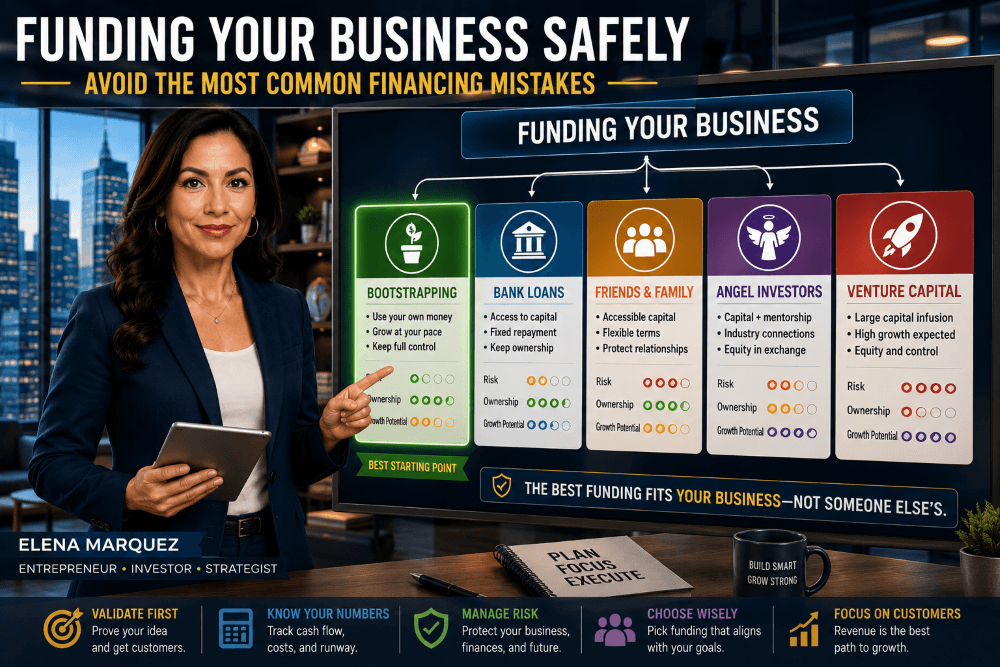
Avoid the Most Common Financing Mistakes
Funding your business safely is about much more than finding money. Every entrepreneur needs capital, but choosing the wrong source of financing can create problems that last for years. The best funding strategy helps your business grow while protecting your financial future, your ownership, and your independence.
Many entrepreneurs believe that a lack of money is the biggest obstacle to success. In reality, poor financing decisions often cause more businesses to fail than a lack of funding. Borrowing too much, giving away too much ownership, or taking on investors before your business is ready can all create unnecessary risks.
Before looking for money, it’s worth asking a different question:
What is the safest way to finance my business?
Funding Your Business Safely Starts with the Right Mindset
Capital is a tool, not a solution.
Money can accelerate a great business, but it can also accelerate a bad one. If customers don’t want your product or service, additional funding usually won’t fix the underlying problem.
Before seeking outside financing, focus on:
- Validating your business idea
- Finding paying customers
- Building reliable cash flow
- Understanding your expenses
A profitable business with modest funding is often healthier than a heavily financed business with no customers.
Bootstrap First Whenever Possible
Bootstrapping means growing your business using your own savings and the revenue generated by your customers.
Many successful companies started with little more than determination, careful budgeting, and a willingness to reinvest profits. We started our dance school Dance Conmigo with our own savings and with the revenues produced by the student. It was funny, we had construction work at the same time as we had students coming in an out.
Advantages of Bootstrapping
- You keep full ownership.
- You make all business decisions.
- You avoid interest payments.
- You develop financial discipline.
- You learn quickly from customer feedback.
Bootstrapping may require slower growth, but it often leads to stronger, more sustainable businesses.
Borrow Carefully
Business loans can be excellent financial tools when used wisely.
A loan can help purchase equipment, expand production, or smooth temporary cash flow challenges. However, borrowed money must always be repaid (with interest), regardless of whether your business succeeds.
Before taking on debt, consider:
- Can your business comfortably make the monthly payments?
- What happens if revenue declines?
- Are you providing a personal guarantee?
- How much interest will you pay over the life of the loan?
Debt should support growth—not become a source of constant financial stress.
Friends and Family: Protect the Relationship
Many entrepreneurs receive their first investment from relatives or close friends.
While this can be an accessible source of capital, it also carries emotional risks.
If you accept money from people close to you:
- Put every agreement in writing.
- Clearly explain the risks.
- Never promise guaranteed returns.
- Treat the investment professionally.
A failed business is difficult enough without damaging important personal relationships.
Angel Investors: More Than Money
Angel investors are experienced individuals who invest their own capital in promising businesses.
In addition to funding, they may provide:
- Mentorship
- Industry contacts
- Strategic advice
- Business experience
However, angel investors usually receive an ownership stake in your company. Before accepting investment, understand how much control you’re giving up and whether your long-term goals align.
Venture Capital Isn’t for Every Business
Many entrepreneurs dream of raising venture capital after reading stories about technology startups.
The reality is that venture capital is designed for a very specific type of company.
Venture capital firms typically look for businesses that have:
- Large market potential
- Rapid growth opportunities
- Scalable business models
- The possibility of a significant exit through acquisition or a public offering
If your goal is to build a stable, profitable local or family business, venture capital may not be the right fit.
Consider Crowdfunding Carefully
Crowdfunding platforms allow entrepreneurs to raise money directly from supporters.
Successful campaigns can generate:
- Capital
- Early customers
- Public awareness
- Product validation
However, crowdfunding also requires significant preparation, marketing, and communication. A successful campaign is rarely an accident.
Government Grants Can Help—But Read the Fine Print
Many governments offer grants, loans, and support programs for entrepreneurs.
These programs can provide valuable assistance, particularly for innovation, research, export development, or hiring.
However, grants often involve:
- Detailed applications
- Eligibility requirements
- Reporting obligations
- Time-consuming paperwork
Before relying on government funding, ensure the application process is worth the potential benefit.
Don’t Raise Money Too Early
One of the most common financing mistakes is seeking investment before proving that customers actually want the product.
Investors want evidence that your business solves a real problem.
Instead of focusing exclusively on raising money, concentrate on:
- Building a minimum viable product (MVP)
- Acquiring your first customers
- Generating early revenue
- Improving your product based on feedback
A business with paying customers is far more attractive to investors than one with only a business plan.
Know Your Financial Runway
Your financial runway is the amount of time your business can continue operating before it runs out of cash.
Knowing your runway helps you make better decisions and avoid panic.
Track regularly:
- Cash reserves
- Monthly expenses
- Monthly revenue
- Burn rate
- Expected future income
The more accurately you understand your finances, the fewer surprises you’ll face.
Common Financing Mistakes Entrepreneurs Make
Many financing problems are completely avoidable.
Some of the most common mistakes include:
- Borrowing more money than necessary.
- Relying heavily on high-interest credit cards.
- Mixing personal and business finances.
- Giving away too much ownership too early.
- Ignoring taxes when budgeting.
- Assuming investors will solve operational problems.
- Spending investment money on unnecessary luxuries instead of business growth.
Good financial decisions today can protect your business for years to come.
The Best Funding Comes from Customers
The safest investor is often your customer.
Every time someone voluntarily pays for your product or service, they validate your business model without asking for ownership or interest payments.
Revenue provides:
- Independence
- Cash flow
- Market validation
- Sustainable growth
Outside funding can accelerate success, but customers create it.
Final Thoughts
Funding is one of the most important decisions every entrepreneur will make.
The goal shouldn’t simply be to raise the most money. The goal is to obtain the right funding, at the right time, and under terms that support the long-term health of your business.
Whether you bootstrap, borrow, accept investors, or pursue grants, thoughtful financial planning will always be one of your greatest competitive advantages.
Remember: the safest funding strategy isn’t necessarily the fastest—it’s the one that helps your business grow without sacrificing its future.
Frequently Asked Questions
What is the safest way to fund a new business?
For many entrepreneurs, bootstrapping is the safest option because it allows you to retain full ownership while validating your business before taking on debt or outside investors.
Should I take a business loan to start a company?
It depends on your business model, cash flow, and ability to repay the loan. Borrow only what you reasonably expect your business can support.
Is venture capital right for every startup?
No. Venture capital is generally best suited to businesses with high-growth potential and scalable business models. Many successful small businesses never seek venture capital.
When should I look for outside investors?
Consider seeking outside investment after you’ve validated your product or service, attracted customers, and demonstrated market demand. This often improves both your negotiating position and your company’s valuation.
Other Business blog posts