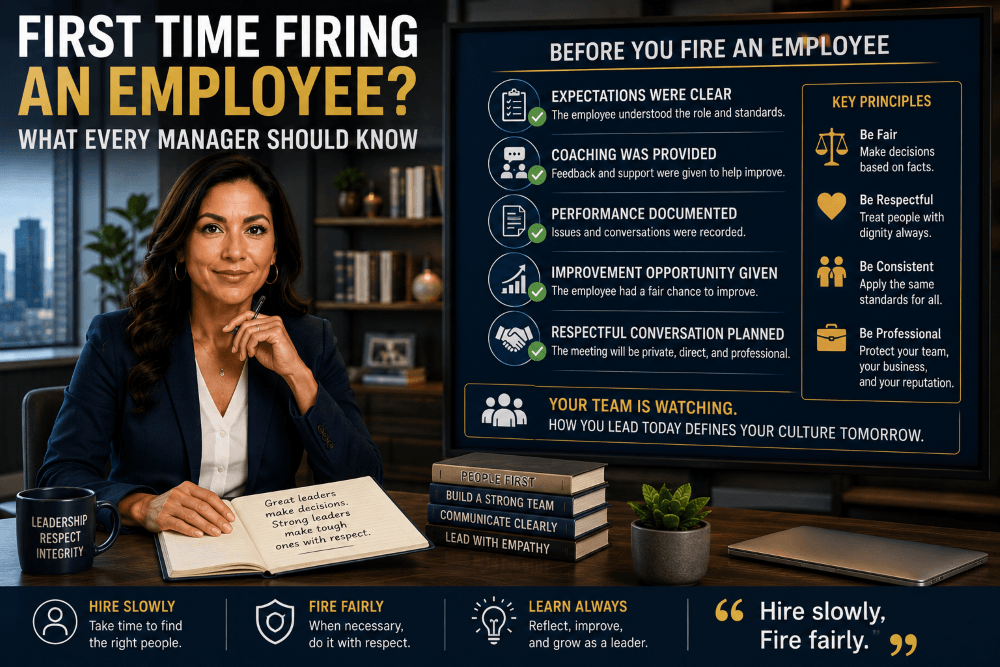
If it’s your first time firing an employee, you’re probably experiencing a mix of emotions. You may feel anxious, disappointed, or even guilty. That’s perfectly normal. Letting someone go is one of the most difficult responsibilities a manager or business owner will ever face.
Many new managers assume firing an employee is simply an administrative task. It isn’t. It’s a leadership decision that affects the departing employee, the remaining team, and the future of your business.
The goal should never be to fire someone quickly or aggressively. Instead, it should be to handle a difficult situation with professionalism, fairness, and respect.
First Time Firing an Employee: Understand the Responsibility
Every hiring decision is ultimately a management decision.
When an employee struggles, it’s natural to ask whether the issue lies with the individual, the hiring process, the training, or the leadership they received.
Great managers understand that terminating employment should rarely be the first solution.
Whenever possible, coaching and development should come before dismissal.
Before You Fire Anyone
Before making a final decision, take a step back and ask yourself a few important questions.
Were Expectations Clear?
Employees cannot meet expectations they don’t understand.
Ask yourself:
- Was the job clearly explained?
- Were performance standards communicated?
- Did the employee understand what success looked like?
Was Proper Training Provided?
Sometimes poor performance is simply the result of inadequate training.
Before assuming someone isn’t capable, consider whether they were given the tools and knowledge necessary to succeed.
Did You Provide Feedback?
Performance problems rarely improve without communication.
Constructive feedback should be:
- Specific
- Timely
- Honest
- Respectful
Employees deserve an opportunity to understand where they are falling short.
Was There a Genuine Opportunity to Improve?
In many cases, employees should receive a reasonable opportunity to correct performance issues before termination.
Improvement plans, coaching sessions, and measurable goals can often transform struggling employees into valuable team members.
Is This an Employee Problem or a Management Problem?
This may be the most difficult question of all.
If multiple employees struggle in the same role, the issue may not be the employee.
It may be:
- unclear expectations,
- unrealistic workloads,
- poor onboarding,
- inadequate supervision,
- or ineffective management.
Honest self-reflection is one of the hallmarks of strong leadership.
Is the Employee Too WOKE?
In many cases under U.S. law (the most relevant context for this terminology), it is legally permissible for a private employer to terminate an employee for poor cultural fit with a traditional, conservative, or explicitly anti-DEI workplace environment—including if the employee’s progressive or “woke” views and advocacy create ongoing friction.
Legal baseline
Most U.S. private-sector employment is at-will. That means an employer can fire someone for any reason or no reason at all, so long as the reason is not illegal. Federal law (primarily Title VII of the Civil Rights Act) prohibits discrimination based on race, color, religion, sex (including sexual orientation and gender identity), national origin, age, disability, and a few other protected categories. Political ideology, political speech, being progressive/“woke,” or supporting DEI is not a protected characteristic under federal law.
Private employers therefore have wide latitude to define their culture, values, and expected conduct. If an employee’s activism, internal advocacy, social-media posts, or interpersonal style consistently clashes with a company’s stated preference for color-blind policies, traditional norms, viewpoint neutrality on certain cultural issues, or opposition to identity-based preferences, that mismatch can be treated as a legitimate performance or culture-fit issue. Courts have long accepted “culture fit” as a valid non-discriminatory basis for termination when it is applied consistently and is not a pretext for illegal discrimination.
A handful of states and localities add limited protections for political activity or off-duty speech (e.g., certain California, New York, and District of Columbia rules). Even there, the protections are usually narrow—they rarely require an employer to tolerate disruptive workplace advocacy that undermines the company’s chosen operating philosophy. Public-sector employees have additional constitutional and civil-service protections that private employees lack.
Practical realities and risks
- Symmetry exists. Progressive-leaning companies have fired or sidelined people for conservative views, “wrongthink,” or insufficient enthusiasm for DEI. Conservative or anti-DEI companies can do the reverse. Both are generally lawful for private employers.
- Pretext and protected-class overlap create risk. If the real driver is the employee’s race, sex, religion, etc., or if the company applies its culture standards unevenly, a discrimination claim can succeed. Documenting concrete behavioral problems (disruption, refusal to follow policies, alienating colleagues or customers) rather than pure ideology is the safer path.
- Contract, handbook, or union rules can limit at-will freedom. A written progressive-discipline policy, severance agreement, or collective-bargaining agreement may require more process.
- Recent environment. Post-2024 shifts (including federal executive actions against certain DEI practices and companies scaling back DEI offices) have made explicit anti-DEI cultures more common and less legally hazardous for private employers. Reverse-discrimination suits against aggressive DEI quotas have also succeeded in some cases, reinforcing that identity-based preferences themselves can be illegal.
Normative angles (not legal ones)
Whether it is “ok” beyond the law depends on values:
- Employer autonomy / freedom of association view: Private organizations should be free to hire and retain people who share their mission and operating philosophy. A religious school, a family-owned traditional business, or a company that prioritizes color-blind merit can coherently decide that certain progressive frameworks are incompatible with how they want to operate.
- Employee expression / pluralism view: Some argue workplaces should tolerate a wider range of political views so long as job performance is solid, and that firing for ideology chills speech and increases polarization.
- Pragmatic/operational view: Chronic cultural mismatch often harms team cohesion, decision quality, and retention of the people the company actually wants. Tolerating open hostility to the organization’s stated values is rarely sustainable.
In short: for private employers in at-will jurisdictions, yes—poor fit with a traditional or anti-DEI culture is a lawful reason to part ways, provided the decision is not a cover for illegal discrimination and any applicable state or contractual limits are respected. The same rule has applied (and continues to apply) in the opposite ideological direction.
Document Everything
Documentation protects everyone involved.
Maintain accurate records of:
- Performance reviews
- Coaching meetings
- Attendance issues
- Written warnings
- Improvement plans
- Performance goals
Good documentation helps ensure that decisions are based on facts rather than emotions.
Understand Your Legal Responsibilities
Employment laws differ significantly by country, province, state, and industry.
Before terminating an employee, make sure you understand your legal obligations regarding:
- Notice requirements
- Final pay
- Benefits
- Human rights protections
- Employment contracts
- Record keeping
When necessary, consult a qualified human resources professional or employment lawyer in your jurisdiction.
A thoughtful legal review can prevent costly disputes later.
Conduct the Conversation with Respect
When the decision has been made, the conversation should be brief, direct, and respectful.
Avoid:
- Public criticism
- Arguments
- Humiliation
- Personal attacks
- False hope
- Unnecessary delays
Treat the employee with dignity throughout the process.
Remember that this conversation may become one of the most memorable moments of that person’s career.
Your Remaining Employees Are Watching
Many managers focus only on the employee leaving.
The remaining team is equally important.
People notice:
- Was the employee treated fairly?
- Was the process respectful?
- Did management behave professionally?
How you handle one difficult conversation helps define your organization’s culture.
Respect builds trust.
Fear destroys it.
Learn From Every Termination
Every termination is an opportunity to improve your organization.
Ask yourself:
- Did we hire the right person?
- Was the interview process effective?
- Could onboarding have been better?
- Were expectations realistic?
- Did management provide enough support?
The goal is not simply to replace employees.
It’s to become better at helping people succeed.
When Coaching Is Better Than Firing
Not every performance issue requires termination.
Employees can often improve when they receive:
- Additional training
- Better communication
- Clearer expectations
- Regular feedback
- Mentoring
Replacing employees is expensive.
Developing good employees is often a better long-term investment.
When Firing Is the Best Option
Good managers want employees to succeed, and many performance problems can be resolved through coaching, training, and clear communication. However, there are situations where continuing the employment relationship is no longer in the best interest of the employee, the team, or the organization.
Termination may be the appropriate course of action when an employee consistently fails to meet reasonable expectations despite being given fair opportunities to improve.
Examples include:
- Consistently poor performance. The employee is unable or unwilling to meet the performance standards required for the role despite coaching, feedback, and reasonable time to improve.
- Poor cultural fit. The employee’s behavior or attitude consistently conflicts with the organization’s values, teamwork, or workplace culture, creating friction within the team. Too woke.
- Serious misconduct. Theft, fraud, harassment, workplace violence, or other serious violations of company policies may require immediate termination, depending on the circumstances and applicable employment laws.
- Repeated policy violations. Ongoing disregard for company policies, safety procedures, or professional standards, despite warnings and corrective action.
- Dishonesty or loss of trust. Trust is the foundation of every employment relationship. Repeated dishonesty, falsifying records, or breaches of confidentiality can make continued employment impossible.
- Poor attendance or chronic unreliability. Frequent unexcused absences, repeated lateness, or an inability to reliably perform scheduled work can place an unfair burden on coworkers and disrupt business operations.
- Negative impact on the team. An employee who consistently undermines morale, refuses to collaborate, or creates unnecessary conflict can reduce the effectiveness and engagement of the entire team.
- Lack of improvement after a fair performance improvement process. When expectations have been clearly communicated, support has been provided, and measurable goals have not been achieved, termination may become the most appropriate and fair decision.
Firing an employee should never be motivated by frustration or anger. Instead, it should be the result of a thoughtful, well-documented process that considers both the individual’s circumstances and the long-term health of the organization.
The best managers recognize that leadership requires both compassion and accountability. While every reasonable effort should be made to help employees succeed, there are times when making a difficult decision is ultimately the fairest outcome for everyone involved.
Common Mistakes Managers Make
Many difficult situations become worse because of avoidable management mistakes.
Some of the most common include:
- Waiting too long to address performance issues.
- Failing to document concerns.
- Avoiding difficult conversations.
- Acting impulsively after a single incident.
- Publicly criticizing employees.
- Making promises they cannot keep.
- Ignoring legal requirements.
- Allowing emotions to control the conversation.
Strong leadership requires preparation, patience, and professionalism.
Five Questions to Ask Before Terminating an Employee
Before making your final decision, ask yourself:
- Did the employee clearly understand expectations?
- Was adequate coaching provided?
- Have performance issues been documented?
- Have I fulfilled my legal responsibilities?
- Is termination truly in the best interest of both the business and the team?
If you can confidently answer “yes” to these questions, you can move forward knowing you’ve handled the situation responsibly.
Final Thoughts
No manager enjoys firing an employee.
In fact, if you find it easy, it may be worth reflecting on your leadership approach.
One of the best pieces of management advice is:
Hire slowly. Fire fairly.
Taking time to hire the right people reduces future problems.
Treating departing employees with dignity protects your company’s culture, your reputation, and your own integrity.
Leadership isn’t measured by how easy decisions are.
It’s measured by how thoughtfully you handle the difficult ones.
Frequently Asked Questions
What should I do before firing an employee?
Ensure expectations were clear, provide coaching and feedback, document performance issues, and understand your legal obligations before making a termination decision.
Should I give an employee a chance to improve?
In many situations, yes. Unless the issue involves serious misconduct or immediate safety concerns, coaching and performance improvement efforts are often appropriate.
How should I conduct a termination meeting?
Keep the conversation private, respectful, direct, and professional. Avoid arguments, personal criticism, or creating false expectations.
What is the biggest mistake first-time managers make?
One of the most common mistakes is waiting too long to address performance problems. Early communication and consistent feedback often prevent larger issues later.
Other Business blog posts