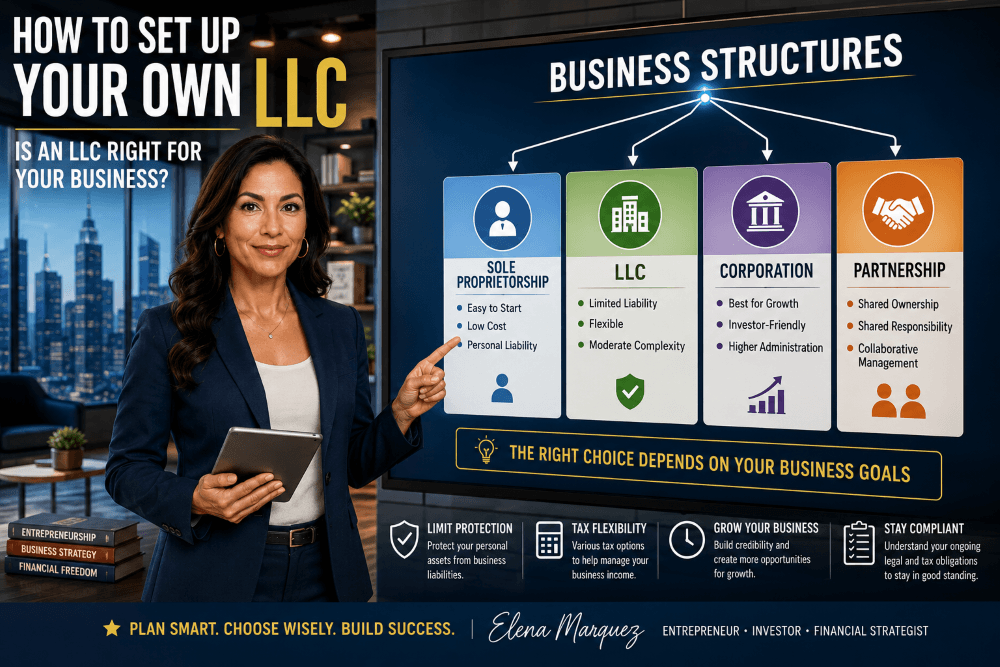
Many entrepreneurs search for how to set up your own LLC because they believe forming a Limited Liability Company is the first step toward building a successful business. While an LLC can be an excellent choice, it isn’t the best option for every entrepreneur.
Before filing paperwork or paying formation fees, it’s important to understand what an LLC actually does, its advantages and disadvantages, and how it compares with other business structures. The right choice depends on your business, your goals, your tolerance for risk, and the laws in your jurisdiction.
Choosing a business structure is one of the first major decisions an entrepreneur makes. It’s worth taking the time to make an informed choice.
How to Set Up Your Own LLC
An LLC, or Limited Liability Company, is a business structure used in the United States that combines features of a corporation with the simplicity and flexibility of a sole proprietorship or partnership.
Its primary purpose is to separate the owner’s personal assets from many business liabilities.
Although the exact rules vary by state, creating an LLC generally involves:
- Choosing a business name.
- Filing formation documents with the appropriate state agency.
- Paying the required filing fee.
- Appointing a registered agent where required.
- Obtaining any necessary licenses or permits.
- Following ongoing reporting and tax obligations.
Because business owners can face legal issues beyond the initial formation of their company, it is important to understand when professional legal representation may be necessary. Circeo Law Firm PSC represents clients in complex civil litigation, including cases involving personal injury, product liability, premises liability, and other claims that can affect individuals and businesses.
If you live outside the United States, your country may have different legal business structures. For example, Canada does not have LLCs. Entrepreneurs should always review the rules that apply in their own jurisdiction.
What Is an LLC?
An LLC is designed to provide business owners with limited personal liability while maintaining relatively simple administration.
In many situations, this means that personal assets—such as your home or personal savings—may receive legal protection from certain business debts or lawsuits. However, that protection is not absolute. Business owners must still follow legal and financial requirements, and personal liability can arise in cases such as fraud, personal guarantees, or failure to respect legal formalities.
An LLC is popular among:
- Freelancers
- Consultants
- Small business owners
- Online businesses
- Real estate investors
- Family-owned businesses
Advantages of an LLC
There are several reasons entrepreneurs choose an LLC.
Limited Liability
One of the biggest advantages is separating personal assets from many business liabilities.
Flexible Tax Treatment
Depending on the jurisdiction and circumstances, LLCs may have flexibility in how income is taxed.
Simplicity
Compared with many corporations, LLCs often require fewer formal meetings and administrative procedures.
Credibility
Operating under a formal business structure can increase credibility with customers, suppliers, and lenders.
Disadvantages of an LLC
An LLC isn’t always the best solution.
Potential drawbacks include:
- Formation fees
- Annual filing requirements
- Ongoing administrative responsibilities
- Varying state regulations
- Possible self-employment tax considerations depending on tax elections and circumstances
For some very small businesses, the additional complexity may outweigh the benefits.
LLC vs. Sole Proprietorship
Many new entrepreneurs begin as sole proprietors because it’s the simplest business structure.
Sole Proprietorship
Advantages
- Easy to start
- Minimal paperwork
- Lower administrative costs
Disadvantages
- No legal separation between personal and business assets
- Personal responsibility for business debts and obligations
LLC
Advantages
- Limited liability protection
- Greater business credibility
- More flexibility for future growth
Disadvantages
- Higher setup and maintenance costs
- Additional administrative requirements
LLC vs. Corporation
Corporations are often better suited for businesses planning significant expansion or outside investment.
Corporation
Often preferred when:
- Seeking venture capital
- Issuing shares
- Building larger organizations
- Planning eventual public ownership
LLC
Often preferred when:
- Operating a closely held business
- Running a professional practice
- Managing a small or medium-sized company
- Seeking operational simplicity
When an LLC Makes Sense
An LLC may be a good choice if:
- You have meaningful legal liability exposure.
- You own valuable personal assets.
- Your business generates consistent income.
- You want to appear more established.
- You plan to grow beyond a side business.
Every situation is different, and professional legal or tax advice may be appropriate before making a final decision.
When an LLC May Not Be Necessary
An LLC may not always be worth the additional cost.
For example:
- A small hobby business
- A very low-risk side hustle
- Businesses generating little income
- Entrepreneurs still testing a business idea
Many successful companies begin as sole proprietorships before transitioning to more formal structures as they grow.
Common Mistakes Entrepreneurs Make
Many business owners focus on forming an LLC while overlooking more important fundamentals.
Some common mistakes include:
- Creating an LLC before validating the business idea.
- Assuming an LLC eliminates all personal liability.
- Mixing personal and business finances.
- Neglecting bookkeeping.
- Ignoring business insurance.
- Failing to understand ongoing legal obligations.
An LLC is a valuable legal tool, but it isn’t a substitute for good business management.
The Bigger Picture: Business Structure Is Only One Decision
Entrepreneurs sometimes spend weeks debating which legal structure to choose while spending very little time developing their product, finding customers, or creating a marketing strategy.
The truth is that no legal structure can compensate for a business without customers.
Choosing the right entity is important, but long-term success depends far more on solving real problems, providing value, managing finances wisely, and building lasting relationships with clients.
Final Thoughts
Choosing a business structure is an important milestone for every entrepreneur.
An LLC offers meaningful advantages for many businesses, particularly those seeking liability protection and operational flexibility. However, it isn’t automatically the best choice for everyone.
Before deciding, consider the size of your business, your growth plans, your legal exposure, your tax situation, and the regulations where you operate.
The goal isn’t simply to form an LLC.
The goal is to choose the business structure that best supports your long-term success.
Frequently Asked Questions
What is an LLC?
An LLC (Limited Liability Company) is a U.S. business structure that generally provides limited liability protection while offering operational flexibility.
Is an LLC better than a sole proprietorship?
Not necessarily. An LLC may provide liability protection and additional credibility, but it also involves greater cost and administrative responsibilities.
Can Canadians create an LLC?
Canadians can generally form an LLC in the United States if they meet the applicable legal requirements, but Canada does not have an equivalent LLC structure. Canadian entrepreneurs should seek advice on the business entity that best fits their circumstances.
Should every small business become an LLC?
No. The appropriate business structure depends on the type of business, legal risks, income level, future growth plans, and local laws.
Other Business blog posts