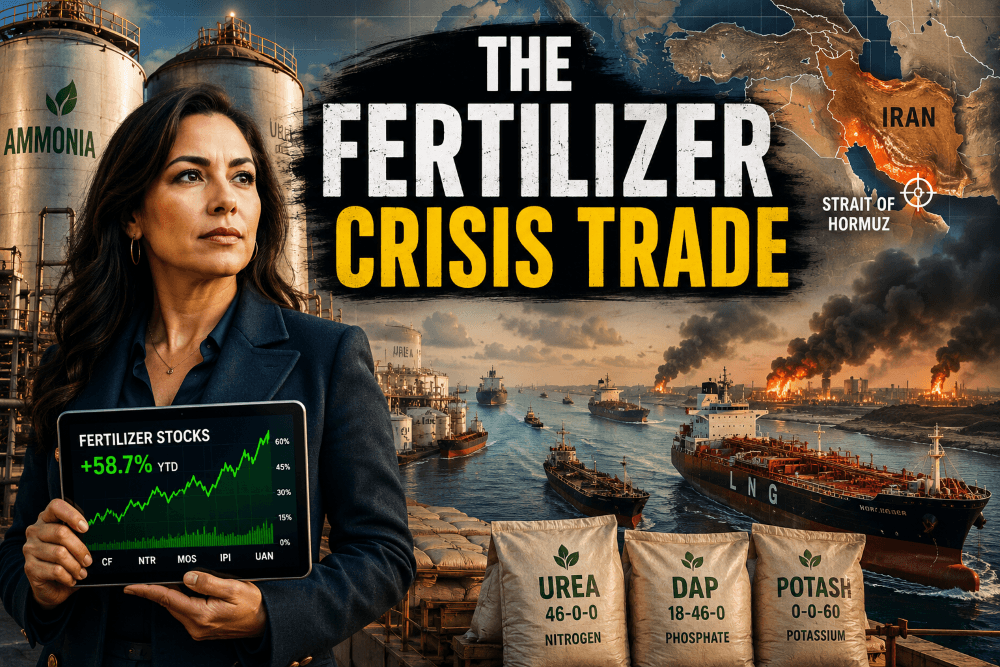
The recent closure and disruption risks surrounding the Strait of Hormuz have sent shockwaves through global fertilizer markets. Fertilizer stocks have rallied sharply as investors anticipate supply shortages, rising natural gas prices, and higher agricultural input costs.
The Strait of Hormuz is one of the world’s most important shipping lanes for energy exports. Any conflict involving Iran immediately affects natural gas markets, and natural gas is absolutely critical for fertilizer production.
In fact, natural gas can account for up to 90% of the cost of producing ammonia, the building block for nitrogen fertilizers such as urea and urea ammonium nitrate (UAN).
As tensions in the Middle East escalate, fertilizer companies are becoming one of the market’s biggest geopolitical trades.
Why Fertilizer Stocks Are Rising
The fertilizer industry depends heavily on stable supplies of natural gas and sulfur.
Natural gas is essential for manufacturing:
- Ammonia
- Urea
- Urea ammonium nitrate (UAN)
Meanwhile, sulfur is a critical ingredient in phosphate fertilizers.
When energy prices rise or supply chains become disrupted, fertilizer producers often face immediate cost increases. But some producers — especially those located in North America — can benefit because global fertilizer prices rise faster than their production costs.
That is exactly what is happening today.
Fertilizer Stocks and Their 2026 Performance
Several publicly traded fertilizer companies have already experienced massive stock moves year to date.
Nitrogen Fertilizer Winners
CF Industries (NYSE: CF) — +60%
CF Industries has become one of the market’s biggest winners from the Middle East crisis.
The company benefits from:
- North American natural gas access
- Strong ammonia pricing
- Higher global nitrogen fertilizer prices
Because CF produces much of its fertilizer domestically, it enjoys a major cost advantage compared to producers in Europe and the Middle East.
CVR Partners (NYSE: UAN) — +28%
CVR Partners is another major beneficiary.
The company specializes in UAN fertilizers, which are directly linked to ammonia and natural gas prices. Investors have piled into the stock as fertilizer prices continue climbing.
Intrepid Potash (NYSE: IPI) — +57%
Intrepid Potash has surged alongside the broader fertilizer sector.
Although potash is less dependent on natural gas than nitrogen fertilizers, investors are betting that prolonged supply disruptions will lift prices across the entire agricultural input market.
Mixed Results
Nutrien (NYSE: NTR / TSX: NTR) — +14%
Nutrien has also benefited from higher fertilizer prices.
However, Nutrien’s diversified business model means its gains have been more moderate than pure-play nitrogen producers.
The company operates:
- Potash mines
- Nitrogen production facilities
- Agricultural retail operations
That diversification provides stability, but also limits explosive upside during commodity spikes.
Mosaic (NYSE: MOS) — -9%
Mosaic has actually declined this year despite rising fertilizer prices.
Why?
Because phosphate fertilizer production depends heavily on sulfur, and sulfur prices have exploded higher due to Middle East supply concerns.
In other words:
- Rising fertilizer prices help revenue
- Rising sulfur prices hurt profit margins
For Mosaic, the market is worried input costs could rise faster than selling prices.
What Happens If the War Ends This Week?
If tensions suddenly de-escalate and shipping through the Strait of Hormuz normalizes, fertilizer stocks could reverse sharply lower.
Commodity markets move quickly.
A ceasefire could trigger:
- Falling natural gas prices
- Lower ammonia prices
- Lower fertilizer prices
- Profit-taking in fertilizer stocks
The stocks that have rallied the most — such as CF Industries and Intrepid Potash — would likely face the largest pullbacks.
Investors should remember that fertilizer companies are highly cyclical businesses. What goes up quickly can also come down quickly.
What Happens If the War Continues for Months?
If the conflict drags on for several more months, the situation becomes much more serious.
Longer-term disruptions could create:
- Persistent fertilizer shortages
- Higher crop production costs
- Lower global agricultural yields
- Food inflation
At that point, fertilizer producers could experience a multi-quarter earnings boom similar to what occurred after the Russia-Ukraine war disrupted global agricultural trade in 2022.
The longer the conflict lasts, the greater the probability that fertilizer prices remain elevated well into 2027.
The Second-Order Effects: Agriculture Stocks Under Pressure
Higher fertilizer prices do not only affect fertilizer companies.
They also impact farmers and agricultural businesses that must absorb rising input costs.
Companies exposed to agricultural production could face margin pressure, including:
- Deere & Company
- Archer Daniels Midland
- Bunge Global
- Tyson Foods
Farmers may delay equipment purchases, reduce fertilizer applications, or shift crop selections depending on profitability.
Meanwhile, food companies could eventually pass rising costs to consumers, adding further inflationary pressure.
Should Investors Buy Fertilizer Stocks Now?
This is where things become difficult.
Momentum investors may continue chasing fertilizer stocks higher if the conflict escalates. In the short term, strong fertilizer pricing could continue driving earnings upgrades.
But geopolitical trades are notoriously dangerous.
A single diplomatic breakthrough could erase weeks of gains almost overnight.
For long-term investors, buying after a large rally carries significant risk.
Investors should consider:
- Position sizing carefully
- Avoiding emotional buying
- Understanding commodity cycles
- Watching natural gas prices closely
The fertilizer sector can produce enormous gains during supply shocks, but those gains often reverse once markets normalize.
For aggressive traders, momentum may still exist.
For conservative investors, patience may be the better strategy.
Final Thoughts
The closure risks surrounding the Strait of Hormuz have transformed fertilizer stocks into one of the hottest sectors in the market.
Natural gas shortages, sulfur supply disruptions, and geopolitical uncertainty are driving fertilizer prices sharply higher.
But investors should remember that these rallies are built on instability.
If the war ends quickly, fertilizer stocks could fall just as fast as they rose. If the conflict continues, however, the entire agricultural supply chain may face prolonged inflationary pressure for months to come.
Frequently Asked Questions
Why does natural gas affect fertilizer prices?
Natural gas is the primary feedstock used to produce ammonia, which is essential for nitrogen fertilizers like urea and UAN.
Which fertilizer stocks benefited the most from the Iran conflict?
CF Industries and Intrepid Potash have been among the strongest performers due to rising fertilizer prices.
Why is Mosaic stock down while fertilizer prices are rising?
Mosaic relies heavily on sulfur for phosphate fertilizer production, and sulfur prices have surged because of Middle East supply concerns.
Could food prices rise because of higher fertilizer costs?
Yes. Higher fertilizer prices increase farming costs, which can eventually lead to higher food prices for consumers.
Other Stock Market blog posts