For years, financial advisors repeated the same formula: get one stable job, work hard, stay loyal to your employer, and retire with a pension.
That world no longer exists.
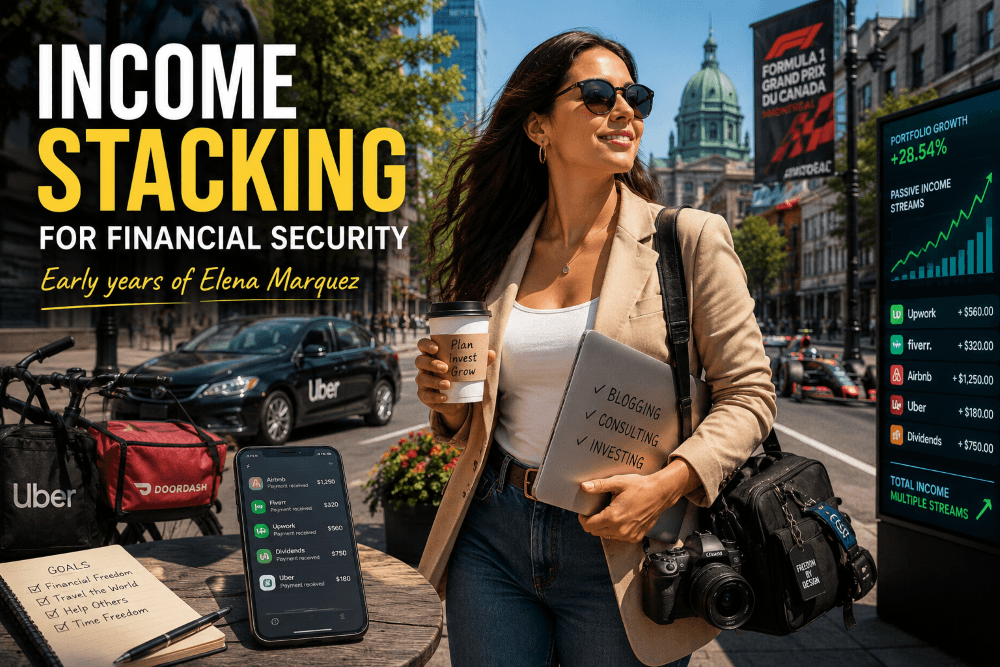
Today, a growing number of people are embracing income stacking — building several streams of income instead of depending on a single paycheck. What started as a survival strategy is quickly becoming a lifestyle choice, especially among younger workers.
But immigrants have understood this concept for decades.
As an immigrant myself, I have always been an income stacker. Long before the term became fashionable, I learned that relying on one employer was risky. One source of income can disappear overnight. Multiple streams create resilience.
Even today, after achieving financial independence, I still maintain several income streams.
I work as a financial blogger, I manage investments, and I provide financial consulting services. Years ago, during the beginning of my life in Canada, I was juggling even more responsibilities. At one point, I was:
- Part owner of a dance school
- Managing several Airbnb properties
- Driving for Uber
- Building my investment portfolio on the side
None of this felt unusual to me. For many immigrants, diversification is not optional — it is survival.
Why Income Stacking Is Growing
The rise of the gig economy has made income stacking easier than ever.
Platforms like Uber Technologies, DoorDash, Fiverr, Upwork, and TaskRabbit have created opportunities that barely existed 15 years ago.
A person can now:
- Drive passengers in the morning
- Deliver food in the afternoon
- Freelance online in the evening
- Sell digital products on weekends
Technology has transformed spare time into earning potential.
According to recent U.S. labor statistics, more than 8 million Americans now work multiple jobs. That number keeps rising because people increasingly understand one uncomfortable truth:
A single paycheck is fragile.
Income Stacking Is Not Just About Money
Many people assume income stacking is only for those struggling financially.
That is not true.
For many workers, multiple jobs are also a form of professional insurance.
Artificial intelligence, layoffs, and economic uncertainty are making people nervous. Entire industries are changing quickly. Workers want backup plans.
Gen Z, in particular, seems to understand this reality better than previous generations.
Many younger workers are building side businesses while maintaining traditional employment. Others are freelancing to develop skills outside their main profession.
In many ways, income stacking is becoming the modern equivalent of diversification in investing.
You would never put 100% of your investments into a single stock. Why would you place 100% of your financial future into a single employer?
My Neighbor Hugo Is a Perfect Example
My neighbor Hugo perfectly represents the new economy.
He works full-time as a marketing director for a company. On weekends, he manages a restaurant part-time. Occasionally, he also works as a photographer.
And this weekend, during the Canadian Grand Prix in Montreal, he is working as an event helper.
Some people might see this and think Hugo is overworked.
I see something different.
I see adaptability.
Hugo is constantly building new relationships, learning new skills, and creating additional sources of income. If one job disappears, he still has others.
That is real security.
The Old Career Model Is Dying
Previous generations often identified themselves through a single profession.
“I am an accountant.”
“I am a teacher.”
“I work for this company.”
Today’s workers are harder to define.
Someone can simultaneously be:
- A software developer
- A YouTuber
- A rideshare driver
- A real estate investor
- A consultant
The boundaries between careers are disappearing.
And frankly, this is healthier.
Modern workers are becoming more entrepreneurial, even if they never officially start a business.
The Psychological Benefits of Income Stacking
Multiple income streams also create psychological freedom.
People with only one paycheck often feel trapped. They tolerate toxic workplaces because they fear losing their only source of income.
Income stackers operate differently.
When you have several sources of revenue, you negotiate from a position of strength. You are less desperate. You have options.
Financial independence rarely arrives from a single salary alone.
It usually comes from combining:
- Active income
- Side hustles
- Investments
- Freelance work
- Small businesses
- Real estate
- Consulting
The people who master this combination often build wealth much faster than those relying exclusively on one employer.
The Future Belongs to the Flexible
The modern economy rewards flexibility.
The workers who thrive over the next decade will likely be those who can adapt quickly, learn continuously, and generate income from multiple sources.
Income stacking is no longer a temporary trend.
It is becoming the new normal.
And immigrants have known this for a very long time.
Frequently Asked Questions
What is income stacking?
Income stacking refers to earning money from multiple sources simultaneously, such as full-time jobs, freelancing, investments, consulting, or side hustles.
Why is income stacking becoming popular?
Economic uncertainty, layoffs, inflation, and technology platforms have made it easier and more necessary for people to diversify their income sources.
Is income stacking only for young people?
No. While Gen Z is embracing it quickly, professionals of all ages are building additional income streams for security and flexibility.
Can income stacking lead to financial independence?
Yes. Many financially independent people combine employment income, investments, side businesses, and freelance work to accelerate wealth building.
Other personal finance blog posts