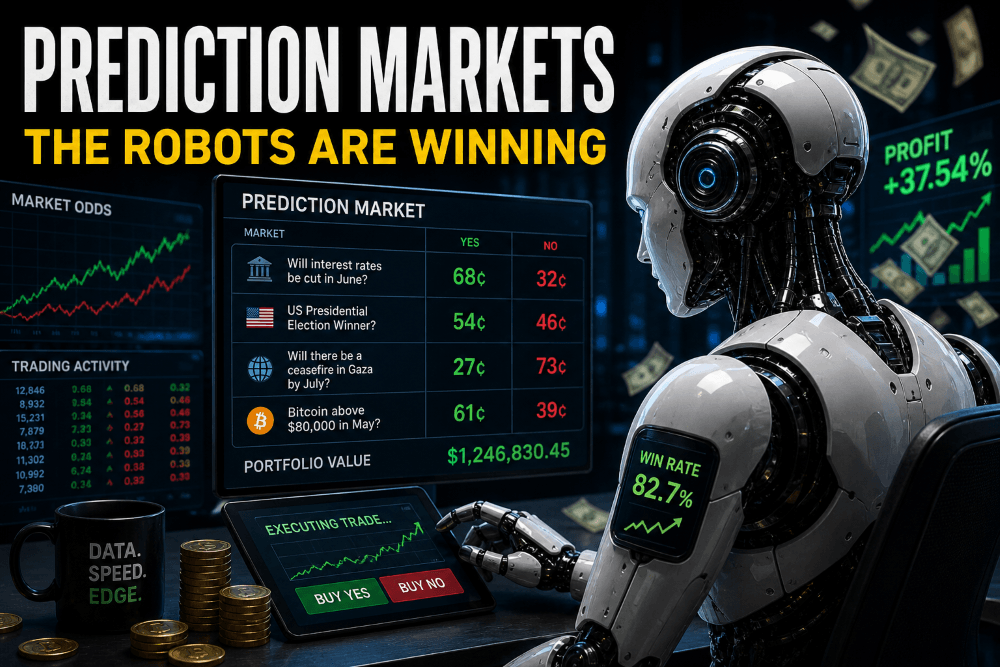
What Are Prediction Markets?
Prediction markets are platforms where people trade on the outcome of real-world events.
Instead of buying stocks, participants buy “contracts” that pay out if a specific event happens—like an election result, an economic decision, or even geopolitical events.
At first glance, prediction markets look like a clever way to aggregate information.
In reality, they function very much like speculation-driven markets, where price reflects what participants think will happen—not necessarily what will happen.
Major Prediction Market Platforms
A handful of platforms dominate the prediction markets space today. They differ widely in regulation, accessibility, and credibility.
1. Kalshi
Kalshi is one of the few fully regulated prediction markets in the United States.
It operates under oversight from the Commodity Futures Trading Commission, which gives it a level of legitimacy most competitors lack.
Users can trade on:
- Interest rate decisions
- Inflation outcomes
- Economic indicators
2. Polymarket
Polymarket is a crypto-based platform that has grown rapidly in popularity.
It allows users to speculate on:
- Elections
- Geopolitical events
- Breaking news outcomes
Because it operates using cryptocurrency, it exists in a regulatory gray zone in many jurisdictions.
3. PredictIt
PredictIt focuses primarily on political outcomes, especially U.S. elections.
It gained popularity among academics and political enthusiasts, though it has faced ongoing regulatory scrutiny and uncertainty.
4. Metaculus
Metaculus is slightly different.
It’s not primarily a betting market, but a forecasting platform where users make probabilistic predictions.
- Often used by researchers
- No direct gambling component in most cases
- Focuses on long-term and scientific questions
5. Manifold Markets
Manifold Markets uses play money instead of real money.
It attracts:
- Hobbyists
- Experimenters
- People interested in forecasting without financial risk
Despite the lack of real stakes, it still reflects similar behavioral patterns.
Bottom line on platforms
- Kalshi → regulated and structured
- Polymarket → fast-growing, crypto-driven
- PredictIt → politics-focused
- Metaculus → forecasting, not gambling
- Manifold → experimental, low-stakes
Different platforms, same underlying dynamic:
Most participants think they have an edge. Very few actually do.
Why People Find Them Thrilling
Prediction markets tap into something deeply human.
They combine:
- The excitement of being “right”
- The illusion of having superior knowledge
- The dopamine rush of quick gains
Participants often feel they are smarter than the crowd, especially when betting on complex topics like politics or economics.
But that confidence is usually misplaced.
Most Popular Types of Predictions
Certain categories dominate prediction markets:
- Politics
Elections, leadership changes, policy decisions - Economics
Interest rates, inflation, recessions - Geopolitics
Wars, sanctions, regime changes - Entertainment & culture
Awards, viral events
The more uncertain and emotional the topic, the more activity it attracts.
What Is Legal and What Is Illegal?
This is where things get complicated.
Some jurisdictions treat prediction markets as:
- Financial instruments
- Gambling
- Or something in between
Regulators are still figuring it out.
What is clearly illegal:
- Using confidential or insider information
- Manipulating outcomes
- Participating when explicitly prohibited
The Soldier Who Bet on Nicolás Maduro
A widely reported case involved a U.S. Special Forces soldier accused of using classified information to bet on the potential capture of Nicolás Maduro.
- He reportedly placed large wagers
- He generated significant profits
- He was later arrested and charged
Authorities allege he had access to non-public operational information and used it for personal gain.
The core facts of the case
The person involved was Gannon Ken Van Dyke, a U.S. Army Special Forces master sergeant.
He was directly involved in planning a U.S. military operation targeting
Nicolás Maduro.
💰 How much did he bet?
- He placed about $33,000 in total bets
- These bets were spread across multiple trades (around 13 wagers)
- The bets were placed between late December 2025 and early January 2026
🤑 How much did he win?
- He made over $400,000 in profit
- Some reports put it more precisely around $404,000–$409,000
📈 Why the payoff was so large
This is the key insight.
At the time he placed the bets:
- The market assigned very low probability to Maduro being captured
- So the contracts were cheap
Because he already knew the outcome:
- He was essentially buying something priced at, say, 5–10% probability
- That later paid out at 100%
That’s how ~$33K turned into ~$400K.
⏱️ The timing (which raised suspicion)
- First bets: December 27, 2025
- Final bets: just hours before the operation
- Event: Maduro captured on January 3, 2026
This timing is what triggered alarms.
🚨 Why he was arrested
Authorities allege:
- He used classified, non-public military information
- He had direct involvement in the planning of the operation
- He knowingly exploited that information for personal gain
Charges include:
- Fraud
- Misuse of government information
- Financial crimes tied to the trades
⚖️ Why this case matters
This wasn’t just a random scandal.
It’s widely described as:
The first major insider trading case in prediction markets
And it exposed something important:
- Prediction markets are extremely vulnerable to insider information
- Unlike stock markets, the events being traded (wars, arrests, elections) often involve people who already know the outcome
🧠 The uncomfortable takeaway
This case highlights a structural problem:
- If you have inside information → you can make massive returns
- If you don’t → you’re trading against people who might
Which reinforces your article’s thesis:
These markets are not a level playing field.
This case illustrates how prediction markets can intersect with national security and insider abuse.
Insider Information: A Structural Weakness
This wasn’t an isolated incident.
There have been multiple allegations of:
- Politically connected individuals trading on privileged knowledge
- Suspicious trades ahead of major geopolitical developments
- Coordinated activity suggesting information leaks
Even when not proven, the perception alone damages trust.
Where money meets information, the temptation to cheat is always present.
How Bots Entered the Picture
As prediction markets grew, so did automation.
Bots now:
- Scan news faster than humans
- Execute trades instantly
- Operate 24/7 without emotion
What began as a human-driven experiment has evolved into a machine-dominated environment.
Why Bots Are Beating Humans
Bots have structural advantages:
- Speed: reacting in milliseconds
- Scale: processing massive data streams
- Discipline: no fear, no greed
Humans, by contrast:
- Chase trends
- Overreact to headlines
- Misjudge probabilities
In simple terms:
Humans guess. Bots calculate.
Why It’s Not Easy to Use a Bot Yourself
Many people assume they can simply deploy a bot and compete.
But a bot without an edge is just:
- A faster way to lose money
- An automated version of poor judgment
The real advantage comes from:
- Superior data
- Better predictive models
- Faster infrastructure
Most individuals lack all three.
The Moral of the Story
Prediction markets are often marketed as tools for insight.
But for most participants, they function as:
A system where the informed and automated extract money from everyone else.
The odds are stacked against:
- Casual users
- Emotional decision-makers
- Anyone without a clear informational advantage
Final Verdict
If you care about preserving your capital:
- Prediction markets are not a reliable path to profit
- Very few individuals consistently win
- Most participants lose money over time
There are simpler, more proven ways to build wealth.
Prediction markets are not one of them.
FAQ
Are prediction markets accurate?
They can reflect crowd expectations, but they are not consistently reliable or superior to other forecasting methods.
Can individuals make money in prediction markets?
A small minority do, but most participants lose money over time.
Is insider trading a real issue?
Yes. There have been allegations and confirmed cases involving privileged information.
Are prediction markets legal?
It depends on the country and the platform. Regulations vary widely.
Other personal finance blog posts