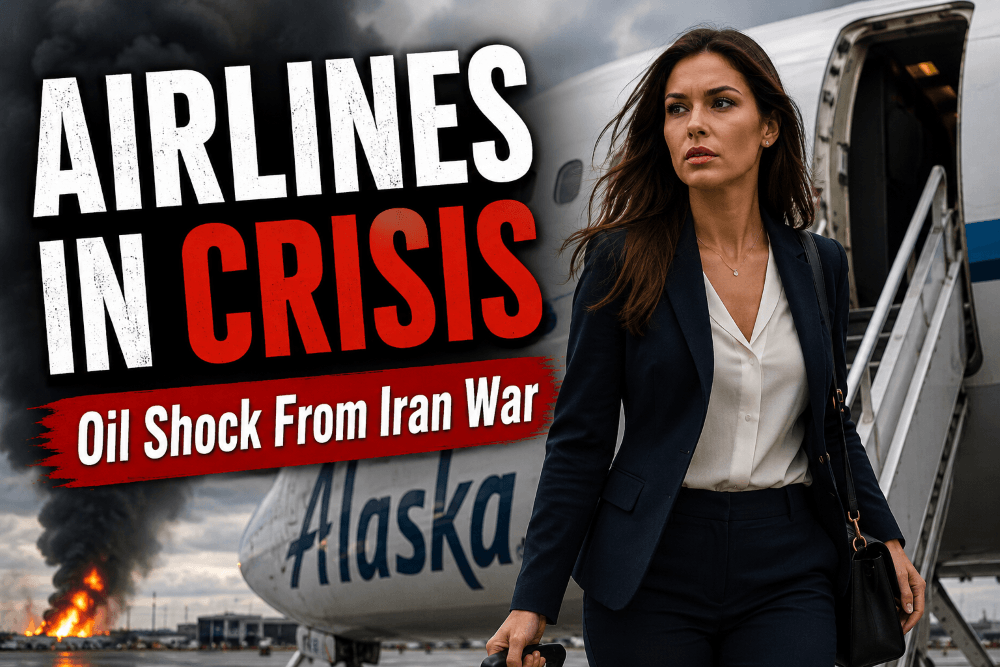
The airline stocks sector is once again under pressure as the war with Iran sends oil prices soaring and disrupts global travel routes. Rising jet fuel costs, airspace closures, and economic uncertainty have combined to create another crisis for an industry that has historically struggled to generate consistent profits.
For long-term investors, this latest shock reinforces an uncomfortable truth: the airline industry has rarely been a great place to invest money.
Even legendary investor Warren Buffett has repeatedly warned investors about airlines, calling the industry a “death trap” and a “bottomless pit” for capital.
Why the Iran War Hurts Airline Stocks
The airline business depends heavily on cheap fuel and stable global transportation networks. War in the Middle East threatens both.
The conflict with Iran has pushed oil prices sharply higher because investors fear disruptions in the Strait of Hormuz, one of the world’s most important oil shipping routes.
For airlines, higher oil prices immediately translate into higher jet fuel costs.
Fuel is often:
- the largest operating expense for airlines,
- difficult to hedge during sudden geopolitical shocks,
- and impossible to avoid.
At the same time, many international airlines have been forced to reroute flights away from dangerous airspace. Longer routes mean:
- more fuel consumption,
- higher labor costs,
- schedule disruptions,
- and lower efficiency.
The result is a rapid decline in profit margins.
Which Airline Companies Are Suffering the Most?
Some airlines are much more vulnerable than others.
American Airlines (NASDAQ: AAL) YTD -13%
AAL has been one of the most vulnerable major airlines because:
- it carries heavy debt,
- it lacks meaningful fuel hedging,
- and it operates with relatively thin margins.
Higher fuel prices hit American Airlines especially hard because the company has little room for error.
United Airlines Holdings (NASDAQ: UAL) YTD -11%
UAL also faces significant pressure due to its large international network.
Long-haul international flights consume enormous amounts of fuel. Any prolonged rise in jet fuel prices could significantly reduce profitability.
Southwest Airlines (NYSE: LUV) YTD 0%
LUV has historically managed fuel costs better than many competitors, but the company still remains highly exposed to rising fuel prices.
Low-cost carriers depend on keeping fares affordable. When fuel prices spike, profit margins quickly disappear.
Alaska Air Group (NYSE: ALK) YTD -18.81%
Alaska Air Group is navigating a challenging environment marked by passenger volume declines and high operational costs.
However, no airline can fully escape the impact of a major oil shock.
Which Airlines Are Handling the Crisis Better?
Some airlines are better positioned to survive prolonged fuel shocks.
Delta Air Lines (NYSE: DAL) YTD +5.56%
DAL has performed better than many rivals because it owns the Trainer oil refinery.
This unusual strategy allows Delta to partially offset rising jet fuel prices.
Delta also benefits from:
- stronger premium pricing,
- a healthier balance sheet,
- and better operational efficiency.
Still, even Delta is vulnerable if oil prices remain elevated for an extended period.
JetBlue Airways (NASDAQ: JBLU) YTD +12.30%
JBLU has struggled with profitability for years.
The Iran war simply adds another layer of pressure to an already difficult business model. But at the very least, the stock is possitive for the year.
What Happens if the War Ends Tomorrow?
If the conflict were resolved quickly, airline stocks could experience a sharp short-term rally.
Investors would likely anticipate:
- falling oil prices,
- lower jet fuel costs,
- normalization of international air routes,
- and stronger travel demand.
A rapid peace agreement could create a temporary rebound in airline profits and stock prices.
However, investors should remember that airlines have historically struggled even during favorable economic conditions.
The industry remains:
- highly competitive,
- capital intensive,
- and extremely vulnerable to recessions and external shocks.
What Happens if the War Lasts Several Months?
A prolonged conflict would likely create much greater damage.
Possible consequences include:
- Sustained high fuel prices
- Reduced consumer travel demand
- Lower corporate travel spending
- Airline bankruptcies or restructurings
- Additional debt issuance
- Dividend suspensions
- Weaker earnings across the industry
Budget airlines would probably suffer the most because they operate with thinner margins and weaker balance sheets.
The longer oil prices remain elevated, the greater the risk that some carriers may require restructuring or government assistance.
What Happens if airports run out of fuel
Airports running out of jet fuel is no longer an impossible scenario if the Iran conflict severely disrupts global oil shipments for an extended period. While major airports typically maintain reserve supplies, a prolonged interruption in refining or fuel transportation could create regional shortages, especially on the U.S. West Coast and in heavily trafficked international hubs. If airports began rationing fuel, airlines could be forced to cancel flights, reduce schedules, prioritize profitable routes, and ground portions of their fleets. The economic consequences would extend far beyond the airline industry, affecting tourism, cargo shipments, business travel, and global supply chains. Even the fear of fuel shortages could trigger panic buying, higher ticket prices, and additional volatility in airline stocks.
Warren Buffett Was Probably Right About Airlines
Warren Buffett has spent decades criticizing the airline industry.
His comments may sound harsh, but history largely supports his view.
Buffett once described airlines as:
- a “competitive tontine,”
- a “death trap” for investors,
- and a “bottomless pit” for capital.
Why?
Because airlines combine nearly every characteristic investors should avoid:
- high fixed costs,
- intense competition,
- commodity exposure,
- unionized labor,
- heavy regulation,
- and constant economic sensitivity.
Even when airlines generate profits, those profits are often temporary.
A recession, terrorist attack, pandemic, fuel shock, or war can erase years of gains almost overnight.
Final Thoughts on Airline Stocks
The Iran war is simply the latest reminder that airline investing remains extremely risky.
While some airlines may survive better than others, the industry as a whole has historically delivered:
- mediocre long-term returns,
- high volatility,
- and repeated financial crises.
There may occasionally be short-term trading opportunities during rebounds, but for most long-term investors, airline stocks are probably best avoided altogether.
There are simply too many better businesses available in the market.
FAQ
Why do wars hurt airline stocks?
Wars often increase oil prices and disrupt international airspace, raising operating costs for airlines and reducing profits.
Which airline is best positioned during high fuel prices?
DAL is generally considered better positioned because it owns a refinery and has stronger pricing power.
Did Warren Buffett invest in airlines?
Yes. Warren Buffett eventually bought airline stocks but later sold them during the pandemic, reinforcing his long-term skepticism toward the industry.
Are airline stocks good long-term investments?
Historically, most airline stocks have delivered poor long-term returns due to high costs, competition, and economic sensitivity.
Other Stock Market blog posts