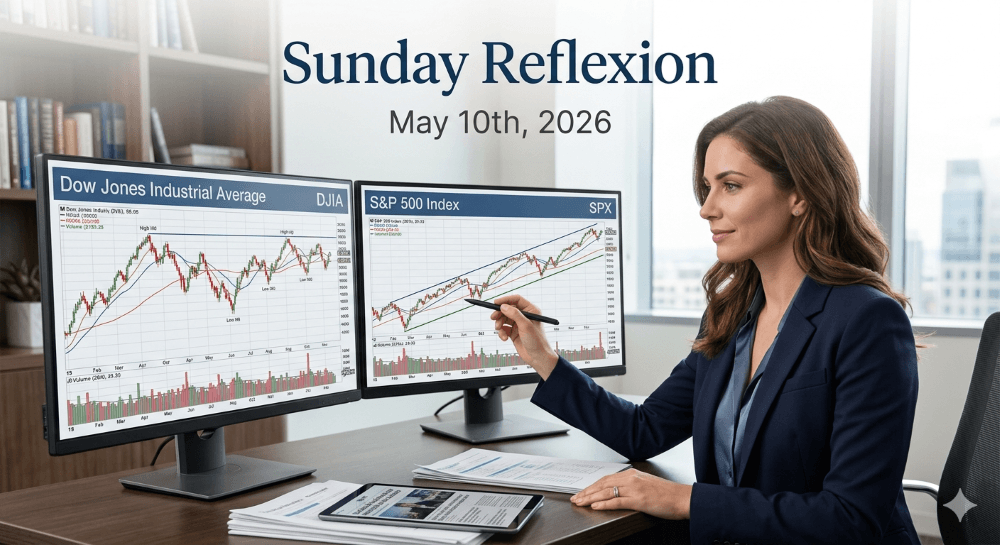
The S&P 500 vs Dow Jones debate has become more important as technology and artificial intelligence reshape the economy. During the past five years, the S&P 500 gained approximately 71.52%, while the Dow Jones Industrial Average rose only 42.65%.
That difference is not random.
The two indexes are built differently, represent different parts of the economy, and reward investors in different ways. Today, the S&P 500 is a far better representation of the modern U.S. economy than the Dow Jones Industrial Average.

What Is the Dow Jones Industrial Average?
The Dow Jones Industrial Average, often called “the Dow,” is one of the oldest stock market indexes in the world.
Created in 1896, it tracks just 30 large American companies.
The Dow includes famous corporations such as:
- Coca-Cola
- McDonald’s
- IBM
- Nike
The problem is not that these are bad companies.
The problem is that the Dow reflects an older version of the economy.
The Dow Uses a Price-Weighted System
This is one of the biggest weaknesses of the Dow.
Companies with higher stock prices have more influence on the index, regardless of how large or economically important the business actually is.
For example:
- A company trading at $500 per share affects the Dow more than a company trading at $100 per share.
- Market value does not matter nearly as much.
This methodology made sense in the 19th century when calculations were done by hand. In today’s world, it feels outdated.
What Is the S&P 500?
The S&P 500 tracks 500 of the largest publicly traded companies in the United States.
Unlike the Dow, the S&P 500 is weighted by market capitalization.
That means the companies with the greatest economic importance have the largest impact on the index.
Today, the biggest weights in the S&P include companies like:
- Microsoft
- NVIDIA
- Amazon
- Meta Platforms
- Alphabet
These companies are driving artificial intelligence, cloud computing, semiconductors, and digital infrastructure.
In other words, they are shaping the future economy.
Why the S&P 500 Better Represents the Economy
1. The Modern Economy Is Technology-Driven
Artificial intelligence is transforming nearly every sector:
- Healthcare
- Finance
- Logistics
- Advertising
- Manufacturing
- Education
The companies leading this transformation are heavily represented in the S&P 500.
The Dow, by comparison, still leans heavily toward traditional industrial-era giants.
If investors want exposure to the businesses defining the next decade, the S&P captures that trend much more effectively.
2. The S&P 500 Is More Diversified
The Dow contains only 30 companies.
The S&P contains 500.
That broader representation gives investors exposure to:
- Technology
- Healthcare
- Financials
- Consumer discretionary
- Energy
- Industrials
- Utilities
- Communication services
The U.S. economy is incredibly diverse, and the S&P reflects that diversity far better.
3. Market-Cap Weighting Makes More Sense
The S&P rewards economic relevance.
If a company grows dramatically because its products dominate the global economy, its influence on the index increases naturally.
That is exactly what happened with companies involved in AI infrastructure and semiconductors.
The Dow’s price-weighted system can distort reality.
A company with a high stock price but slowing growth can still exert oversized influence simply because its shares are expensive.
4. Investors Already Prefer the S&P 500
The rise of passive investing has made the S&P 500 the benchmark for most investors.
Massive investment funds track the index, including products from:
- Vanguard
- BlackRock
- State Street Global Advisors
When people talk about “the market,” they increasingly mean the S&P 500, not the Dow.
Why the Dow Still Matters
Despite its limitations, the Dow remains culturally important.
Financial media still references it constantly because:
- It has more than a century of history.
- The number is easy for the public to understand.
- It contains iconic American corporations.
The Dow is not useless.
It simply no longer represents the cutting edge of the economy.
The AI Revolution Explains the Performance Gap
The performance difference over the past five years tells the story clearly.
The companies benefiting most from AI, cloud computing, semiconductors, and digital advertising became enormous winners.
The S&P 500 captured those gains because it is heavily weighted toward those sectors.
The Dow did not.
That is why the S&P significantly outperformed.
Investors who owned the S&P effectively owned the companies building the future. Investors focused on the Dow owned a more traditional collection of mature blue-chip businesses.
Which Index Is Better for Investors?
For most long-term investors, the S&P 500 is likely the better benchmark because it:
- Reflects the broader economy
- Captures innovation trends
- Offers greater diversification
- Uses a more logical weighting system
- Better represents where capital is flowing
The Dow remains historically significant, but the S&P 500 is increasingly the true mirror of modern American capitalism.
As artificial intelligence reshapes the economy over the next decade, that gap may become even larger.
Frequently Asked Questions
Is the S&P 500 better than the Dow Jones?
For most investors, yes. The S&P 500 is broader, more diversified, and better reflects modern sectors like technology and AI.
Why does the Dow underperform the S&P 500?
The Dow contains only 30 companies and uses a price-weighted system, which can limit exposure to fast-growing sectors.
Does the Dow include AI companies?
Some technology companies are included, but the Dow has far less exposure to AI-driven businesses compared to the S&P 500.
Which index do professional investors follow most closely?
Most institutional investors and fund managers use the S&P 500 as the primary benchmark for the U.S. stock market.
Other Stock Market blog posts