Published: October 24, 2026 | By Alain Guillot
Elmet Group: A Small Company With a Big Opportunity
Every once in a while, a relatively unknown company appears on Wall Street’s radar because it operates in an industry that suddenly becomes strategically important.
Elmet Group (NASDAQ: ELMT) may be one of those companies.
The Maine-based manufacturer went public in April 2026 at $14 per share. By October, its stock had climbed approximately 45%, attracting attention from investors looking for opportunities beyond artificial intelligence and the usual technology giants.
On October 23, investment bank Cantor Fitzgerald raised its price target for Elmet from $20 to $30, a remarkable 50% increase.
The announcement caught my attention.
A $30 target would represent approximately 43% upside from the stock’s recent reference price of $20.91.
But does Elmet deserve such an optimistic valuation? Or are investors getting carried away with enthusiasm for defense spending and critical minerals?
Let’s examine the company, its financial performance, and what investors might reasonably expect over the next 12 months.
What Does Elmet Group Actually Do?
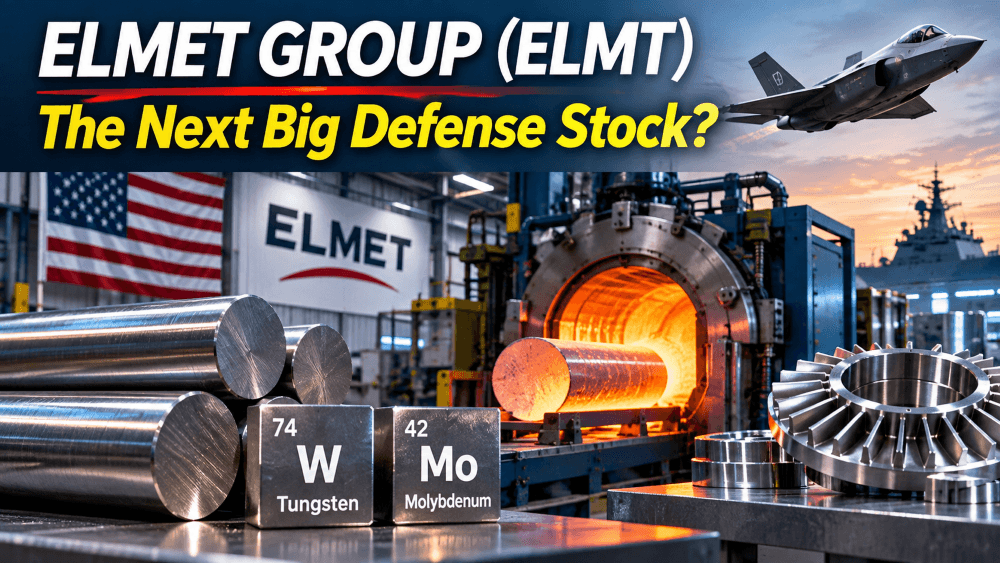
Elmet Group is an American manufacturer specializing in advanced materials and precision-engineered components.
Its expertise includes two strategically important metals: tungsten and molybdenum.
These metals have exceptional properties. They can withstand extremely high temperatures, resist wear, and maintain their strength under demanding conditions.
That makes them essential in several industries, including aerospace, defense, energy, electronics, and advanced manufacturing.
Elmet’s products and capabilities support military programs involving fighter jets, missiles, naval vessels, and other sophisticated equipment.
Consider the F-35 fighter jet, for example. Modern military aircraft require specialized materials capable of surviving enormous heat and mechanical stress.
These aren’t ordinary materials that can easily be replaced with cheaper alternatives.
Elmet operates in a specialized industry where technical expertise, manufacturing capabilities, and supply-chain reliability create meaningful barriers to entry.
This is one reason I find the company interesting.
Why Tungsten Is Becoming Strategically Important
To understand Elmet’s investment opportunity, we need to understand the global tungsten market.
China dominates global tungsten production.
For decades, Western manufacturers have depended heavily on Chinese supply chains for critical minerals and processed materials.
That dependence has become a national security concern.
Imagine a situation in which geopolitical tensions disrupt tungsten exports. American defense manufacturers could suddenly find themselves struggling to obtain essential materials.
The United States government wants to reduce that vulnerability.
Instead of relying primarily on foreign suppliers, Washington is encouraging domestic production, processing, and manufacturing.
Elmet is positioned to benefit from this shift.
It is not simply selling industrial metals. It is helping rebuild a strategically important American supply chain.
And governments are often willing to invest significant amounts of money when national security is involved.
The $450 Million Government Investment
Perhaps the most significant development for Elmet occurred in September 2026.
The U.S. Department of War, entered into an agreement to invest up to $450 million in Elmet’s tungsten-related operations.
The investment is intended to expand mining, processing, and manufacturing capacity, including projects in Nevada and improvements at existing facilities.
For a relatively small publicly traded company, this is a substantial commitment.
Elmet also announced a Defense Logistics Agency contract supporting the National Defense Stockpile.
That agreement has a potential ceiling of $2 billion, including a guaranteed funded commitment of $150 million.
However, there is an important distinction.
A $2 billion contract ceiling does not mean Elmet has already received $2 billion in revenue.
The agreement establishes a framework for future purchases over several years, and the ultimate value depends on orders, supply availability, and execution.
Likewise, the $450 million investment is not a government gift.
The financing involves preferred shares and warrants that could eventually give the government a significant ownership interest in the company.
That creates opportunities for expansion but also potential dilution for existing shareholders.
Investors should pay attention to both sides of the transaction.
Elmet’s Financial Performance: Is the Growth Real?
One of my first questions when evaluating a promising stock is whether the company’s financial results support the excitement.
In Elmet’s case, the recent numbers are encouraging.
During the second quarter of 2026, the company reported:
| Financial Metric | Q2 2026 |
|---|---|
| Revenue | $66.4 million |
| Revenue growth | 35.2% |
| Adjusted EBITDA | Approximately $8.9 million |
| Gross margin | Approximately 25% |
| Order backlog | Approximately $132 million |
| Backlog growth | Nearly 55% |
Revenue growth of 35% is impressive for an industrial manufacturing company.
Even more encouraging, profitability improved and the order backlog expanded.
A growing backlog suggests customers are placing orders that should support future business activity.
But there is an important detail hidden inside the revenue growth.
According to Elmet, approximately 55% of its revenue increase came from higher net demand. The remainder was associated with changes in tungsten and molybdenum raw-material prices.
In other words, some of the company’s reported growth reflects higher metal prices rather than simply selling more products.
This matters because commodity prices can fluctuate.
For investors, sustainable volume growth and improving profit margins are more valuable than revenue increases driven entirely by inflation in raw materials.
Nevertheless, the combination of stronger demand, improved margins, and a growing backlog suggests that Elmet’s business momentum is genuine.
Why Wall Street Is Becoming More Optimistic
Cantor Fitzgerald’s decision to increase its Elmet price target from $20 to $30 was not an isolated event.
Other investment firms have also expressed optimism.
As of October 23, 2026, several published analyst targets included:
| Investment Firm | Price Target |
|---|---|
| Cantor Fitzgerald | $30 |
| Needham | $28 |
| Canaccord Genuity | $26 |
| Roth MKM | $26 |
The broader analyst consensus was approximately $25 per share.
Wall Street’s enthusiasm is understandable.
Elmet benefits from several favorable developments occurring simultaneously:
- Increased demand for military equipment and defense manufacturing.
- Government efforts to establish more secure domestic supply chains.
- Potentially constrained global tungsten supply.
- Higher demand for specialized metals.
- Significant investments in additional production capacity.
These factors could support growth over several years.
However, analysts’ price targets are opinions, not guarantees. They can change quickly when earnings disappoint or market conditions deteriorate.
The Problem: Elmet Stock Is Not Cheap
A wonderful business does not automatically make a wonderful investment.
The price investors pay matters enormously.
At approximately $20.91 per share, and using a reported 2026 earnings estimate of $0.48 per share, Elmet trades at roughly 44 times expected annual earnings.
If the stock reaches $30 without an increase in estimated earnings, that multiple would rise to approximately 63.
Those valuations are demanding for a manufacturing business.
Investors are essentially paying today for substantial future growth.
That can work when a company consistently exceeds expectations.
But it also creates significant downside risk if growth slows.
A stock trading at a high earnings multiple can decline even when the underlying company continues growing.
For example, suppose Elmet increases earnings by 20%, but investors become less willing to pay a premium valuation.
The stock could still fall.
This is why I prefer to distinguish between a good company and a good stock at a particular price.
Elmet appears to have a promising business.
Whether it is an attractive investment depends on its valuation and the price at which shares are purchased.
Four Risks Investors Should Understand
1. Shareholder Dilution
The government’s $450 million financing arrangement includes preferred equity and warrants that could represent up to 19.9% of Elmet’s common shares on a post-transaction basis.
This is not a minor detail.
If more shares are issued, existing investors may own a smaller percentage of the company.
The financing also creates preferred-share obligations.
Elmet could grow its total profits substantially without delivering the same percentage growth in earnings attributable to each common share.
2. Dependence on Government Spending
Defense spending provides Elmet with an attractive market, but government contracts come with risks.
Programs can be delayed, budgets can change, and procurement decisions can be influenced by political priorities.
A company heavily exposed to government contracts may have less control over the timing of its revenue than investors expect.
3. Execution Risk
Building and expanding industrial manufacturing capacity is complicated.
Projects can encounter construction delays, equipment problems, cost overruns, and unexpected regulatory challenges.
Elmet’s growth strategy requires successful execution across several major initiatives.
The announcement of a new facility or financing agreement is only the beginning.
Ultimately, the company must turn those investments into profitable production.
4. Commodity Price Volatility
Tungsten and molybdenum prices can move significantly.
Higher prices may benefit certain parts of Elmet’s business, but they can also increase input costs and create volatility.
Investors should not assume that rising metal prices automatically translate into higher profits.
ELMT Stock Forecast: Three Scenarios for October 2027
Rather than relying exclusively on one analyst’s prediction, I prefer to consider several possible outcomes.
For illustration, I will use a reference share price of $20.91.
These are my subjective scenarios, not precise valuation-model outputs or probability-weighted forecasts.
| Scenario | 12-Month Price | Potential Return |
|---|---|---|
| Bear case | $15 | -28% |
| Base case | $25 | +20% |
| Bull case | $30–$34 | +43% to +63% |
Bear Case: $15 Per Share
In this scenario, Elmet encounters difficulties expanding production, earnings disappoint, or investors become less enthusiastic about expensive industrial growth stocks.
The company might still have a viable long-term business, but its valuation could contract.
A decline toward $15 would be painful for investors buying around $21.
Base Case: $25 Per Share
This is my preferred planning scenario.
Elmet continues growing, government-supported projects progress, and profitability improves.
Investors remain willing to pay a premium for the company’s strategic position, but the stock does not experience an extraordinary valuation expansion.
At $25, an investor purchasing at $20.91 would earn approximately 20% over 12 months.
That would be an excellent return, although far from guaranteed.
Bull Case: $30–$34 Per Share
This scenario assumes strong operating performance, accelerating defense demand, successful capacity expansion, and continued investor enthusiasm.
The company might exceed earnings expectations and demonstrate that its long-term profit potential is greater than analysts currently anticipate.
Under those circumstances, Cantor Fitzgerald’s $30 target could prove reasonable.
However, this scenario requires several things to go right.
It should not be treated as the most likely outcome simply because an analyst published an optimistic target.
Would I Buy Elmet Stock Today?
I find Elmet interesting, particularly because it operates in an industry that may benefit from structural changes in American industrial policy.
The company is positioned at the intersection of defense spending, critical minerals, and supply-chain security.
These are powerful long-term themes.
Nevertheless, I would be reluctant to purchase a large position immediately after a substantial rally.
At approximately $21, I see Elmet as a speculative growth investment rather than a bargain.
For someone comfortable with volatility, a small position might be reasonable.
For a more conservative investor, waiting for either a better valuation or additional financial results could be preferable.
Personally, I would find the stock more attractive around $18 to $20, assuming the company’s fundamentals remained intact.
That would provide a somewhat larger margin of safety.
I would also pay close attention to the upcoming third-quarter earnings report.
The questions I would want answered include whether revenue growth is accelerating, whether profit margins are improving, and how management expects to finance its expansion without excessively diluting shareholders.
Most importantly, I would look for evidence that government commitments are translating into sustainable earnings and cash flow.
Final Verdict: Is Elmet a Good Investment for the Next 12 Months?
My answer is a cautious yes, but only for investors willing to accept meaningful risk.
Elmet has several attractive characteristics.
It operates in a strategically important industry, benefits from strong government interest, and has demonstrated impressive recent growth.
The long-term demand for secure supplies of tungsten and advanced industrial materials could provide opportunities for years.
But much of that optimism may already be reflected in the stock price.
At approximately $21 per share, I believe a reasonable 12-month planning scenario is around $25, representing roughly 20% potential appreciation.
Cantor Fitzgerald’s $30 target is possible, but I consider it a bullish outcome rather than a conservative estimate.
There is also a realistic possibility of losing 25% or more if the company disappoints or the market reduces the premium it is willing to pay.
For investors seeking exposure to American industrial reshoring and defense supply chains, Elmet deserves a place on the watchlist.
For investors seeking predictable earnings, low volatility, and a substantial margin of safety, there may be better opportunities elsewhere.
The lesson is simple: finding a promising company is only half the investment decision. The other half is making sure you don’t pay too much for it.
Sources and Further Reading
- Investor’s Business Daily — Defense Play Elmet Gets 50% Target Hike
- Elmet Group — Second Quarter 2026 Financial Results (SEC filing)
- Elmet Group — September 2026 Government Investment Announcement
- Elmet Group — Government Investment Agreement (SEC filing)
- ELMT Analyst Price Targets — Stock Analysis
Disclaimer: This article is for educational and informational purposes only and does not constitute personalized investment advice. The price scenarios are estimates, not guarantees. Stock prices, financial forecasts, and valuations can change. Investors should conduct their own research and consider their financial circumstances and risk tolerance before making investment decisions.
Other speculative posts
Leave a Reply