By Alain Guillot | October 20, 2026 | Speculative Portfolio
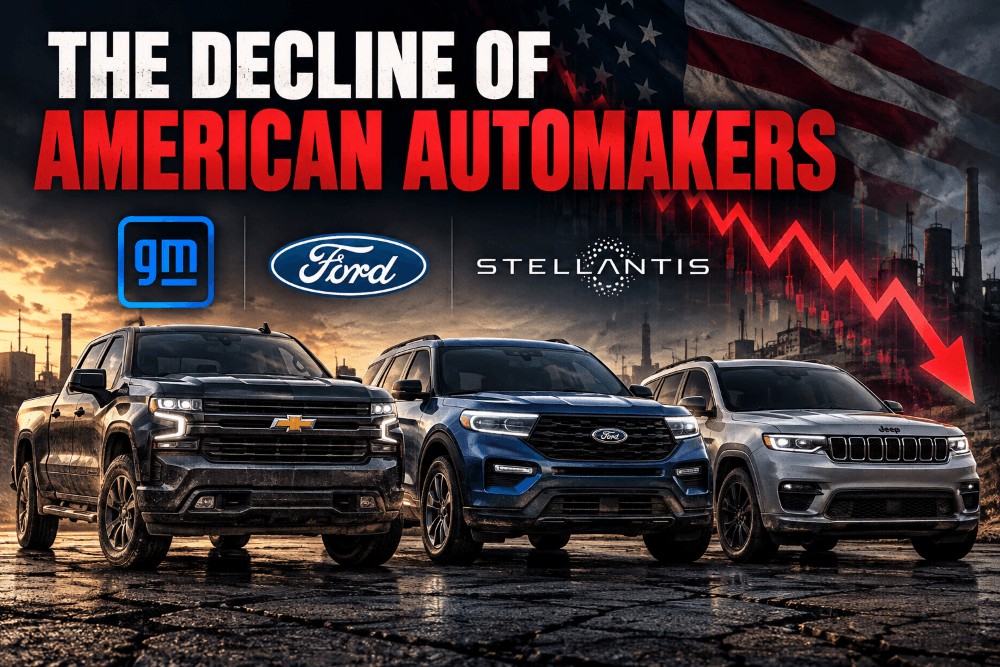
The American auto industry decline is becoming increasingly difficult to ignore. General Motors (GM), Ford (F), and Stellantis (STLA) face serious challenges, including expensive vehicles, rising production costs, foreign competition, and American consumers who are increasingly unable to afford new cars.
I believe these problems are structural, not temporary. In my opinion, the traditional American automakers will continue losing ground, and I wouldn’t rule out the possibility that one or more could eventually face bankruptcy or a major restructuring.
For investors, my position is simple: I would avoid these stocks, consider selling existing positions, and potentially short them if the right opportunity presents itself.
GM Earnings: Another Warning for the American Auto Industry
On October 20, 2026, General Motors reported its third-quarter financial results.
At first glance, the numbers weren’t terrible. GM reported:
- Quarterly revenue of approximately $50 billion.
- Adjusted operating earnings of $4.1 billion.
- Adjusted earnings per share of $3.70.
- A new $20 billion share repurchase authorization.
Nevertheless, GM shares plunged approximately 8% during the trading session.
Why would investors punish a company that is still making billions of dollars?
Because stock prices reflect expectations about the future, not simply current profitability.
GM warned about higher commodity costs, production disruptions, and pressure on future earnings. Investors are beginning to question how sustainable the company’s profitability really is.
Source: General Motors Q3 2026 Earnings
GM Stock vs. the S&P 500: Five Years of Disappointment
As an investor, I always compare individual stocks against a simple alternative: buying an S&P 500 index fund.
Why take the additional risk of owning an individual company if it consistently underperforms the broader market?
Using the five-year performance figures I reviewed, the comparison is disappointing:
| Investment | Five-year price appreciation |
|---|---|
| General Motors (GM) | 31% |
| S&P 500 Index | 115% |
Imagine investing $10,000 five years ago.
- General Motors: Your investment would be worth approximately $13,100.
- S&P 500: Your investment would be worth approximately $21,500.
That’s an $8,400 difference on a $10,000 investment.
Of course, past performance doesn’t guarantee future returns. But the opportunity cost of holding an underperforming stock is very real.
And I see little reason to believe the next five years will be dramatically better for traditional American automakers.
The American Auto Industry Decline Is a Structural Problem
I believe the difficulties facing General Motors, Ford, and Stellantis go much deeper than a disappointing earnings report.
These companies are competing in an industry undergoing enormous technological and economic changes.
Unfortunately, their business models remain heavily dependent on expensive vehicles, especially large pickup trucks and SUVs.
1. American Automakers Have Become Dependent on Expensive Trucks and SUVs
For years, American manufacturers have focused heavily on large pickup trucks and SUVs.
The reason is straightforward: these vehicles generally generate higher profit margins than inexpensive compact cars.
Selling a large pickup truck for $70,000 can be much more profitable than selling an economy car for $25,000.
From a short-term profitability perspective, this strategy makes sense.
But there is a problem.
What happens when the average American can no longer afford the vehicles American automakers want to sell?
Manufacturers have increasingly prioritized expensive vehicles while abandoning parts of the affordable passenger-car market.
I believe this strategy has created a dangerous disconnect between what automakers want to sell and what many consumers can reasonably afford.
2. Americans Are Spending Too Much on Their Cars
Car ownership in the United States has become extraordinarily expensive.
According to Edmunds, the average monthly payment for a financed new vehicle reached $787 in the third quarter of 2026.
Even more concerning, 21.2% of new-car buyers who financed their purchases committed to monthly payments of at least $1,000.
Source: Edmunds Q3 2026 Financing Report
But the monthly payment is only part of the cost.
Consumers must also consider insurance, gasoline, maintenance, repairs, registration, taxes, and depreciation.
According to AAA’s 2026 Your Driving Costs study, the average annual cost of owning and operating a new vehicle is approximately $12,863.
That works out to:
$1,072 per month, or nearly $13,000 per year.
Source: AAA 2026 Vehicle Ownership Costs
Importantly, AAA’s estimate already incorporates financing and other ownership costs. We should not add the average car payment on top of this figure.
Consider what this means for an American household.
If someone earns $60,000 annually before taxes, a $12,863 annual vehicle expense represents approximately 21% of gross income.
And that is for just one vehicle.
A household with two cars can face an enormous transportation burden, although costs will vary depending on the vehicles, financing, and driving habits.
I don’t believe this situation is sustainable indefinitely.
3. High Gas Prices Make Large Vehicles Less Attractive
Large trucks and SUVs have another weakness: fuel consumption.
When gasoline is inexpensive, consumers may be willing to overlook the cost of filling up a large vehicle.
But when fuel prices rise, the economics change dramatically.
A vehicle that consumes twice as much gasoline as a smaller, more efficient car becomes increasingly expensive to operate.
With oil prices elevated in 2026, fuel efficiency is becoming more important to household budgets.
Consumers have alternatives, including:
- Smaller gasoline-powered cars.
- Fuel-efficient hybrid vehicles.
- Plug-in hybrids.
- Fully electric vehicles.
Japanese and Korean manufacturers have strong positions in several of these categories, while Chinese manufacturers are rapidly expanding their electric and hybrid offerings.
I believe the American industry’s dependence on large gasoline-powered vehicles makes it especially vulnerable to prolonged periods of expensive fuel.
Tariffs Are Protecting American Automakers From Competition
One of my biggest concerns about the American auto industry is its dependence on government protection.
The United States imposes tariffs and other trade restrictions on imported vehicles, with particularly severe barriers affecting Chinese electric vehicles.
These policies protect domestic manufacturers from some of the most aggressive international competitors.
But protection comes at a cost.
When foreign competitors face substantial barriers to entering a market, domestic companies experience less competitive pressure.
That can reduce incentives to lower prices, innovate, and improve efficiency.
Consider BYD, the Chinese automaker that has become a major global competitor in electric and plug-in hybrid vehicles.
BYD offers a growing selection of vehicles across different price categories and has developed substantial expertise in battery technology.
American consumers have limited access to these products because of trade restrictions.
I am not arguing that every Chinese vehicle is superior to every American vehicle. Quality, reliability, safety, and service networks vary considerably.
My argument is that American consumers should have the freedom to choose among more competitors.
If General Motors, Ford, and Stellantis are truly competitive, they should be able to demonstrate that through their products rather than depending on government protection.
Tariffs may preserve domestic market share in the short term, but they cannot guarantee international competitiveness.
Chinese, Japanese, and Korean Automakers Are Becoming Stronger
The competitive threat is not limited to China.
Japanese manufacturers such as Toyota and Honda have spent decades building reputations for reliability, efficiency, and strong resale values.
Korean companies such as Hyundai and Kia have also become increasingly competitive in vehicle design, technology, and electrification.
Meanwhile, Chinese manufacturers, particularly BYD, have become formidable competitors in electric vehicles and battery technology.
These companies are not perfect, and their success varies by market.
Nevertheless, they represent a significant challenge to traditional American manufacturers.
The industry is shifting toward vehicles that combine affordability, energy efficiency, software, battery technology, and reliability.
I question whether GM, Ford, and Stellantis can adapt quickly enough while maintaining attractive profit margins.
Could GM, Ford, or Stellantis Eventually Go Bankrupt?
I recognize that predicting bankruptcy is a very strong statement.
These are enormous corporations with substantial manufacturing operations, valuable brands, and access to financing.
General Motors is currently profitable, and its October earnings report certainly does not indicate an imminent bankruptcy.
In fact, GM announced a $20 billion share repurchase authorization, suggesting that management remains confident in the company’s financial position.
But profitability today does not guarantee survival tomorrow.
We have already seen what can happen to the American auto industry during a major crisis.
General Motors filed for bankruptcy protection in 2009 and emerged through a government-supported restructuring. Chrysler also entered bankruptcy that year.
Ford avoided bankruptcy, but it experienced substantial financial pressure.
Could something similar happen again?
I believe it is possible over a sufficiently long period, especially if several problems occur simultaneously:
- Consumer demand weakens significantly.
- Financing becomes more expensive.
- Fuel prices remain elevated.
- Foreign competitors gain technological advantages.
- Profit margins decline.
- Debt and restructuring costs become difficult to manage.
This is a long-term risk scenario, not a prediction that bankruptcy is imminent.
However, investors should not assume that a company is safe simply because it has been around for a hundred years.
My Investment Strategy: Sell or Consider Short Selling
For my speculative portfolio, I am bearish on three companies:
| Company | Ticker | My outlook |
|---|---|---|
| General Motors | GM | Bearish |
| Ford Motor Company | F | Bearish |
| Stellantis | STLA | Bearish |
I see three possible approaches.
1. Avoid Buying These Stocks
This is the simplest approach.
There are thousands of publicly traded companies and many diversified index funds available to investors.
Why invest in an industry facing significant structural challenges when there may be better opportunities elsewhere?
2. Consider Selling Existing Positions
If I already owned GM, Ford, or Stellantis, I would seriously reconsider my investment thesis.
I would ask myself whether the expected future return justifies the risks.
A stock that appears cheap based on its price-to-earnings ratio is not necessarily a bargain.
Sometimes companies trade at low valuations because investors correctly anticipate deteriorating business conditions.
3. Consider Short Selling
For more adventurous investors, short selling may provide an opportunity to profit from falling stock prices.
When short selling, an investor borrows shares, sells them, and hopes to repurchase them later at a lower price.
For example:
- Sell short 100 shares at $50: receive $5,000 in sale proceeds.
- Repurchase 100 shares at $40: pay $4,000.
- Gross trading profit: $1,000 before borrowing costs, commissions, and other expenses.
But short selling carries substantial risks.
Unlike buying a stock, where the maximum loss is generally the amount invested, a short seller faces theoretically unlimited losses if the stock price keeps rising.
Borrowing costs, margin requirements, dividends owed to the share lender, and sudden short squeezes can also create problems.
Even a correct long-term bearish thesis can result in a losing short trade if the timing is wrong.
For my speculative portfolio, I would therefore look for clear downward price momentum and favorable technical signals rather than shorting these companies simply because I dislike their long-term prospects.
What Could Prove My Bearish Thesis Wrong?
Every investment thesis should include the possibility of being wrong.
Several developments could improve the outlook for American automakers.
GM, Ford, and Stellantis could successfully introduce more affordable vehicles, improve hybrid and electric offerings, and reduce production costs.
Their profitable truck and SUV businesses could continue generating substantial cash flow.
Government protection might also remain in place for many years, allowing domestic manufacturers to maintain market share despite foreign competition.
Finally, lower interest rates and gasoline prices could make vehicle ownership more affordable.
These are meaningful counterarguments.
Nevertheless, I believe the long-term risks outweigh the potential rewards at current conditions.
Conclusion: I Am Pessimistic About the Future of American Automakers
The American auto industry decline is not something I expect to happen overnight.
GM, Ford, and Stellantis may remain profitable for years, and their stock prices could experience substantial rallies along the way.
But my investment outlook remains negative.
I believe these companies face a combination of serious challenges: expensive products, financially stretched consumers, high fuel costs, international competition, and dependence on trade protection.
Meanwhile, manufacturers in China, Japan, and South Korea continue developing increasingly competitive vehicles.
For me, the opportunity cost of investing in traditional American automakers is simply too high.
My conclusion is that I would rather own a diversified S&P 500 index fund than invest in GM, Ford, or Stellantis for the long term.
And in my speculative portfolio, I will be watching these three companies for potential short-selling opportunities.
I am not predicting exactly when their share prices will decline or whether any of these companies will eventually go bankrupt.
But I am betting that the next decade will be extremely challenging for the traditional American auto industry.
Frequently Asked Questions
Why is the American auto industry declining?
Traditional American automakers face pressure from expensive vehicle prices, high ownership costs, fuel prices, international competition, and the cost of transitioning toward more efficient and electric vehicles. However, individual companies remain profitable, so the industry’s challenges do not necessarily mean that every manufacturer is experiencing an absolute decline.
Is General Motors a good stock to buy in 2026?
GM remains profitable and generates substantial cash flow, but I am bearish because of its dependence on large vehicles, rising costs, and international competition. Investors should compare its valuation, earnings prospects, and risks against diversified alternatives such as the S&P 500.
Could Ford, GM, or Stellantis go bankrupt?
Bankruptcy is possible for any heavily capital-intensive manufacturer facing prolonged financial distress. However, there is no evidence from GM’s latest earnings that bankruptcy is imminent. My concern is about long-term structural risks rather than an immediate financial collapse.
Is short selling GM, Ford, or Stellantis a good idea?
Short selling can generate profits when share prices fall, but it is substantially riskier than simply avoiding a stock. I would only consider a short position after evaluating price trends, borrowing costs, financial strength, and potential catalysts, with a clearly defined risk-management strategy.
Disclaimer: This article reflects my personal opinions and investment outlook, not individualized financial advice. Short selling involves significant risks, including potentially unlimited losses. I may change my views as market conditions evolve.
Other speculative posts
Leave a Reply