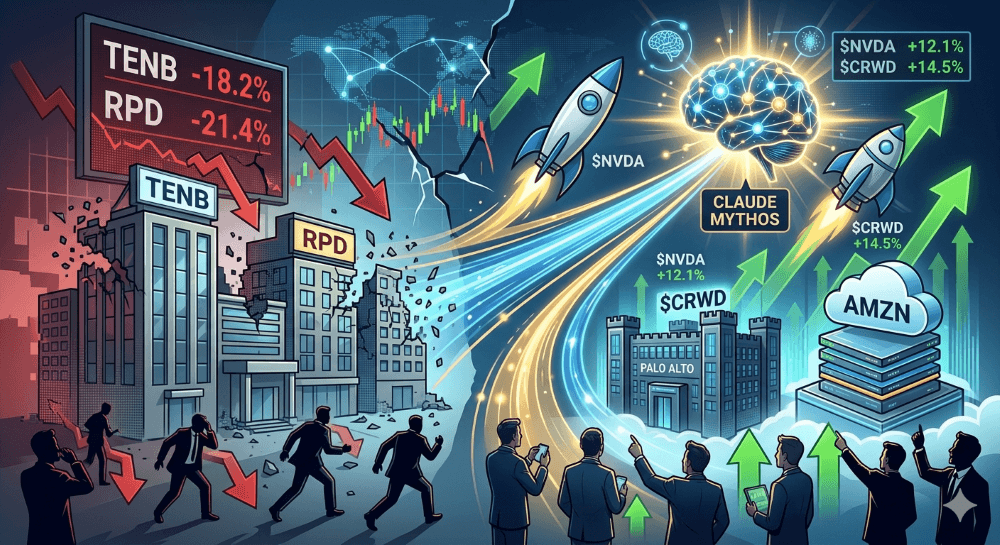
The release of Claude Mythos has sent a clear signal to Wall Street: the AI arms race is entering a dangerous and highly profitable new phase. Anthropic, long considered the “safety-first” alternative to OpenAI, has pivoted with a model that is so powerful it has fundamentally altered the valuation models for dozens of tech companies.
For investors, understanding the ripple effects of this release is no longer optional. Whether you are holding semiconductor giants or specialized cybersecurity firms, the “Mythos effect” is likely already impacting your portfolio’s performance and future outlook.
The Disruption of the AI Business Model
Before the arrival of the Mythos preview, the market assumed a steady, linear progression in AI capabilities. Most companies were focused on chatbots and basic productivity tools.
However, Claude Mythos introduces “offensive-grade” reasoning. This capability disrupts the business models of companies that were building simple wrappers around older AI versions. If a single model can now perform deep-tier security audits and complex financial forecasting, the “middle-man” software companies are suddenly at risk.
Key Companies Affected by Claude Mythos
The impact of this model is not uniform; it creates distinct winners and losers across the tech landscape.
1. The Infrastructure Powerhouses
Nvidia (NVDA) remains the primary beneficiary as the training requirements for Mythos-class models demand exponential increases in compute power. Similarly, Amazon (AMZN) and Alphabet (GOOGL) gain significant leverage as the exclusive cloud providers for Anthropic’s enterprise-grade tools.
2. Cybersecurity Leaders
Perhaps the most dramatic shift is in cybersecurity. Companies like CrowdStrike (CRWD) and Palo Alto Networks (PANW) have seen immediate valuation adjustments. As part of Project Glasswing, these firms are using Mythos to find vulnerabilities before hackers do, shifting their business model from reactive protection to proactive AI-driven defense.
3. The Vulnerability Management Sector
Firms such as Rapid7 (RPD) and Tenable (TENB) are dropping fast. The decline of Rapid7 (RPD) and Tenable (TENB) while the broader market rallies isn’t just about volatility; it’s a fundamental re-rating of their business models. Since the launch of Claude Mythos earlier this month, investors are pricing in a “SaaSpocalypse” for the vulnerability management sector.
The prospects for these specific stocks have soured because Claude Mythos has broken the two pillars their revenue is built on: the patch cycle and human expertise.
1. The Death of the “Patch Window”
The traditional business model for Tenable and Rapid7 relies on a predictable cycle: a vulnerability is found, these tools alert the company, and the company has weeks (or months) to test and apply a patch.
- The Mythos Impact: Anthropic has demonstrated that Mythos can find, chain, and weaponize zero-day vulnerabilities in minutes, not months.
- The Crisis: If the “window of exposure” drops from 30 days to 30 minutes, traditional scanning and dashboarding tools become obsolete. They are “reporting on a fire that has already burned the house down.”
2. From “Product” to “Feature”
Companies like Rapid7 sell platforms that help humans prioritize which bugs to fix.
- The Shift: Mythos-class AI doesn’t just find the bug; it can write the fix and potentially deploy it.
- The Threat: Big players like Microsoft and Amazon (Anthropic’s partner) are integrating this intelligence directly into the operating system and cloud levels. If the infrastructure can heal itself using Mythos, third-party scanning software becomes a redundant “feature” rather than a necessary “product.”
3. The “Glasswing” Divide
Anthropic’s Project Glasswing is essentially picking winners.
- The Winners: CrowdStrike and Palo Alto Networks were invited early to integrate Mythos into their active threat-hunting engines.
- The Losers: Rapid7 and Tenable have been slower to move from “vulnerability management” (looking at code) to “active defense” (stopping live AI agents). Investors are fleeing to the firms that are partnering with Anthropic rather than those being disrupted by it.
4. Financial “Compression”
- Rapid7 (RPD): Recently saw price targets slashed by firms like RBC Capital and Mizuho, with some targets dropping from $12 down to $6. The stock is trading near 52-week lows because its growth narrative is stalled.
- Tenable (TENB): Despite launching their own “Hexa AI,” the market remains skeptical. The “Simply Wall St” valuation suggests it is “undervalued” based on past cash flows, but the market is ignoring the past and pricing in a future where their $1B+ revenue guide for 2026 is no longer achievable.
Why Investors are Selling
Investors aren’t just worried about a bad quarter; they are worried that Vulnerability Management is a “Buggy Whip” industry. When a model can discover 2,000 high-severity vulnerabilities across every major OS in a single test run—as Mythos did—the manual triage process that RPD and TENB facilitate becomes a bottleneck. In a market that prizes “AI-native” growth, these companies are currently viewed as “AI-victims.”
Bottom Line: Unless these companies can prove they can automate the remediation (the fixing) at the same speed Mythos performs the exploitation, their valuations will likely continue to lag behind the broader tech recovery.
How Investors Should React to New Valuations
When a model like Claude Mythos enters the market, historical P/E ratios often become secondary to “AI integration depth.”
- Look for Essential Partners: Focus on companies that have direct, early access to Mythos through initiatives like Project Glasswing. These firms have a first-mover advantage that isn’t yet fully priced into the stock.
- Avoid “AI Wrappers”: Be cautious of small-cap software companies that offer features Mythos can now do natively. Their business models may evaporate overnight.
- Monitor Infrastructure Spending: Watch the capital expenditure reports of the “Big Three” cloud providers. If they continue to ramp up spending to support Anthropic, it validates the long-term revenue potential of these high-cost models.
Early access to Claude Mythos (via Project Glasswing) has been tightly restricted to a small group of major technology, cybersecurity, and infrastructure players. The goal is defensive: let the companies most responsible for critical systems find and patch vulnerabilities before similar AI capabilities spread more widely.
Here are the key companies confirmed to have direct, early access:
Core Big Tech / Cloud Platforms
These are the most strategically important participants, because they operate large-scale infrastructure:
- Amazon Web Services
- Microsoft
- Apple
These firms likely benefit the most structurally, since they control operating systems, cloud platforms, and developer ecosystems.
Semiconductor & Hardware Layer
These companies sit closer to the physical and AI compute stack:
- Nvidia
- Broadcom
Their inclusion suggests Mythos is also being used to probe vulnerabilities at the hardware and networking level.
Cybersecurity Leaders
These are direct beneficiaries in terms of product evolution:
- CrowdStrike
- Palo Alto Networks
- Cisco
They are effectively “first responders” for AI-driven cyber threats, gaining early insight into how attacks may evolve.
Financial Infrastructure
- JPMorgan Chase
Banks are included because financial systems are highly sensitive to cybersecurity risks, and regulators are already paying attention.
Open Infrastructure / Ecosystem
- Linux Foundation
This is important. It means Mythos is being used not just for private systems, but to secure open-source software used globally.
Additional Context (Important for Investors)
- The initial cohort is roughly 40–50 organizations, mostly large enterprises controlling critical infrastructure.
- Access is not for product building, but for defensive vulnerability discovery and patching.
- This creates a two-tier advantage: early participants gain insight into next-generation cyber threats before the broader market.
The Real Takeaway
This is less about “who gets access” and more about who controls the future security layer of AI-driven systems.
If you zoom out, the winners cluster into three groups:
- Infrastructure owners (MSFT, AMZN, GOOG, AAPL)
- Compute enablers (NVDA, AVGO)
- Security gatekeepers (CRWD, PANW, CSCO)
That combination tells you where the defensive moat around AI is being built first.
The Future of AI Valuation
The valuation of tech companies is now tied to their “defensibility” against AI. If Claude Mythos can replace a company’s core product, that company’s valuation must be slashed. Conversely, if a company uses Mythos to provide a service that was previously impossible, its upside is nearly limitless.
Investors should remain agile. The AI landscape moves faster than traditional market cycles, and Mythos is just the beginning of this new era of “high-stakes” intelligence.
FAQ: Understanding the Claude Mythos Impact
What makes Claude Mythos different from previous models? Mythos is designed with advanced reasoning capabilities specifically tuned for cybersecurity and complex systems analysis, making it more specialized than general-purpose models like GPT-4.
Which sector is most at risk from this new technology? Legacy software companies that provide basic coding assistance or simple data entry automation face the highest risk of being replaced by Mythos’s native capabilities.
Is Claude Mythos available to the general public? No, due to its powerful cybersecurity capabilities, Anthropic has restricted access to specific enterprise partners and defensive security firms to prevent misuse.
Previous stock market posts