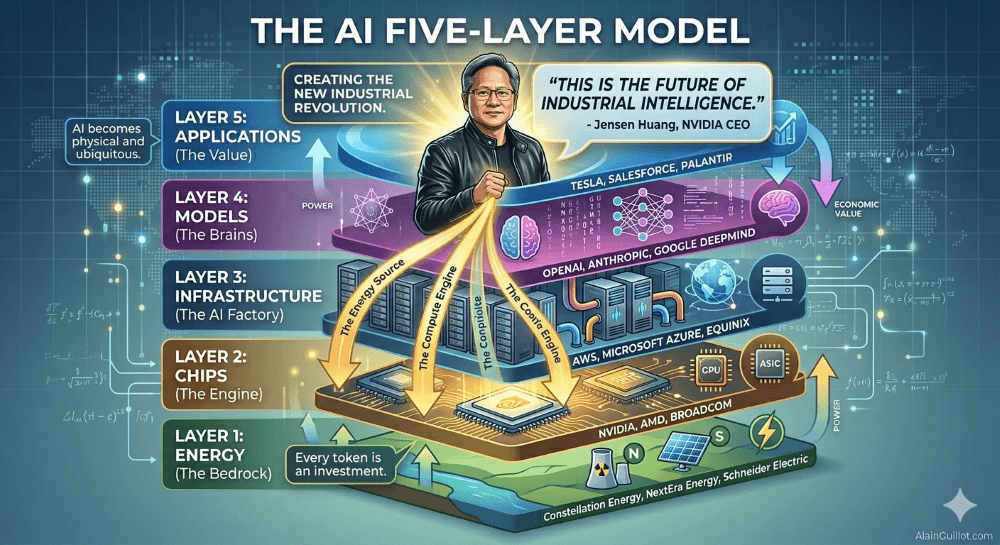
In a world where artificial intelligence is no longer just a buzzword but a global industrial shift, NVIDIA CEO Jensen Huang has introduced a compelling framework to understand its complexity: the AI Five-Layer Model. Often referred to as the “AI Five-Layer Cake,” this model illustrates that AI is not just a single software application; it is a multi-trillion dollar stack of interdependent technologies.
By breaking down the industry into five distinct layers—Energy, Chips, Infrastructure, Models, and Applications—Huang provides a roadmap for where the next decade of value will be created. Understanding the AI Five-Layer Model is essential for investors, entrepreneurs, and tech enthusiasts who want to see the “big picture” behind the curtain of real-time intelligence.
What is the AI Five-Layer Model?
The AI Five-Layer Model describes the full-stack architecture required to produce “intelligence” on demand. Unlike traditional software, which is “pre-recorded” code, AI is generative and real-time. This requires a massive physical and digital foundation.
Layer 1: Energy (The Bedrock)
At the bottom of the cake is raw power. Every token generated by an AI model is essentially a conversion of electricity into intelligence. Energy is the ultimate constraint; without a massive increase in power capacity, the layers above cannot scale.
- NextEra Energy: The world’s largest renewable energy company, essential for “Green AI.”
- Constellation Energy: A leader in nuclear power, providing the 24/7 carbon-free energy AI factories need.
- Schneider Electric: Specializes in energy management and thermal cooling for high-density data centers.
Layer 2: Chips (The Engine)
This layer converts the energy from Layer 1 into raw compute. These aren’t standard processors; they are highly specialized accelerators designed for parallel processing at an unprecedented scale.
- NVIDIA: The undisputed king of the GPU, providing the Blackwell and Rubin architectures.
- AMD: A primary challenger with their Instinct accelerators and a massive 6-gigawatt deal with OpenAI.
- Broadcom: The leader in custom AI silicon (ASICs) for companies like Google and Meta.
Layer 3: Infrastructure (The AI Factory)
Huang calls this layer the “AI Factory.” This includes the physical data centers, high-speed networking (like InfiniBand), and the complex cooling systems required to keep tens of thousands of chips running as a single cohesive unit.
- Microsoft Azure: Building some of the largest AI supercomputers in the world to power OpenAI.
- Amazon Web Services (AWS): Dominates cloud infrastructure with its custom Trainium and Inferentia chips.
- Equinix: The “landlord” of the internet, providing the physical space and interconnection for AI clouds.
- Vertiv Holdings Co (VRT): A leader in thermal and power management, essential for cooling the high-density racks used in AI processing.
Layer 4: Models (The Brains)
On top of the physical layers sit the models. These are the algorithms that have been “taught” to understand language, biology, physics, and even robotics.
- OpenAI: The makers of GPT-5, setting the gold standard for reasoning and language.
- Anthropic: Focuses on “Constitutional AI” to build safe, interpretable models like Claude.
- Google DeepMind: Pushing the “Agentic Era” with Gemini, which can plan and execute complex tasks.
Layer 5: Applications (The Value)
This is where the economic “icing” meets the cake. Applications are where businesses and consumers interact with AI to solve real-world problems, from drug discovery to autonomous driving.
Addressing complex, multi-step real-world problems often necessitates AI systems that can maintain state and recover from failures, ensuring tasks are completed reliably even when interrupted. This requirement drives the development of an agentic, durable execution framework that lets AI agents run long-running, resilient operations while preserving context and progress.
- Salesforce: Integrating AI agents into CRM to automate customer service and sales.
- Tesla: Using physical AI for Full Self-Driving (FSD) and humanoid robotics (Optimus).
- Palantir: Helping enterprises and governments integrate AI models into their actual operations.
Why This Model Matters for 2026
The AI Five-Layer Model shows that a breakthrough in one layer creates a “pull” on all the others. A successful application (Layer 5) creates a massive demand for more models (Layer 4), which requires more factories (Layer 3), more chips (Layer 2), and ultimately, more power (Layer 1). We are witnessing the birth of a new industrial revolution where intelligence is the primary export.
Frequently Asked Questions
What is the most important layer in the AI Five-Layer Model?
While all layers are interdependent, Jensen Huang often points to Energy as the fundamental constraint and Applications as the layer where actual economic value is realized.
Why is it called a “Five-Layer Cake”?
The metaphor emphasizes that each layer sits on top of the other. You cannot have a robust application layer without the foundational layers of chips and energy supporting it.
Can a company exist in multiple layers of the model?
Yes. Tech giants like Google and Microsoft are “full-stack” players, owning everything from custom chips and massive data centers to their own frontier models and consumer applications.
Previous stock market posts