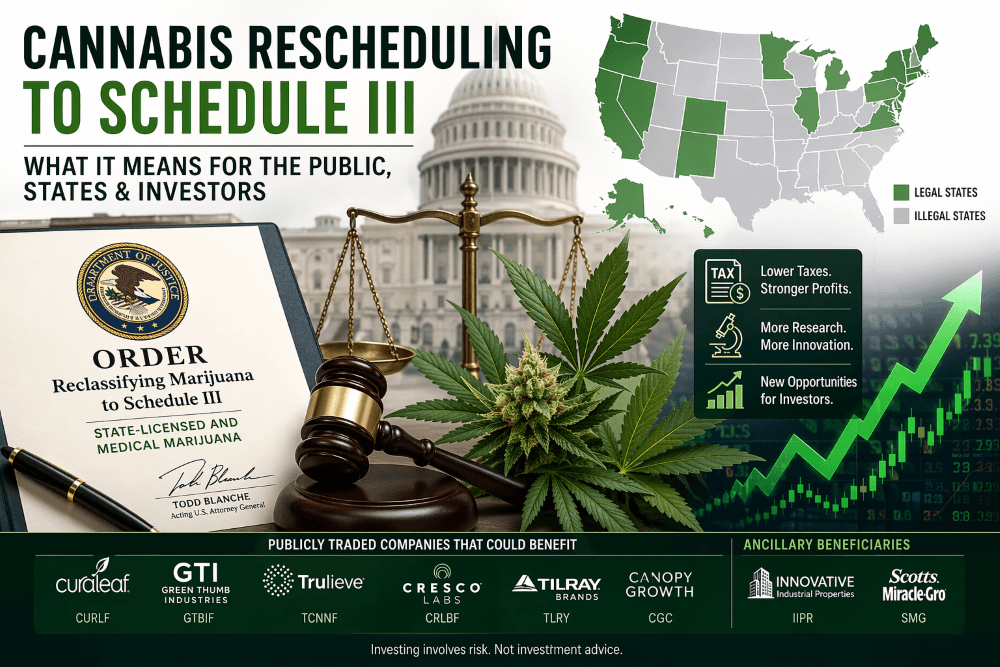
Intro: Trump DOJ just dropped a bomb on marijuana policy: They’re fast-tracking the rescheduling of cannabis. How? By moving it out of the ultra-restrictive Schedule I category (same as heroin) into a lighter one with low-to-moderate abuse potential. This will slash taxes, boost research, ease banking/funding, and supercharge the $47 billion industry. Stocks smoked then dipped, but the shift is real. Big win for states that already legalized it.
Cannabis Rescheduling: What It Means for Investors and the Public
The recent cannabis rescheduling decision by Todd Blanche marks one of the most important regulatory shifts in the industry in decades. Moving cannabis to Schedule III is not legalization, but it changes the economic reality in meaningful ways.
For investors and the general public, cannabis rescheduling introduces a mix of opportunity, confusion, and uneven impact across states.
The Role of Donald Trump and Mike Tyson
The decision to move cannabis toward Schedule III did not emerge in a vacuum. Donald Trump played a central role by setting the policy direction, issuing a directive to pursue rescheduling, and shaping the leadership at the Department of Justice that ultimately carried it out. While the formal order was signed by Todd Blanche, the initiative reflects the broader priorities of the administration. At the same time, the push for reform was reinforced by a wide coalition of voices outside government, including industry leaders, lobbyists, and public figures such as Mike Tyson, who was among many advocates calling for a reassessment of federal cannabis policy.
What Cannabis Rescheduling Actually Changes
Cannabis rescheduling moves marijuana out of the strictest federal category and recognizes medical value.
In practical terms, this means:
- Businesses may no longer be subject to punitive IRS tax rule 280E
- Medical research becomes easier
- The stigma around cannabis begins to soften
However, cannabis remains federally controlled. This is not full legalization.
How the General Public Is Affected
For everyday people, the effects of cannabis rescheduling will be subtle at first.
Over time, the public may see:
- Greater access to medically approved cannabis treatments
- More standardized dosing and pharmaceutical-grade products
- Increased insurance coverage for certain cannabis-based medications
That said, recreational users will not see immediate changes. Federal law still restricts non-medical use.
A Tale of Two Americas: Legal vs. Illegal States
Cannabis rescheduling creates a fragmented reality across the United States.
States Where Cannabis Is Legal
In states with established markets, the benefits are economic:
- Stronger, more profitable local cannabis companies
- Expansion of retail networks and production
- Increased tax revenues at the state level
Companies operating in these states gain a competitive advantage as their tax burden decreases.
States where marijuana is fully legal (recreational + medical)
These states have legalized cannabis for adult use:
- Alaska
- Arizona
- California
- Colorado
- Connecticut
- Delaware
- Illinois
- Maine
- Maryland
- Massachusetts
- Michigan
- Minnesota
- Missouri
- Montana
- Nevada
- New Jersey
- New Mexico
- New York
- Ohio
- Oregon
- Rhode Island
- Vermont
- Virginia (limited retail rollout)
- Washington
States where marijuana is legal for medical use only
These states allow cannabis, but strictly for medical purposes:
- Alabama
- Arkansas
- Florida
- Hawaii
- Louisiana
- Mississippi
- New Hampshire
- North Dakota
- Oklahoma
- Pennsylvania
- South Dakota
- Utah
- West Virginia
States Where Cannabis Is Illegal
In prohibition states, the impact is minimal:
- Cannabis remains illegal locally
- No retail or commercial benefit
- Continued reliance on black markets
This divergence reinforces a patchwork system where geography determines access and opportunity.
States where marijuana remains illegal (or highly restricted)
These states still prohibit cannabis broadly:
- Idaho
- Indiana
- Iowa
- Kansas
- Kentucky
- Nebraska
- North Carolina
- South Carolina
- Tennessee
- Texas
- Wisconsin
- Wyoming
What this means in practice
Even with federal Schedule III rescheduling, these state laws still control day-to-day reality.
- In legal states, businesses can expand and benefit economically
- In medical-only states, access remains controlled and limited
- In illegal states, cannabis remains largely prohibited
The result is a divided system where your location determines your access, your legal risk, and even the investment opportunities tied to local markets.
Winners in the Stock Market
The biggest beneficiaries of cannabis rescheduling are U.S.-focused operators.
Companies such as Curaleaf Holdings, Green Thumb Industries, and Trulieve Cannabis stand to gain significantly.
Why they benefit:
- Lower effective tax rates
- Immediate improvement in profitability
- Stronger balance sheets
Ancillary businesses also benefit. Firms like Innovative Industrial Properties and Scotts Miracle-Gro gain from industry expansion without direct exposure to cannabis regulation.
Mixed Outcomes for Canadian Producers
Canadian companies such as Tilray Brands and Canopy Growth may benefit, but less directly.
Their upside depends on future U.S. market access, not immediate regulatory relief.
This makes them more speculative plays compared to U.S. operators.
Who Could Lose?
Not every company benefits from cannabis rescheduling.
Potential losers include:
- Smaller operators unable to scale even with tax relief
- Companies heavily diluted by past financing
- Firms that rallied too far ahead of the news
In some cases, stocks fall after good news due to profit-taking and over-optimistic expectations.
Investment Opportunities After Cannabis Rescheduling
Cannabis rescheduling does not create instant wealth, but it changes the framework for evaluating the sector.
Investors should focus on:
- Profitability expansion
Companies with strong operations will now show real earnings power. - Balance sheet strength
Lower taxes improve cash flow, but debt still matters. - Regulatory optionality
Future catalysts like banking reform could unlock further upside.
The key insight is simple: cannabis is shifting from a speculative trade to a cash flow story.
Conclusion
Cannabis rescheduling is a meaningful step forward, but it is not the finish line.
For the public, the effects will unfold gradually. For states, the divide between legal and illegal jurisdictions will persist. For investors, the opportunity lies in identifying which companies can convert regulatory relief into sustainable profits.
The market reaction may be volatile, but the long-term implications are becoming clearer.
FAQ
What is cannabis rescheduling?
Cannabis rescheduling refers to moving marijuana to a less restrictive federal classification, recognizing medical use and reducing regulatory burdens.
Does Schedule III mean cannabis is legal?
No. Cannabis remains federally controlled. Schedule III only reduces restrictions and acknowledges medical value.
Which stocks benefit most from cannabis rescheduling?
U.S. operators like Curaleaf, Green Thumb Industries, and Trulieve benefit most due to tax relief.
Will cannabis banking laws change next?
Not automatically. Additional legislation, such as the SAFE Banking Act, would be required.
Previous stock market posts