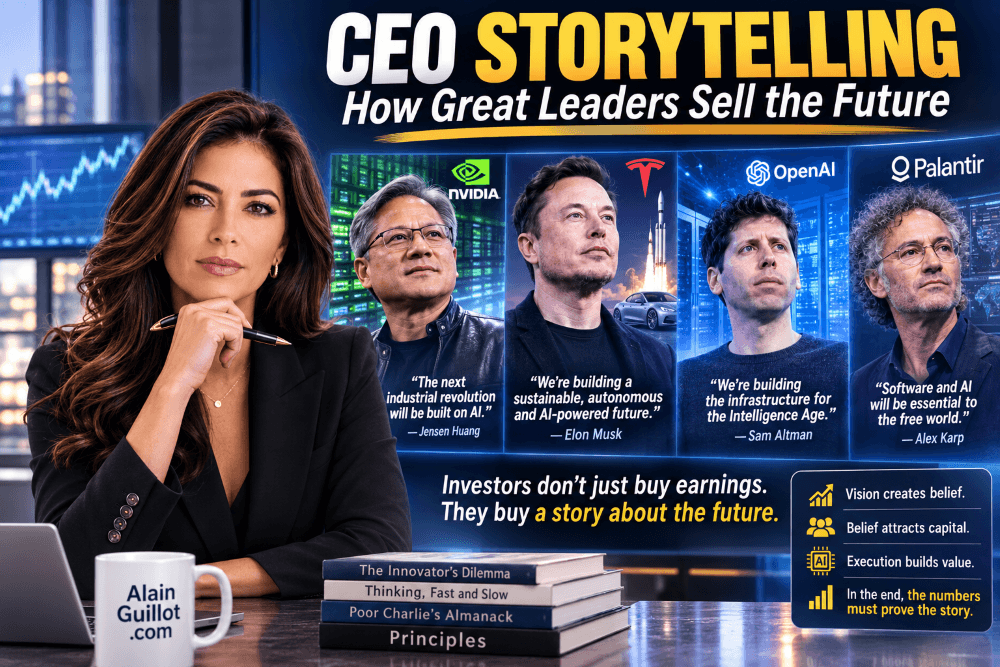
CEO storytelling is one of the most underrated skills in business. When investors buy shares in a company, they aren’t simply buying its current earnings. They are buying a story about what that company might become five, ten, or twenty years from now.
The best CEOs understand this instinctively.
They explain where the world is going, why their company will matter in that future, and why investors should remain patient while management tries to turn that vision into reality.
Sometimes the story becomes reality.
Sometimes investors wait for years.
And sometimes the story turns out to have been better than the business.
That distinction is enormously important for investors.
Why CEO Storytelling Matters to Investors

A company’s financial statements tell us about the past.
Revenue, earnings, margins and cash flow tell investors what has already happened. Stock prices, however, are heavily influenced by expectations about what will happen next.
That’s where CEO storytelling becomes extraordinarily powerful.
A compelling CEO effectively tells investors:
Here’s what the world will look like in the future, and here’s why our company will be one of the winners.
If enough investors believe that story, they may tolerate years of heavy investment, disappointing earnings or seemingly outrageous valuations.
The CEO’s job is not merely to report quarterly results.
The CEO has to keep investors believing in the destination.
Jensen Huang: Selling the AI Industrial Revolution
Few executives demonstrate the power of CEO storytelling better today than Nvidia CEO Jensen Huang.
Nvidia was once primarily understood as a company that made graphics processors for video games.
Huang gradually expanded that story:
Gaming → accelerated computing → artificial intelligence → AI factories → robotics and physical AI.
Today, Huang describes massive data centers as “AI factories.” Nvidia isn’t merely selling chips under this narrative. It is supplying infrastructure that transforms electricity and computing power into artificial intelligence.
That language gives investors an entirely different mental model for understanding Nvidia.
And importantly, the numbers have increasingly supported the story. Nvidia reported fiscal 2026 fourth-quarter revenue of $68.1 billion, up 73% from a year earlier.
In 2026, Nvidia went even further by introducing DSX, a platform designed as a blueprint for constructing entire AI factories.
Huang isn’t asking investors to think of Nvidia simply as a semiconductor manufacturer.
He’s asking them to imagine Nvidia as one of the fundamental infrastructure companies of the AI economy.
That’s powerful storytelling.
Elon Musk: Selling Tomorrow for Decades
Elon Musk may be the ultimate modern corporate storyteller.
The Tesla story was originally about electric cars.
Then it became about sustainable energy.
Then autonomous driving.
Then robotaxis.
Then artificial intelligence.
Then humanoid robots.
Tesla now explicitly presents its future around autonomous vehicles, AI and its Optimus humanoid robot.
Musk’s remarkable skill has been convincing many investors to evaluate Tesla not simply as an automobile manufacturer, but as a company that could eventually participate in several enormous industries.
This creates an interesting problem for investors.
How long should you believe a CEO’s story when much of the promised value remains in the future?
There isn’t an easy answer.
But it demonstrates why storytelling can influence valuation enormously.
Alex Karp: Palantir Is More Than Software
Palantir CEO Alex Karp offers another fascinating example of CEO storytelling.
Read one of Karp’s shareholder letters and you’ll quickly discover that it doesn’t sound like a normal corporate earnings report.
He writes about America, Western civilization, military power, artificial intelligence and the future of warfare.
The message is much bigger than:
“We sell enterprise software.”
Karp presents Palantir as technological infrastructure that governments and corporations will need to operate in an increasingly complicated and dangerous world.
For years, investors had to decide whether they believed him.
Now there is substantial financial evidence behind the narrative.
In the first quarter of 2026, Palantir reported revenue of $1.6 billion, an increase of 85% year over year. Its U.S. revenue increased 104%, while U.S. commercial revenue jumped 133%.
That’s where storytelling becomes especially powerful.
The numbers begin validating the story.
Sam Altman: Selling the Intelligence Age
Sam Altman isn’t the CEO of a publicly traded company, but he belongs in any modern discussion about business storytelling.
The OpenAI story isn’t simply:
“We created a popular chatbot.”
The much larger narrative is that artificial intelligence could become fundamental infrastructure for the global economy.
Consider Stargate.
When announced in 2025, Stargate intended to invest as much as $500 billion over four years building AI infrastructure in the United States.
By April 2026, OpenAI was describing its infrastructure ambitions as building the foundation for an emerging “compute-powered economy.”
That’s an extraordinary story.
Altman is essentially asking investors, governments and business partners to imagine AI compute as infrastructure comparable in importance to previous generations’ railroads, electricity grids and telecommunications networks.
Whether that vision is ultimately fulfilled remains to be seen.
But hundreds of billions of dollars are already being committed around the idea.
That’s storytelling translated into capital allocation.
CEO Storytelling Isn’t New
Today’s CEOs didn’t invent this skill.
Some of history’s most successful entrepreneurs were extraordinary storytellers.
Steve Jobs didn’t sell specifications.
He sold a world in which computers became personal, music became digital and eventually a small device in your pocket became your camera, map, music player, telephone and connection to the internet.
Jeff Bezos spent years persuading Amazon shareholders to accept tiny profits because he argued that reinvesting cash into growth would create something far more valuable in the future.
Warren Buffett uses a very different storytelling style.
Instead of technological utopias, Buffett tells simple stories about businesses, managers, incentives, patience and compound interest. His annual Berkshire Hathaway shareholder letters helped generations of investors understand how he thinks about owning businesses.
Different personalities.
Different stories.
Same fundamental skill:
Give investors a framework for imagining the future.
When CEO Storytelling Becomes Dangerous
There is another side to this phenomenon.
A persuasive CEO can convince investors to overlook:
- Weak cash flow
- Excessive valuations
- Continually missed deadlines
- Deteriorating economics
- Questionable business models
- Technological claims that haven’t been demonstrated
The ability to tell a compelling story isn’t evidence that the story is true.
Perhaps the most infamous example is Elizabeth Holmes.
Holmes convinced investors, journalists, politicians and prominent businesspeople that Theranos had developed revolutionary blood-testing technology.
The story was extraordinary.
The underlying technology did not live up to it.
That distinction is crucial for investors.
The Story-to-Reality Gap
This leads to a useful concept I call the Story-to-Reality Gap.
Every investor listening to a visionary CEO should continually ask:
Is reality catching up with the story?
There are three stages worth watching.
1. Story
The CEO explains the future.
“This is where the world is going.”
2. Execution
The company begins building products, infrastructure and customer relationships capable of creating that future.
Investors should look for tangible progress rather than presentations and promises.
3. Evidence
Eventually, the financial statements should confirm that something valuable is actually happening.
Revenue grows.
Margins improve.
Cash flow appears.
Customers return.
The company develops genuine competitive advantages.
I think of the process this way:
Story → Execution → Evidence
A great story can buy management time.
It cannot substitute for results forever.
How Investors Should Evaluate a Great CEO Story
When you hear an exciting corporate narrative, don’t automatically dismiss it.
Some of the greatest investments in history initially sounded wildly ambitious.
Instead, ask:
- Is the future the CEO describes plausible?
- Does the company possess an advantage that could make it a winner?
- Is management delivering measurable milestones?
- Are customers actually paying for the product?
- Are financial results gradually validating the narrative?
- How much of that future is already reflected in the stock price?
That final question is particularly important.
A wonderful company can still be a terrible investment if investors have already priced perfection into the shares.
Investors Don’t Invest in Spreadsheets Alone
CEO storytelling matters because investing is inherently about an uncertain future.
Steve Jobs sold a world in which computers became personal.
Elon Musk sold a future built around electric transportation and autonomy.
Jensen Huang is selling an industrial revolution powered by AI factories.
Sam Altman is selling an Intelligence Age.
Alex Karp is selling the idea that software and artificial intelligence will become fundamental instruments of economic and national power.
Some of those stories will become reality.
Others won’t.
The investor’s job isn’t to avoid stories. Every investment contains a story about the future, whether we acknowledge it or not.
The investor’s job is to continually ask:
Is the company turning the story into reality?
Because eventually, even the greatest storyteller has to deliver.
Essential Tips for Powerful Storytelling
Storytelling builds an instant connection with your audience, whether you are speaking to one person or a room of thousands. By revealing your humanity, you build trust, speak your audience’s language, and keep them engaged.
1. Make It Personal
Show how the story touches you directly or how it impacts everyone in the room.
Example: When I first moved to Canada, I worked as a late-night janitor vacuuming office buildings while attending school during the day. Sharing this personal detail illustrates a universal truth: anyone with the drive to succeed can overcome initial obstacles.
2. Prepare a Clear Roadmap
Take your audience on a structured journey. Contrast where you started with where you are now, or map out the distance between current reality and a future vision.
- In business contexts: Paint a vivid picture of the ultimate goal.
- Outline the steps: Provide a clear, sequential path showing how to bridge the gap between today’s challenge and tomorrow’s solution.
3. Know and Adapt to Your Audience
Tailor your tone, vocabulary, and body language to the room. Expressing an idea around the kitchen table requires a different approach than presenting the same concept in a board meeting.
- Research who is in front of you before you speak.
- Keep the core message consistent, but adjust your delivery and response style based on their background and expectations.
4. Practice, Practice, Practice
You cannot master storytelling solely by reading books or watching tutorials—you have to get in front of people.
- Join structured groups: Look into local or online public speaking clubs like Toastmasters.
- Create informal spaces: Host monthly meetups with peers who share similar interests.
- Seek stage time: Whether virtually or in person, take every opportunity to share your stories aloud and gather feedback.
Frequently Asked Questions About CEO Storytelling
What is CEO storytelling?
CEO storytelling is the ability of a chief executive to communicate a compelling vision about a company’s future to investors, employees, customers and other stakeholders. Effective storytelling helps people understand not only what a company does today, but what it could become.
Why is CEO storytelling important to investors?
Investing is largely based on expectations about future earnings and growth. CEO storytelling gives investors a framework for understanding where management believes the company and its industry are heading.
Who are examples of great CEO storytellers?
Modern examples include Jensen Huang, Elon Musk, Alex Karp and Sam Altman. Historical examples include Steve Jobs, Jeff Bezos and Warren Buffett, although each uses a very different storytelling style.
How can investors tell a good story from hype?
Look for evidence. Customers, revenue, margins, cash flow, product development and competitive advantages should increasingly support the CEO’s narrative. A useful framework is Story → Execution → Evidence.
Other Personal Development Posts